
Swan Neck Deformity — Symptoms, Causes & Treatment
Also known as Swan Neck Deformity. Causes, symptoms and how physiotherapy treats Swan Neck Deformity — without surgery or medicines.
Understanding Swan Neck Deformity
Swan Neck Deformity can arrive suddenly or build over months, and how much it hurts is a poor guide to how serious it is — minor strains can hurt intensely, while slow-building problems stay quiet until they start limiting you.
Physiotherapy approaches Swan Neck Deformity by treating the cause rather than chasing the symptom: a detailed movement assessment first, then a plan combining hands-on treatment, targeted exercise and the habit changes that stop it returning.
Causes & risk factors of Swan Neck Deformity
What commonly drives it — your assessment pins down which of these apply to you.
Sudden spikes in activity
A new sport, a new gym program, a long trek — tissue adapts to gradual change and protests when change is sudden.
Muscle strain and overload
A sudden lift, an awkward movement or simply more load than the tissues were prepared for — the most common trigger.
Posture and long static hours
Desks, driving and screens keep the same structures loaded for hours at a stretch — comfortable at first, aching later.
Joint stiffness and age-related change
Joints that move less start to hurt more; age-related wear is normal, but painful stiffness is not something to simply accept.
Weakness and deconditioning
When supporting muscles lose strength, load shifts to structures that were never meant to carry it.
When physiotherapy is the right call
If any of these sound like you, an assessment is the right first step.
- ✓ Movement feels restricted, weak or guarded compared to before
- ✓ You want to return to sport or work with a plan, not by trial and error
- ✓ Swan Neck Deformity that keeps returning or hasn't settled within two weeks
- ✓ Pain or stiffness that limits work, sleep or daily activities
- ✓ You want to avoid long-term painkillers — or surgery has been mentioned
Your treatment journey
Step by step — from your first assessment to a tracked recovery plan.
A detailed first assessment
History, movement testing and strength checks — a focused session to find what is actually driving your Swan Neck Deformity.
A diagnosis you understand
Your physiotherapist explains the findings in plain language — what is affected, why it happened and what that means for you.
Active, tracked treatment
Hands-on therapy, the right modalities and graded exercise — progressed session by session and tracked on Fizo IQ™.
Prevention, built in
The final phase rebuilds strength and habits so the same problem does not come back — with a home plan you keep.
What recovery looks like
- ✓ Strength and movement rebuilt, not just pain reduced
- ✓ Lower chance of recurrence, with a prevention plan
- ✓ Care without long-term medicines — at a clinic near you or at home
- ✓ Relief that comes from treating the cause, not masking it
- ✓ A clear diagnosis and a timeline you can plan around
When to see a doctor — red flags
How CB Physiotherapy treats Swan Neck Deformity
We treat Swan Neck Deformity the way we treat everything: assessment first, plan second, treatment third. It sounds obvious, but it is the difference between sessions that fill a slot and sessions that move you towards a goal. Care is delivered by certified physiotherapists at a clinic near you or at home.
Your whole journey is tracked on Fizo IQ™ — the diagnosis, the root cause, the milestones and the goals — so progress is measured, not guessed, and the plan adapts the moment your response calls for it.
Exercises that help with Swan Neck Deformity
Make these exercises yours — a CB physio personalizes, doses and tracks your plan week by week.
Get my personalized planGeneral guidance only — stop if an exercise increases your pain, and check with your physio before starting a new routine.
Get Swan Neck Deformity treatment near you
Certified physiotherapists at a clinic near you or at home — same-day slots, assessment-led care.
Request received!
We'll call you within 10 minutes to confirm your home visit.We'll call you within 10 minutes to confirm your slot.
Chat with us on WhatsAppSwan Neck Deformity, answered
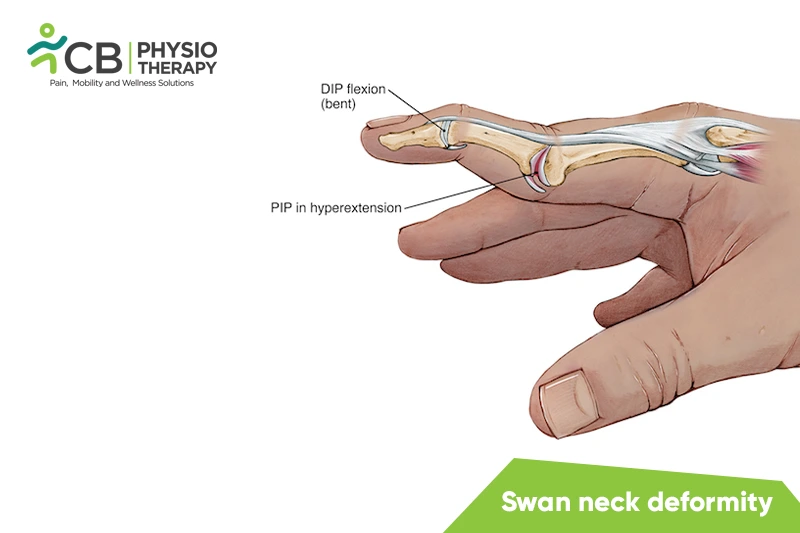
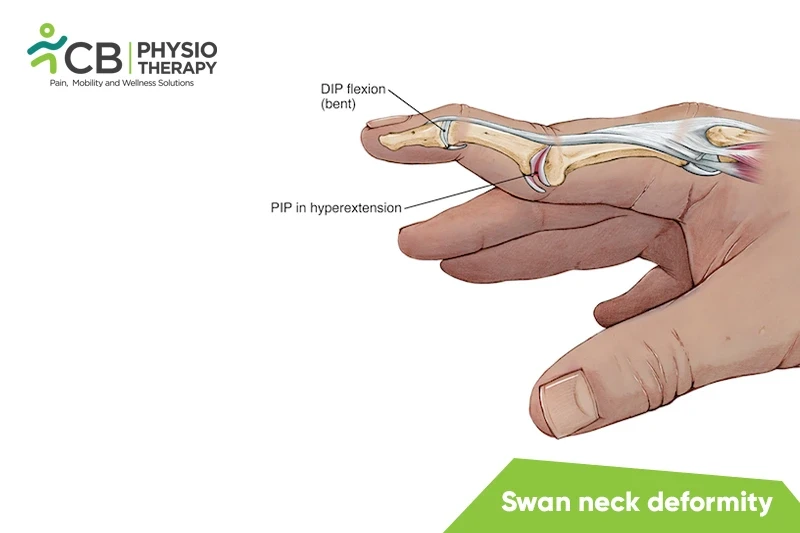
Swan neck deformity is a deformed position of the finger, in which the joint closest to the fingertip (DIP) is permanently bent toward the palm while the nearest joint to the palm (PIP) is bent away from it.
There are several causes of swan neck deformity, the most common causes are:
- Arthritis.
- Untreated Mallet finger.
- Direct trauma to the PIP joint.
- Nerve damage.
- Jammed fingertip.
- Tightened hand muscles.
- Loose finger ligaments.
- Ruptured finger tendon or tendons.
- Genetic conditions like Ehlers-Danlos syndrome.
- Muscle spasms caused by nerve damage.
Swan neck deformity is easy to recognize the symptoms in the later stages.
Symptoms include:
- Pain while bending the knuckle.
- Locking of the joint.
- Stiffness.
- Snapping sound when bending the finger.
- Two outer joints of the finger are bent, which resemble a swan's neck.
- Difficult to grasp an object or make a fist.
- Limited movement and loss of some fundamental functions of the fingers and hands.
Pathology
This Deformity arises from the DIP, PIP, or even the MCP joints. Swan neck deformity occurs due to abnormal stress on the ligament around the PIP joint of the finger. The stress causes the ligament to loosen, resulting in hyperextension of the PIP joint, causing the PIP joint to bow in towards the palm. And the joint furthest from the palm (DIP joint) forces the fingertip to point towards the palm. There is a stretching of the volar plate at the PIP joint that causes hyperextension and some damage to the attachment of the extensor tendon to the base of the distal phalanx which produces a hyper-flexed mallet finger.
Physical examination:
The examiner does the visual examination of the hands, looks for a hyperextended middle joint (PIP), and checks whether the tip of the finger is flexing inwards to point towards the palm. Active and passive movements are assessed at the MCP, PIP, and DIP independently. In addition, to determine if a patient has a swan neck deformity, the examiner looks for other causes like rheumatoid arthritis.
Bunnell’s test:
To determine whether a patient is present with an intrinsic tightness or capsular restriction, Fianchetto-Bunnell littler test is performed by holding the MCP in an extended position while passively flexing the PIP, noting the available ROM. The same test is then repeated with the MCP flexed, if there is no change in motion between the two tests, then capsular restriction at the PIP joint is suggested. In case the motion increases when the MCP is flexed, then intrinsic muscle tightness is suggested.
X-ray:
An X-ray of the finger or fingers is used to determine if an acute injury may be the cause. X-ray is ordered to evaluate for articular disruption, even carpal collapse, or severe arthritis in the later stages.
Medication: NSAIDs, Disease-modifying anti-rheumatic drugs (DMARDs), analgesics, glucocorticoids, etc.
Note: Medication should not be taken without a doctor's prescription.
Surgery:
Severe cases of deformity that do not respond to conservative treatment, are most likely recommended for surgery. Surgical options available for swan neck deformity are soft tissue surgery, finger joint fusion, PIP joint arthroplasty, etc.
Splints:
Extension block splints help to correct the hyperextension at the PIP joint. A progressive extension splint can help improve the DIP flexion deformity. A ring splint, also called a figure eight splint, is placed around the PIP joint to correct deformity in the initial stages for a few weeks. The advantage of a ring splint is that the finger can be bent down freely.
Stretching Exercises:
Hand therapy for passive stretching can be combined with splinting. This combination of treatments may increase flexibility and mobility at both the DIP and the PIP joints. Gently straighten the affected finger and hold for 5 secs at the apex of this finger extension. Perform 1 set of 10 repetitions 3 to 5 times per day to promote flexibility in the finger joints.
Strengthening exercises help to maintain the range of motion, strengthen weak muscles, and improve function in the fingers and hands.
Range of motion Exercises:
Finger passive range of motion is recommended to maintain flexibility and range of motion in the fingertips.
Finger Flexion:
Place the affected hand's elbow on a flat surface, such as a table, and lift the forearm straight up. Slowly bend the fingers to the middle of the palm, one at a time. Hold for 5 secs at the apex of each finger flexion. To improve flexion and range of motion in the fingers, do 1 set of 10 repetitions 3 times a day.
Finger Extension:
Stand in front of the table, and place the affected hand on the table's surface with the palm flat and the fingers extended. Lift each finger as far off the table as possible, one at a time, hold for 5 secs at the apex of the finger extension, and then relax. Perform 1 set of 10 repetitions 3 times per day. Pick up small objects such as coins and marbles with the injured finger and thumb promotes joint health and flexibility in addition to finger extension, squeeze a rubber ball, and hold each squeeze for 5 secs will help the injured hand's range of motion and flexibility.
Finger Adduction and Abduction:
Stand tall and bend the elbow to a 90° angle. Spread the fingers as wide as possible by bringing the arm of the affected finger to the side of the body. Hold for 5 seconds before reuniting the fingers. Perform 1 set of 10 repetitions 3 times a day to increase the circulation of oxygenated blood to the fingers and improve joint health.
The patient is advised to restore the balance in the structures of the hand and fingers. Care should be taken to align the PIP joint and prevent hyperextension and restore the DIP extension. If it doesn't work then surgery may be needed.
Don't let Swan Neck Deformity decide your day.
Get assessed today — find the cause, get a plan, and know when you'll feel better.