
Frozen Shoulder — Symptoms, Causes & Treatment
Also known as Frozen Shoulder. Causes, symptoms and how physiotherapy treats Frozen Shoulder — without surgery or medicines.
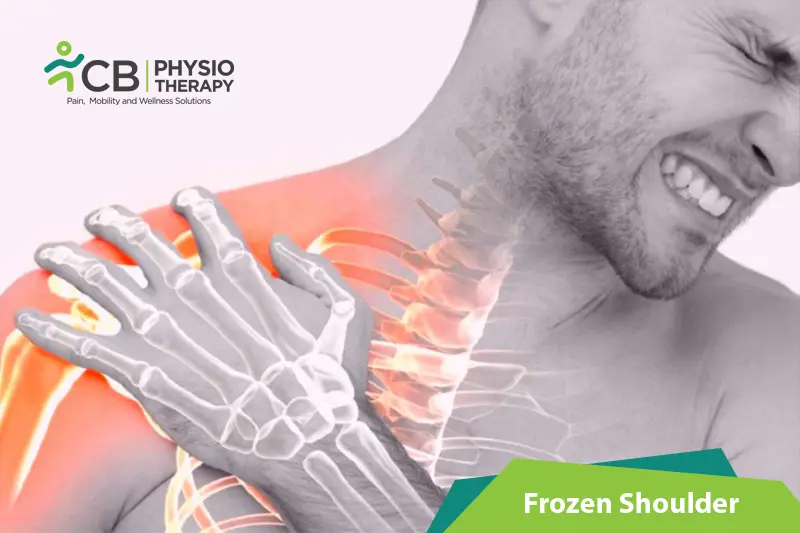
Understanding Frozen Shoulder
Frozen shoulder (adhesive capsulitis) is the shoulder joint's capsule becoming inflamed, thickened and tight — turning the body's most mobile joint into its most stubborn. It typically moves through phases: a painful "freezing" stage, a stiff "frozen" stage where pain eases but movement stays blocked, and a gradual "thawing". Untreated, the full cycle can take well over a year — good treatment exists to shorten and soften it.
It often arrives without a clear injury, is more common between 40 and 60, and notably more common with diabetes or thyroid conditions. The diagnosis matters because frozen shoulder is treated differently from rotator cuff problems that mimic it — stage-appropriate treatment is everything here.
Causes & risk factors of Frozen Shoulder
What commonly drives it — your assessment pins down which of these apply to you.
Capsule inflammation and tightening
The joint's wrapper itself thickens and contracts — the defining mechanism, not a muscle problem.
Diabetes and thyroid links
Both raise the risk substantially and can make the course longer — worth managing actively alongside treatment.
Immobilisation after injury or surgery
A shoulder kept still — in a sling, after a fracture, post-surgery — is a shoulder invited to freeze.
Age and hormonal factors
Most common in the 40–60 window and in women — reasons are still being studied.
A quiet start
Often no injury at all: an ache reaching for a shelf that grows over weeks into a shoulder that will not move.
When physiotherapy is the right call
If any of these sound like you, an assessment is the right first step.
- ✓ Shoulder pain and stiffness growing over weeks without injury
- ✓ Cannot reach overhead, behind your back or fasten clothing
- ✓ Night pain when lying on the affected side
- ✓ You have diabetes or thyroid disease and a stiffening shoulder
- ✓ You've been told to "wait it out" and want to recover faster
Your treatment journey
Step by step — from your first assessment to a tracked recovery plan.
Stage assessment
Range measurements and history place you precisely: freezing, frozen or thawing — each is treated differently.
A plan for your stage
Pain-dominant stages are calmed, not stretched into; stiffness-dominant stages are progressively mobilised.
Mobilise and stretch
Joint mobilisation, capsular stretching and exercise progressions matched to what the shoulder tolerates — never brute force.
Restore full function
Strengthening through the returning range until reaching, lifting and lying on it are ordinary again.
What recovery looks like
- ✓ A shorter, softer course than waiting it out
- ✓ Night pain settled early — sleep comes back first
- ✓ Range regained stage by stage, measured every visit
- ✓ No forced manipulation — progress the shoulder accepts
- ✓ Guidance for diabetes/thyroid factors that slow recovery
When to see a doctor — red flags
How CB Physiotherapy treats Frozen Shoulder
Frozen shoulder punishes impatience and rewards consistency — so CB Physiotherapy's plan is built around your stage, not a fixed protocol. Pain-stage care is gentle and frequent; stiffness-stage care is progressively firmer; and every session's range gains are measured and logged on Fizo IQ™.
Because the course runs months, home sessions and a disciplined home program matter more here than in almost any condition we treat — and we set both up from week one.
Exercises that help with Frozen Shoulder
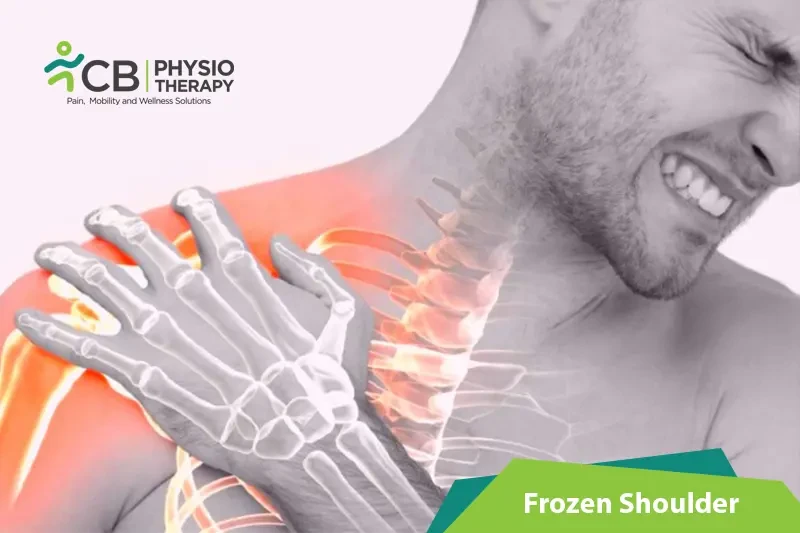
Make these exercises yours — a CB physio personalizes, doses and tracks your plan week by week.
Get my personalized planGeneral guidance only — stop if an exercise increases your pain, and check with your physio before starting a new routine.
Get Frozen Shoulder treatment near you
Certified physiotherapists at a clinic near you or at home — same-day slots, assessment-led care.
Request received!
We'll call you within 10 minutes to confirm your home visit.We'll call you within 10 minutes to confirm your slot.
Chat with us on WhatsAppFrozen Shoulder, answered
Frozen shoulder is a condition that affects the shoulder joint. Frozen shoulder is also referred to as Adhesive Capsulitis, characterized by initial pain followed by a progressive restricted active and passive joint (glenohumeral) range of motion.
Frozen shoulder progresses through three phases:
Freezing phase: This is a painful phase, a sharp pain is present at rest and also at extremes of movement, and night pain with disrupted sleep may last anywhere from 3-9 months.
Frozen phase: This is a phase with more stiffness and pain at extremes of movement, there is a progressive loss of glenohumeral movement in the capsular pattern. The duration of this phase is around 4 months and lasts till about 12 months.
Thawing phase: This phase is marked by progressive improvement in functional range of motion which can last from 1 to 3.5 years.
Frozen shoulder involves restricted movement of the shoulder joint and other symptoms like:
- Progressive increase in pain,
- Decrease in active and passive range of motion of the shoulder,
- Stiffness in the arm,
- Disrupted sleep,
- Difficulty in performing overhead activities like combing, grooming, dressing, fastening items behind the back, etc.
Pathology:
The pathology includes chronic inflammatory response with fibroblastic proliferation which may be immunomodulated. The tissue is present with fibroblasts, proliferating fibroblasts, and chronic inflammatory cells. The infiltrate of chronic inflammatory cells is predominantly made up of mast cells, with B cells, T cells, and macrophages present.
This condition arises spontaneously for which causes are unknown. It can have multiple reasons like:
- After surgical intervention,
- Stroke,
- Diabetes mellitus,
- Parkinson's disease,
- Cancer,
- Shoulder injury,
- Thyroid disorder,
- Dupuytren disease,
- Complex regional pain syndrome.
Physical examination:
The patient is examined for cervical, thoracic, shoulder range of motions (ROM) with shoulder external rotation (ER), internal rotation (IR), abduction (Abd). Neurological examination of the patient is also done, the patient is asked for aggravating and relieving factors. The severity of pain is determined by taking a proper history of the condition and medical history.
X-ray:
X-ray of the shoulder is done to identify any bone issue, such as bone spurs.
Magnetic resonance imaging (MRI):
Magnetic resonance imaging (MRI) is used to identify damage to soft tissues, such as a rotator cuff tear. As an MRI can potentially show inflammation, it cannot diagnose frozen shoulder
Lab tests:
Blood tests are done to detect conditions like diabetes, polymyalgia rheumatic, shoulder tumor, etc because such patients have a high risk of developing frozen shoulder.
Medicines: Non-steroidal and anti-inflammatory, analgesics, painkillers, corticosteroid injections, etc.
Note: Medicines should not be taken without the doctor's prescription.
Joint distension:
In this method, doctors inject sterile water into the shoulder capsule to stretch it easily and aid in a smoother movement of the shoulder.
Surgery:
Surgery is the last option for treating frozen shoulder and is done when other treatment options fail. The procedure used is arthroscopy which requires specialized tools, which are inserted into the shoulder through small cuts.
Heat therapy facilitates relaxation and mobilization of the joints, thus heat is found to be very effective in this condition. The patient who complains of night pain is treated by heat therapy.
Cold therapy helps to decrease pain and inflammation, which helps in increasing joint range of motion.
Ultrasound produces deep heat and also increases the excitability of the contracted soft tissue.
Transcutaneous Electrical Nerve stimulations (TENS):
Transcutaneous Electrical Nerve stimulations (TENS) are used to decrease pain and swelling and thus help to improve range of motion.
Laser therapy is highly effective for frozen shoulder. This therapy over several weeks reduces chronic inflammation within the joint and gradually helps restore range of motion and normal function.
Kinesiology taping provides stability and security to the affected joint and also reduces edema. These tapes are also known to increase support for the affected joint which makes it easy to move while also decreasing shoulder pain.
Gentle shoulder mobilization:
Gentle relaxed passive gliding movement of the head of the humerus on the glenoid is performed by giving axial traction and approximation, these are carried out along with antero-posterior glide and abduction-adduction glide. In the beginning, slow rhythmic movements are given. Mobilization by accessory movements like acromio-clavicular, sterno-clavicular, and/or scapula-thoracic joint articulation is also recommended.
Passive movements:
Passive movements reduce pain, pathological limitation of motion. This occurs because of the neuro-modulation effect on the mechanoreceptors within the joint. Passive movements are followed by simple active movements.
Stretching exercises:
Prolonged stretching causes an increase in the movements too. The exercises include a maximum number of combinations of various movements by minimizing the number of exercises. Graduated relaxed sustained stretching, given in PNF pattern like shoulder elevation with flexion, abduction and external rotation, shoulder internal rotation with extension, adduction, and elbow flexion i.e attaining "hand to lumbar position".
Self -Assisted stretching:
In Self Assisted stretching method the patient uses his normal or contralateral arm for gradually stretching the affected shoulder. Pendulum stretch, towel stretch, cross-body stretch, inward-outward stretch, armpit stretch, finger walk are examples of simple stretching exercises.
Strengthening exercises like closed chain isometric exercises, open chain exercises can be done, other exercises with the help of weights, therabands, pulleys, etc are also given. The weight should be tolerable and comfortable for the patient.
The patient should be advised to do regular stretching exercises even when stiffness and pain are decreased to avoid the recurrence of periarthritis or stiffness. Diabetes patient responds very slowly to the treatment and also feel much more pain as compared to those who are non-diabetic.
Don't let Frozen Shoulder decide your day.
Get assessed today — find the cause, get a plan, and know when you'll feel better.