
Carpal Tunnel Syndrome (cts) — Symptoms, Causes & Treatment
Also known as Carpal Tunnel Syndrome (cts). Causes, symptoms and how physiotherapy treats Carpal Tunnel Syndrome (cts) — without surgery or medicines.
Understanding Carpal Tunnel Syndrome (cts)
Living with Carpal Tunnel Syndrome (cts) usually means negotiating with it daily — adjusting how you sit, move, sleep and work around it. It is common; that never makes it something you simply have to live with.
In most cases the problem behaves mechanically: particular movements or positions load the affected structures more than they can currently tolerate. A physiotherapy assessment identifies that mechanism, and treatment targets it directly — most mechanical cases respond well to conservative care, without medicines or surgery.
Causes & risk factors of Carpal Tunnel Syndrome (cts)
What commonly drives it — your assessment pins down which of these apply to you.
Joint stiffness and age-related change
Joints that move less start to hurt more; age-related wear is normal, but painful stiffness is not something to simply accept.
Weakness and deconditioning
When supporting muscles lose strength, load shifts to structures that were never meant to carry it.
Old injuries and compensations
A previous injury that never fully rehabilitated often leaves a movement pattern that overloads something else.
Sudden spikes in activity
A new sport, a new gym program, a long trek — tissue adapts to gradual change and protests when change is sudden.
Muscle strain and overload
A sudden lift, an awkward movement or simply more load than the tissues were prepared for — the most common trigger.
When physiotherapy is the right call
If any of these sound like you, an assessment is the right first step.
- ✓ You've been diagnosed with Carpal Tunnel Syndrome (cts) and told to "rest and see"
- ✓ Movement feels restricted, weak or guarded compared to before
- ✓ You want to return to sport or work with a plan, not by trial and error
- ✓ Carpal Tunnel Syndrome (cts) that keeps returning or hasn't settled within two weeks
- ✓ Pain or stiffness that limits work, sleep or daily activities
Your treatment journey
Step by step — from your first assessment to a tracked recovery plan.
A detailed first assessment
History, movement testing and strength checks — a focused session to find what is actually driving your Carpal Tunnel Syndrome (cts).
A diagnosis you understand
Your physiotherapist explains the findings in plain language — what is affected, why it happened and what that means for you.
Active, tracked treatment
Hands-on therapy, the right modalities and graded exercise — progressed session by session and tracked on Fizo IQ™.
Prevention, built in
The final phase rebuilds strength and habits so the same problem does not come back — with a home plan you keep.
What recovery looks like
- ✓ Strength and movement rebuilt, not just pain reduced
- ✓ Lower chance of recurrence, with a prevention plan
- ✓ Care without long-term medicines — at a clinic near you or at home
- ✓ Relief that comes from treating the cause, not masking it
- ✓ A clear diagnosis and a timeline you can plan around
When to see a doctor — red flags
How CB Physiotherapy treats Carpal Tunnel Syndrome (cts)
At CB Physiotherapy, treatment for Carpal Tunnel Syndrome (cts) starts with finding its cause: a structured, physiotherapist-led assessment before anything is prescribed. Your plan then combines hands-on therapy, targeted exercise and the right modalities — delivered at a clinic near you or at home, and coordinated with your doctor where medical care is involved.
Every case runs on Fizo IQ™, our recovery engine: diagnosis, root cause, plan, milestones and goals, tracked session by session. You always know where you are in your recovery — and what comes next.
Exercises that help with Carpal Tunnel Syndrome (cts)
Make these exercises yours — a CB physio personalizes, doses and tracks your plan week by week.
Get my personalized planGeneral guidance only — stop if an exercise increases your pain, and check with your physio before starting a new routine.
Get Carpal Tunnel Syndrome (cts) treatment near you
Certified physiotherapists at a clinic near you or at home — same-day slots, assessment-led care.
Request received!
We'll call you within 10 minutes to confirm your home visit.We'll call you within 10 minutes to confirm your slot.
Chat with us on WhatsAppCarpal Tunnel Syndrome (cts), answered
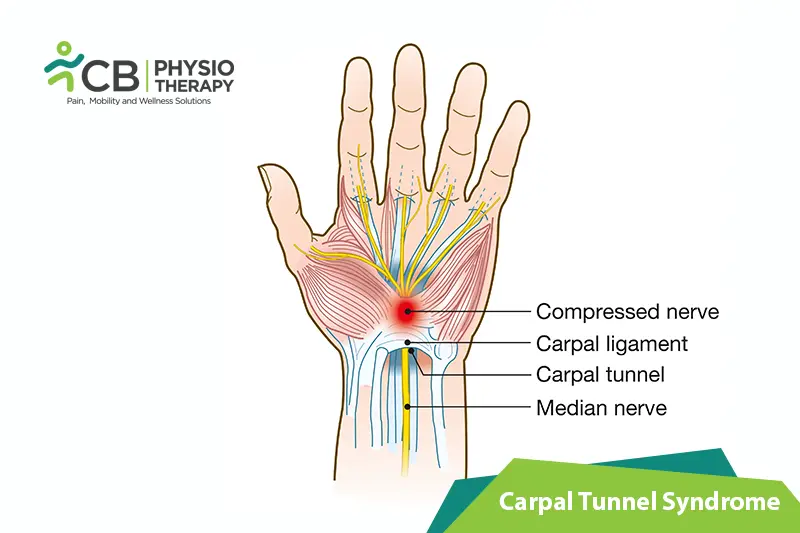
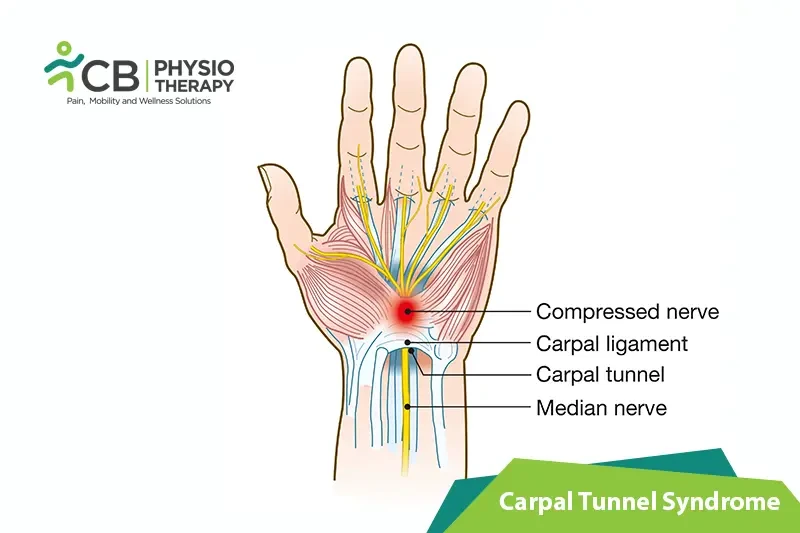
Carpal tunnel syndrome is a condition that affects both the hand and arm. It is the most common entrapment neuropathy caused by the compression of the median nerve as it travels through the carpal tunnel in the wrist. A Carpal tunnel is a passage in the wrist through which the median nerve runs to end in hand. Early symptoms include pain, numbness, and tingling when the median nerve is compressed or squeezed in the wrist. The median nerve provides sensation to the index, middle, and ring fingers and also controls the muscles around the base of the thumb.
Symptoms of carpal tunnel syndrome begin gradually or come and go at first. But when the condition worsens, the symptoms may become more frequent or persist longer. When the contents of the carpal tunnel, like the median nerve, blood vessels, and tendons, enlarge they take up space in the tunnel and eventually crowd the nerve. This causes increased pressure on the nerve and causes carpal tunnel symptoms.
Symptoms include:
- Pain, aching, or burning in hand mainly in the thumb and index, middle, and ring fingers,
- Pain can also travel to the forearm towards the shoulder,
- Numbness, tingling, pins, and needles, or cramps in the thumb and index, middle, and ring fingers can radiate up to the forearm towards the shoulder,
- A shock-like sensation that radiates towards the thumb and index, middle, and ring fingers,
- Hand weakness,
- Difficulty in performing fine movements or everyday tasks,
- Loss of proprioception,
- Worsening of symptoms during the night as a result of wrist bent position,
- Worsening of symptoms during the day due to carrying out repetitive movements or holding something with the wrist bent forwards or backward for a prolonged time,
- Activities such as driving, using a phone, reading a book, or typing can aggravate the symptoms.
Pathology:
Carpal tunnel syndrome (CTS) is an entrapment neuropathy of the median nerve. Carpal tunnel is located at the base of the palm, bounded on 3 sides by carpal bones and anteriorly by the transverse carpal ligament. Inside this tunnel there runs the median nerve, the flexor tendons, and their synovial sheaths. Hypertrophy or edema of the flexor synovium causes compression of the median nerve at the wrist. This can cause physical damage to the nerve resulting in pain, numbness and weakness, etc.
Carpal tunnel syndrome is caused due to pressure inside the tunnel which becomes too high and compresses the median nerve as it passes through the narrowed tunnel. It occurs due to:
- Genetic predisposition,
- Repetitive hand movements such as typing, or machine work,
- Obesity,
- Autoimmune disorders such as rheumatoid arthritis,
- Pregnancy,
- Traumatic injury,
- Partial dislocations and fractures.
Physical examination:
A complete examination of the entire upper limb, including neck, shoulder, elbow, and wrist, to exclude other causes. Initial inspection of the hand and wrist can provide clues about the cause. The patient is examined for sensation to pain, two-point discrimination, and soft tissue over the median nerve is examined for mechanical restriction, etc.
Carpal compression test:
A carpal compression test is done by applying firm pressure directly over the carpal tunnel for 30 seconds. The test is positive when paresthesias, pain, or other symptoms are produced.
Medication: NSAIDS, Diuretics, Oral steroids, Vitamin B6, Corticosteroid injections, etc.
Note: Medication should not be taken without a doctor's prescription.
Surgery:
Surgery is the treatment done for patients with severe median nerve damage, characterized by permanent sensory or motor loss, or axonal loss or denervation indicated by electrodiagnostic studies. Open carpal tunnel release (OCTR) and endoscopic carpal tunnel release (ECTR) are the two types of effective surgeries done for the patients.
Modification of activities and workplace:
Modification of activities and workplace is done which can be beneficial in controlling milder symptoms of CTS. For example, proper placement of the hand on the keyboard at a proper height and minimizing flexion, extension, abduction, and adduction of the hand when typing.
Ice therapy can be used by applying ice to the wrist for 10- 15 minutes once or twice an hour.
Heat therapy can be applied by immersing the affected hand in warm water moving the hand and wrist in the water.
Ultrasound therapy is used to break the adhesions, increase circulation and improve range of motion by using its fibrinolytic, anti-inflammatory, and anti-irritant action of the ultrasound.
Transcutaneous electrical stimulation (TENS):
Transcutaneous electrical stimulation (TENS) is highly effective to reduce pain and swelling.
Laser therapy is used to decrease pain and paresthesia. Laser therapy is also approved by the FDA for the treatment of carpal tunnel syndrome (CTS).
Iontophoresis:
Iontophoresis is also found to be effective as a treatment of carpal tunnel syndrome.
Splinting and hand brace
The physiotherapist advises the patient to take sufficient rest. Immobilization helps to eliminate active movements in the affected hand. The wrist is fixed in a neutral position so the tension in the carpal canal will be minimal and the carpometacarpal and the interphalangeal joints are fixed in slight flexion to achieve the same.
Manual therapy includes mobilization of soft tissue, carpal bone, and median nerve. It is a hands-on technique that helps to increase the mobility of the nerve. It also helps to improve the range of motion of joints that are affected by the carpal tunnel.
Massage therapy includes compression, cross-fiber function, deep tissue work, stretching, and trigger point. This therapy reduces pain, improves grip strength, and makes muscles more flexible.
Stretching exercises:
Stretching exercises include "Stretch Armstrong." In this exercise, the arms are placed in front (one at a time), spreading the fingers, and then "stretching the wrist and fingers as far as possible and then holding that position for 20 seconds. Basic wrist stretches include bending the hand towards the body so that the fingers point up toward the ceiling.
Strengthening exercises help to strengthen the hands and the grip. Hand exercises like hand squeeze exercises like squeezing a soft rubber ball and then holding the squeeze position for 5 seconds. The physiotherapist recommends 10 repetitions and 3 times a day. For the wrist, wrist curls are done by bending the wrist 30 times daily while the arm is bent like the letter L, and a wrist resistance exercise can also be done by raising one hand while the other hand is kept down.
Movement exercises:
Movement exercises consist of tendon gliding and nerve gliding. The tendon exercise consists of moving fingers through different positions like curling them inward till they're bent at the middle knuckles and straightened so that the hand is shaped like an L. Nerve exercise such as moving parts of the hand and wrist into different positions. Straightening the fingers out so that they point up, other exercises consist of bending the wrist so that the fingertips are pointed away from the body of the patient.
The patient is advised to avoid inappropriate and provoking positions, and continue strengthening and mobility exercises to help the affected arm recover. The patient is also educated on how to manage the carpal tunnel symptoms and modify the daily activities to reduced repetitive movements that aggravate pain.
Don't let Carpal Tunnel Syndrome (cts) decide your day.
Get assessed today — find the cause, get a plan, and know when you'll feel better.