
Cervical Spondylosis — Symptoms, Causes & Treatment
Also known as Cervical Spondylosis. Causes, symptoms and how physiotherapy treats Cervical Spondylosis — without surgery or medicines.
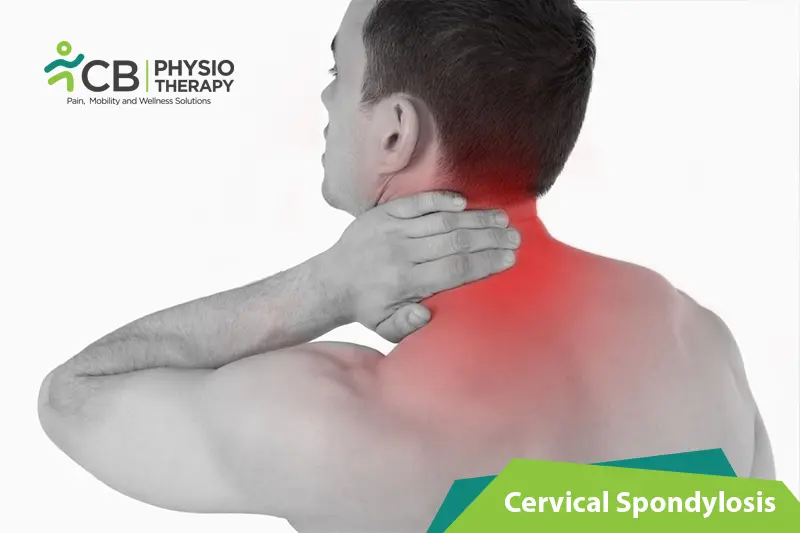
Understanding Cervical Spondylosis
Cervical spondylosis is age-related change in the neck's discs and joints — discs losing height, joints growing bony edges, the canal and nerve passages narrowing a little. Here is the essential context: after fifty, most people have these changes on a scan, and most of them have no pain. Spondylosis on a report is a description of a neck that has been used, not a sentence.
It becomes a problem when stiff segments and weak support push load onto irritable structures — producing neck pain, restricted turning, headaches, or arm symptoms when a nerve passage gets crowded. Those problems are mechanical, and mechanical problems respond to physiotherapy — whatever the X-ray says about your age.
Causes & risk factors of Cervical Spondylosis
What commonly drives it — your assessment pins down which of these apply to you.
Disc height loss with age
Discs dry and settle over decades — universal, usually silent, occasionally load-shifting enough to irritate.
Bony spurs and joint change
The body reinforces loaded edges with bone; spurs matter only when they crowd a nerve's exit.
Decades of posture load
The forward-head years come home: segments kept stiff wear faster and complain sooner.
Weak deep-neck support
With stabilisers underused, the changed joints take load unprotected — the difference between having spondylosis and feeling it.
Nerve passage crowding
When narrowing pinches a nerve root: arm pain, tingling or weakness in a specific pattern our testing can map.
When physiotherapy is the right call
If any of these sound like you, an assessment is the right first step.
- ✓ Neck pain or stiffness with "spondylosis" on your report
- ✓ Restricted turning that makes driving checks hard
- ✓ Headaches rising from the neck's base
- ✓ Arm pain, tingling or heaviness in a repeatable pattern
- ✓ You've been told it's "just age" and want function back anyway
Your treatment journey
Step by step — from your first assessment to a tracked recovery plan.
Function-first assessment
We measure what your neck can and cannot do — movement, strength, nerve signs — rather than treating the X-ray.
Separating change from cause
Which findings are just age, and which are actually producing your symptoms — the distinction that shapes the plan.
Mobilise what's stiff
Manual therapy for the restricted segments, modalities for irritated tissue, nerve-glide work where arms are involved.
Support what's changed
Deep-neck and scapular strengthening — permanent protection for joints that will keep their age-related change.
What recovery looks like
- ✓ Pain and stiffness eased despite what the report says
- ✓ Turning range back for driving, work and sleep
- ✓ Fewer neck-based headaches
- ✓ Arm symptoms settled with nerve-specific treatment
- ✓ Strength that keeps an ageing neck comfortable for years
When to see a doctor — red flags
How CB Physiotherapy treats Cervical Spondylosis
CB Physiotherapy treats cervical spondylosis by refusing to treat a birth year. Your assessment separates age-related findings from the actual symptom drivers, and the plan targets the drivers: mobilising stiff segments, calming irritated tissue and building the deep support that changed joints need.
Care runs at a clinic near you or at home, tracked on Fizo IQ™. The goal is written in function — degrees of turn, hours of comfortable work, nights of unbroken sleep — because that is what you actually came for.
Exercises that help with Cervical Spondylosis
 Top 5 Exercises For Neck Pain
Steps & precautions →
Top 5 Exercises For Neck Pain
Steps & precautions →
 Top 5 Exercises For Cervical Spondylosis.
Steps & precautions →
Top 5 Exercises For Cervical Spondylosis.
Steps & precautions →
Make these exercises yours — a CB physio personalizes, doses and tracks your plan week by week.
Get my personalized planGeneral guidance only — stop if an exercise increases your pain, and check with your physio before starting a new routine.
Get Cervical Spondylosis treatment near you
Certified physiotherapists at a clinic near you or at home — same-day slots, assessment-led care.
Request received!
We'll call you within 10 minutes to confirm your home visit.We'll call you within 10 minutes to confirm your slot.
Chat with us on WhatsAppCervical Spondylosis, answered
Cervical spondylosis is a condition that causes degeneration of vertebrae, discs, and ligaments in the cervical spine. The neck or cervical spine is formed of seven small vertebrae that start at the base of the skull. In cervical spondylosis, the edges of vertebrae may develop overgrowths of bone known as spurs, these spurs occur as a result of the tendency of the body trying to grow extra bone called osteophytes. Over some time, the disc gets thinner and loses the ability to absorb shock.
People with cervical spondylosis, mostly don't have significant symptoms, if present they include:
- Pain around the shoulder blade,
- Radiating pain to arm and fingers,
- Muscle weakness,
- Difficulty in lifting the arms and holding objects firmly,
- Headache radiating to the back of the head,
- Tingling in the shoulders and arms,
- Numbness in shoulders and arms.
Pathology:
Cervical spondylosis occurs due to disc degeneration. Due to old age or wear and tear, the disc loses water and collapses. Initially, this process starts in the nucleus pulposus. This results in the central annular lamellae moving inward while the external concentric bands of the annulus fibrosis bulge out. This causes increased stress on the cartilaginous endplates. Bone formation occurs resulting in osteophytes.
Cervical spondylosis occurs because of numerous reasons, a few of them are mentioned below:
- Common after 40 years of age,
- Wear and tear and long term degeneration of the cervical spine,
- A previous neck injury,
- Bony spurs,
- Pressure of the extra bone on the spine, such as the spinal cord and nerves, results in pain.
- Dehydrated spinal discs, gel-like material present between the discs can dry out causing vertebrae to rub together, which can cause pain,
- Herniated discs in which the disc develops cracks, allow the leakage of internal cushioning material, causing pressure on the spinal cord and nerves,
- Ligament stiffness,
- Car accident,
- Overuse or strenuous activity during occupations or hobbies,
- Repetitive movements,
- Lifting heavyweight that can put extra pressure on the spine, resulting in early wear-and-tear.
Physical examination:
Physical examination includes checking reflexes, muscle weakness, or sensory deficit, and testing the range of motion of the neck.
X- rays:
X- Rays can be used to check for bone spurs, osteophytes, and other abnormalities.
CT scan:
CT scan helps to provide more detailed images of the neck.
Magnetic resonance imaging (MRI):
Magnetic resonance imaging (MRI) scan helps to locate pinched nerves.
Myelogram:
Myelogram dye is used which gives a more detailed image.
Nerve function tests:
A nerve conduction test is used to check the function of cervical nerves.
Electromyography:
Electromyography is used to check the function of the cervical muscles.
Medications: Muscle relaxants, Narcotics, Antiepileptic drugs, Steroid injections, Non-steroid anti-inflammatory drugs (NSAIDs).
Note: Medication should not be taken without the doctor's permission.
Surgery:
Surgery is considered in patients with severe or progressive cervical myelopathy, or in patients in whom conservative measures fail.
Surgical treatment for degenerative cervical disorders involves decompression of the neural elements. Decompression may be achieved using an anterior, posterior and combined approach. Surgery interventions include foraminotomy, anterior cervical discectomy without fusion, anterior cervical discectomy with fusion, cervical arthroplasty.
For compression at more than two levels, posterior compression developmental narrowing of the canal and posterior decompression ossification of the posterior longitudinal ligament are recommended. Posterior laminoforaminotomy/ foraminotomy and/or discectomy is also done. Development of the adjacent level disease may lead to total disc arthroplasty.
Heat therapy provides symptomatic relief by increasing circulation and decreasing pain.
A cold pack is used to provide relief for sore muscles.
The passage of sound waves causes tissues to oscillate at a frequency that increases blood flow. It is used to decrease inflammation that is caused due to the herniated disc.
Transcutaneous electrical stimulations (TENS):
Transcutaneous electrical stimulations help decrease pain and swelling.
This therapy helps to increase blood circulation, stimulates the spinal nerve, reduces pain and inflammation.
Collar or neck brace:
A soft neck brace or collar is temporarily used for relief. Though, wearing a neck brace or collar for a long time can make the muscles weaker.
Massage therapy uses appropriate pressure, to reduce cervical pain. Massage is also effective in increasing blood flow, reducing swelling, promoting tissue growth, and providing relief from muscle spasms.
Manual therapy can be used for reducing pain, thus improving function by increasing the range of motion.
Thrust manipulation:
Thrust manipulation technique is given in a prone supine or sitting position, then cervical traction is applied to enlarge the neural foramen and reduce neck stress.
Non-thrust manipulation:
Non-thrust manipulation techniques include posterior-anterior (PA) glide, given in prone positions. The cervical spine techniques include retraction, rotation, glides in ULTT1 (Upper Limb Tension Test 1) position and PA glides.
Soft tissue mobilization is performed on the muscles to decrease pain and increase mobility.
Range of motion can be increased by doing simple exercises, like neck flexion, extension, side flexion, and rotation movements.
Neck stretching exercises:
Neck stretching exercises are done to decrease neck stiffness and pain. And also increase the flexibility of the neck.
Strengthening exercises are recommended to regain the lost strength of the neck muscles. These exercises include isometric exercises, isotonic exercises, and many more.
The patient is advised to maintain the alignment of the spine during sitting and standing activities. And not to remain in the same position for a longer period and therefore take breaks in between.
Don't let Cervical Spondylosis decide your day.
Get assessed today — find the cause, get a plan, and know when you'll feel better.