Soft Tissue Mobilization — How It Works & What It Treats
Also known as Soft Tissue Mobilization. What Soft Tissue Mobilization is, how it works and what it treats — explained by CB Physiotherapy's clinical team.
How Soft Tissue Mobilization works
Soft Tissue Mobilization is one of the treatment approaches our physiotherapists draw on — always as part of an assessment-led plan, never as a standalone fix.
What makes any therapy work is the decision-making around it: whether it fits your diagnosis, at what dose, and combined with what. At CB Physiotherapy, Soft Tissue Mobilization is prescribed after a movement assessment and paired with active rehabilitation, because passive treatment alone rarely produces lasting change.
Soft Tissue Mobilization — techniques & equipment
What the treatment actually involves — your plan combines the pieces your assessment calls for.
Assessment before application
Your physiotherapist first confirms Soft Tissue Mobilization suits your diagnosis — and screens for anything that rules it out.
Targeted application
The treatment is applied to the specific structures your assessment identified, at a dose set for your case.
Paired with active rehab
Exercise and movement retraining run alongside, so the gains each session makes are kept.
Reviewed and progressed
Your response is checked every session; the plan is adjusted rather than repeated on autopilot.
Conditions Soft Tissue Mobilization treats
Where it fits best — your assessment confirms whether it belongs in your plan.
- ✓ Cervical Spondylosis →
- ✓ Frozen Shoulder →
- ✓ Carpal Tunnel Syndrome (cts) →
- ✓ Arthritis →
- ✓ Tennis Elbow →
- ✓ Osteoarthritis →
- ✓ Pain or stiffness that has not settled with rest
- ✓ As part of a wider, assessment-led recovery plan
- ✓ When your assessment identifies the specific problem Soft Tissue Mobilization addresses
What a Soft Tissue Mobilization session looks like
Step by step — from screening to treatment to what comes next.
Screening and consent
A quick reassessment and safety screen — you will know what the session involves and why before it starts.
The treatment itself
Soft Tissue Mobilization applied to the targeted area — most patients find sessions comfortable, and you can speak up at any point.
Active follow-through
Exercise or movement work right after, while the treatment effect is fresh.
Response check
What changed and for how long — the answer shapes your next session and the plan.
Benefits of Soft Tissue Mobilization
- ✓ Delivered by certified physiotherapists, never unsupervised
- ✓ Dosed to your case after a proper assessment
- ✓ Always combined with active rehab, for results that last
- ✓ Available at CB clinics near you — and at home where equipment allows
- ✓ Drug-free support for pain relief and recovery
Safety & contraindications
How CB Physiotherapy delivers Soft Tissue Mobilization
You will not walk into CB Physiotherapy and simply receive Soft Tissue Mobilization — you will receive an assessment, and Soft Tissue Mobilization if your case calls for it. That order matters: it is how we make sure every session moves you towards a goal rather than just filling a slot.
Your plan runs on Fizo IQ™ — diagnosis, root cause, milestones, goals — and Soft Tissue Mobilization is combined with hands-on care and exercise as indicated, at a clinic near you or at home where the equipment allows.
Real published prices from our physiotherapists for Soft Tissue Mobilization in India — your exact quote is confirmed after assessment, before you commit. Packages save 10%.
Get Soft Tissue Mobilization near you
Certified physiotherapists at a clinic near you or at home — same-day slots, assessment-led care.
Request received!
We'll call you within 10 minutes to confirm your home visit.We'll call you within 10 minutes to confirm your slot.
Chat with us on WhatsAppSoft Tissue Mobilization, answered
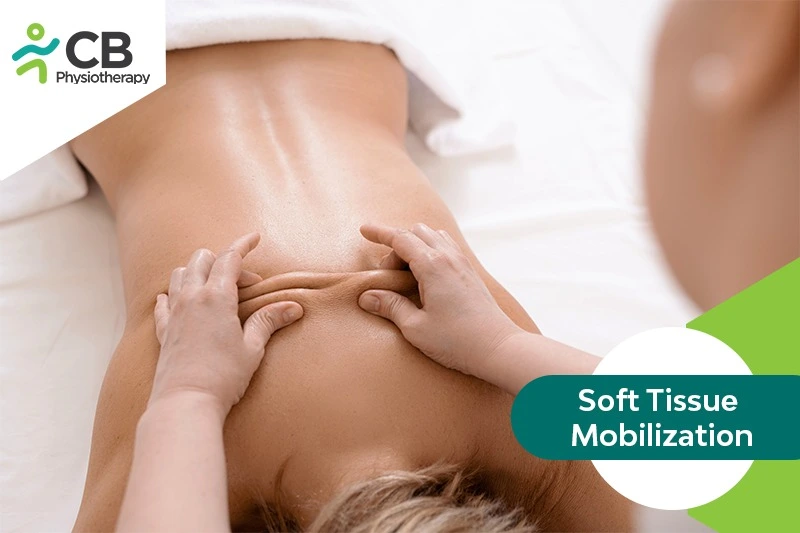
A soft tissue mobilization is a form of manual physical therapy that uses hands-on techniques on your muscles and ligaments to heal scar tissue that sometimes forms after a soft tissue injury. Soft Tissue Mobilization (STM) uses stretching and deep pressure to break up rigid muscle tissue, relax muscle tension, and move fluids trapped in the tissues that cause pain and inflammation. STM is used to treat soft tissue injuries including muscle strains and sprains. It is a type of manual therapy. Soft Tissue Mobilization aids in relaxing tense muscles, reducing scar tissue, and stretching and lengthening fascia to improve range of motion.
Strain-Counterstrain:
The technique uses passive positioning to relieve muscle, joint, and tissue tightness. A physical therapist will identify specific pain points and hold the position anywhere from 90 seconds to 3 minutes to relax the soft tissue, reducing pain and stiffness.
Graston Technique:
The Graston Technique uses a specially designed stainless steel tool to treat scar tissue. This special technique allows for faster rehabilitation. Studies show the Graston technique for low back pain reduces pain and increases range of motion.
ASTYM:
ASTYM treatment uses a specialized plastic tool to stimulate the breakdown of scar tissue and promotes regeneration and improved muscle and joint function. Scar tissue can cause muscle tension, limited flexibility, and range of motion restrictions. ASTYM has been proven to be a highly effective treatment for chronic tendonitis and bursitis as it reduces inflammation.
Manual Lymphatic Drainage (MLD):
This type of soft tissue mobilization uses specific manual hand movements that follow anatomical lymph pathways, helping to move fluid and improve circulation. Manual Lymphatic Drainage for headaches, migraines, swollen legs, and more.
Manual traction:
Manual traction for sciatica or bulging or herniated discs is an effective type of manual therapy for individuals suffering from back pain. It is a type of decompression therapy helping to relieve tension on the spine. Manual traction is an applied pressure lasting for a few seconds in duration, stretching the spine and taking pressure off the lumbar discs. It can also be applied as a sudden, quick thrust.
Trigger Point Therapy / Myofascial Release:
Myofascial release is a soft tissue manual therapy for the treatment of chronic muscular pain and immobility. Myofascial release focuses on reducing pain by easing the tension and tightness in the specified areas of pain. It is a type of massage also known as “deep tissue work”.
Cross friction:
This type of manual therapy aims to maintain mobility within the soft tissue structures of ligament, tendon, and muscle and prevent scars from forming. It is a specific, localized deep tissue massage that must be applied transversely (cross) to the identified location of the pain. Cross friction massage is beneficial in reducing pain and regenerating connective tissue, aiding in the healing process.
Your therapist will start by performing a physical exam. They’ll identify problem areas and determine your range of motion in the affected joints. Depending on your condition, they may recommend several sessions of mobilization therapy. During mobilization therapy, your therapist may use a variety of techniques. For example, they may apply gentle pressure and stretch the affected tissue. Soft tissue mobilization works by mobilizing muscles and therefore breaking up scar tissue. The mobilizations also help to remove waste products from the damaged area which increases the speed of the healing process. Soft tissue mobilization also helps to release the tension in the muscle which increases flexibility and range of movement.
Potential problems in your upper extremities include:
- Tennis elbow
- Golfers elbow
- Carpal tunnel syndrome
- Tendinitis of your biceps or rotator cuff
- A contracture
Potential problems in your lower extremities include:
- Tendinitis of your heel or knee
- A strain or tear in your quadriceps tendon
- An ankle or knee sprain
- Shin splints
- Plantar fasciitis
- Morton’s neuroma
- Hip pain
Ready to start your recovery?
Get assessed today — find the cause, get a plan, and know when you'll feel better.