
Morton's Neuroma — Symptoms, Causes & Treatment
Also known as Morton's Neuroma. Causes, symptoms and how physiotherapy treats Morton's Neuroma — without surgery or medicines.
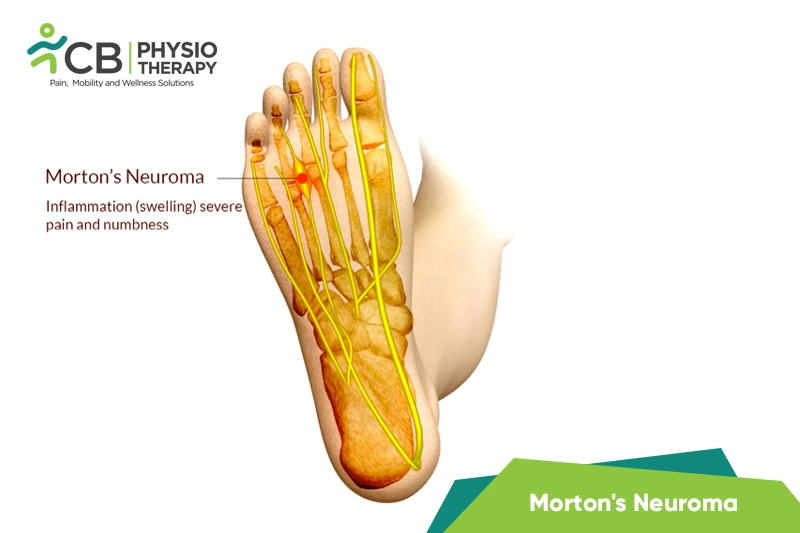
Understanding Morton's Neuroma
Morton's Neuroma affects people differently, and the right care starts with understanding how it affects you. Its day-to-day impact — on movement, strength, energy and confidence — is where physiotherapy does its work.
Our role in Morton's Neuroma is practical: protect and rebuild movement and daily function with a plan set after a careful assessment, in coordination with your doctor wherever medical management is involved. No two plans look the same, because no two cases behave the same.
Causes & risk factors of Morton's Neuroma
What commonly drives it — your assessment pins down which of these apply to you.
More than one possible driver
Morton's Neuroma can have several contributing factors — a careful history and physical assessment separate them rather than guessing.
Reduced movement and deconditioning
Whatever the trigger, less movement quickly adds weakness and stiffness of its own — usually the most reversible part.
Daily-life load and habits
Work posture, repeated tasks, sleep and stress all shape how a condition behaves day to day.
General health and history
Overall health, previous injuries and existing conditions influence both the picture and the plan — the assessment takes all of it in.
When physiotherapy is the right call
If any of these sound like you, an assessment is the right first step.
- ✓ A new diagnosis of Morton's Neuroma and you want a clear rehabilitation start point
- ✓ Daily tasks, walking or stairs are getting harder than they used to be
- ✓ Strength, stamina or balance has visibly dropped
- ✓ You want a structured clinic + home program with measurable milestones
- ✓ Family members need guidance to support you safely
Your treatment journey
Step by step — from your first assessment to a tracked recovery plan.
A detailed first assessment
History, movement testing and strength checks — a focused session to find what is actually driving your Morton's Neuroma.
A diagnosis you understand
Your physiotherapist explains the findings in plain language — what is affected, why it happened and what that means for you.
Active, tracked treatment
Hands-on therapy, the right modalities and graded exercise — progressed session by session and tracked on Fizo IQ™.
Prevention, built in
The final phase rebuilds strength and habits so the same problem does not come back — with a home plan you keep.
What recovery looks like
- ✓ More independence in daily tasks
- ✓ Better strength, balance and stamina
- ✓ Fewer setbacks, with red flags monitored
- ✓ A program your family understands and can support
- ✓ Progress measured milestone by milestone on Fizo IQ™
When to see a doctor — red flags
How CB Physiotherapy treats Morton's Neuroma
We treat Morton's Neuroma the way we treat everything: assessment first, plan second, treatment third. It sounds obvious, but it is the difference between sessions that fill a slot and sessions that move you towards a goal. Care is delivered by certified physiotherapists at a clinic near you or at home.
Your whole journey is tracked on Fizo IQ™ — the diagnosis, the root cause, the milestones and the goals — so progress is measured, not guessed, and the plan adapts the moment your response calls for it.
Exercises that help with Morton's Neuroma
Make these exercises yours — a CB physio personalizes, doses and tracks your plan week by week.
Get my personalized planGeneral guidance only — stop if an exercise increases your pain, and check with your physio before starting a new routine.
Get Morton's Neuroma treatment near you
Certified physiotherapists at a clinic near you or at home — same-day slots, assessment-led care.
Request received!
We'll call you within 10 minutes to confirm your home visit.We'll call you within 10 minutes to confirm your slot.
Chat with us on WhatsAppMorton's Neuroma, answered
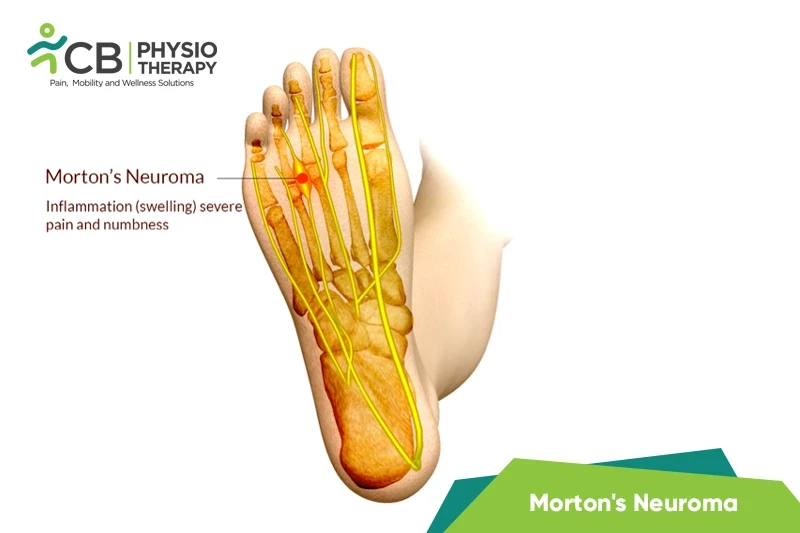
Morton's neuroma occurs when the nerve between the toe becomes inflamed and swollen. Symptoms of Morton's neuroma include pain between the toes and the feeling of stepping on a pebble. Morton's neuroma affects the forefoot or the ball of the foot, between the metatarsal bones and toes. It's also called intermetatarsal neuroma.
This condition develops when the nerve suffers excessive pressure or compression between the toes. It occurs more often in women than men, because of shoe styles and many more reasons like:
- Congenital foot problem.
- Flat feet, toes in an unusual position, high arches.
- Certain medical conditions such as hammertoes, bunions, etc.
- Playing sports such as running, tennis, and other racquet sports.
- Athletes are also more likely to injure their feet, which can lead to Morton's neuroma.
- Wearing high heels, tight-fitting, narrow, or pointed-toe shoes.
An irritated or damaged nerve between the toe bones causes Morton's neuroma. The compression or squeezing causes inflammation and irritation. Symptoms of Morton's neuroma get worse over time. Common symptoms of Morton's Neuroma include:
- Pain at first, starts slowly.
- Pain makes it hard to walk.
- Sharp pain between the toes while standing or walking.
- Swelling between the toes.
- Tingling and numbness in the foot.
- Feeling like bunched-up socks or a small rock under the ball of the foot.
- Pain worsens with high-heeled shoes or standing on the balls of the foot.
Pathology:
Morton's Neuroma involves the thickening and degeneration of the interdigital nerve of the foot, commonly between the third and fourth metatarsal heads.
Physical examination:
During an examination, the health provider will look at the feet, to check if there's a mass between the toes, and puts pressure on the spaces between the toe bones to check the location of the foot pain.
X-rays:
An X-ray doesn't show a neuroma but can help rule out other conditions that cause foot pain, such as arthritis or stress fracture.
Magnetic resonance imaging (MRI):
Magnetic resonance imaging of the foot provides a detailed picture of tissues and nerves and in getting a proper diagnosis.
Ultrasound:
Ultrasound gives real-time images of the internal structures of the foot and helps detect soft tissue abnormality.
Electromyography:
Electromyography helps to measure the electrical activity of the nerves and muscles. It can rule out nerve conditions that can cause symptoms similar to those of Morton's neuroma.
Medications: Nonsteroidal anti-inflammatory drugs (NSAIDs), steroid injections, Anti-inflammatory drugs injected into the skin, local anesthetic injection, etc.
Note: Medication should not be taken without the doctor's prescription.
Surgery:
If conservative treatment doesn't relieve the symptoms, then foot surgery such as neurectomy is recommended. Neurectomy is the most common surgery for Morton's neuroma, other procedures like cryogenic neuro ablation, radiofrequency ablation, etc can help reduce symptoms.
Rest and elevation:
Rest and elevation of the affected foot help to relieve the pressure on the compressed nerve.
Application of ice on the foot where there is a neuroma can subside the flare-up, especially after a long day of activities. Ice therapy significantly reduces inflammation and pain.
Heat therapy can be used by soaking the feet for 10 minutes and the pain magically disappears. This can be followed by massaging the feet and rubbing them with a pain ointment.
Therapeutic ultrasound is beneficial to decrease the associated inflammation and pain.
Extracorporeal Shockwave Therapy:
Extracorporeal Shockwave Therapy is a useful modality to reduce pain in patients with Morton's neuroma.
Footwear:
Shoes with the adequate room across the ball of the foot and in the toe are recommended. Foot pads and arch supports such as metatarsal pads fit inside the shoe and help reduce pressure on the nerve.
Orthotic s:
Orthotics help with gait abnormalities, as gait abnormalities can lead to back pain, arthritis, or other problems. Orthotics are customized shoe inserts that can reduce some of the pain caused due to Morton's neuroma, by relieving the pressure from the painful nerve. Metatarsal pads in the shoe inserts and removable metatarsal pads can also offload the ball of the foot where there is pain.
The foot muscles are originally weaker, which is why Morton's neuroma has appeared. Strengthening exercises like balancing the foot, drawing the alphabet with the foot and many more can be done.
Stretching exercises:
Stretching exercises such as toe extensor stretch, lower foot, plantar fascia, and calf muscles regularly stretching can be carried on.
Deep tissue massage is applied with caution and utmost care to avoid aggravating the neuroma. Massage techniques are used to relieve pressure and compression on the metatarsal heads.
Manual therapy is effective in relieving pain, by altering afferent nociceptive barrages, normalizing sensorimotor mismatches, and activating descending anti-nociceptive pathways.
The patient is advised not to wear tight or high-heeled shoes for long periods, shoes with a wide toe box should be worn so that the toes aren't cramped. While playing, athletic shoes should be worn with plenty of padding to cushion the balls of the feet. The patient should also maintain a healthy weight since extra pounds put more pressure on the foot.
Don't let Morton's Neuroma decide your day.
Get assessed today — find the cause, get a plan, and know when you'll feel better.