
Vertigo — Symptoms, Causes & Treatment
Also known as Vertigo. Causes, symptoms and how physiotherapy treats Vertigo — without surgery or medicines.
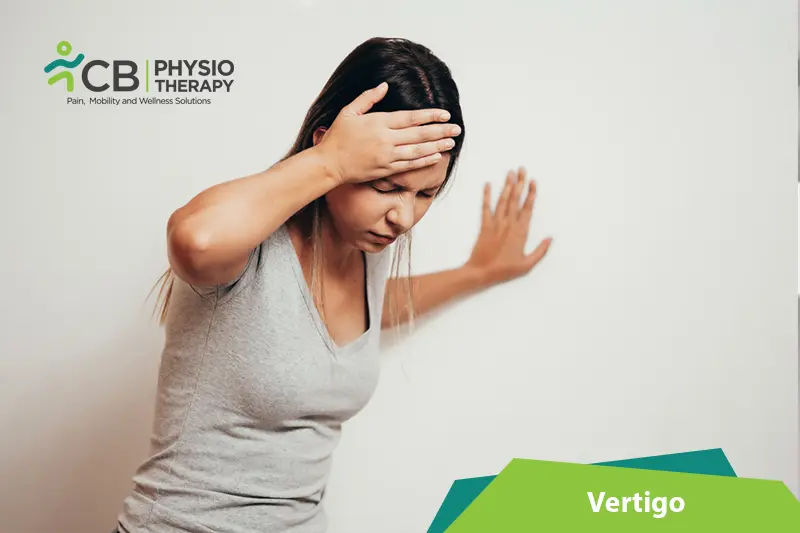
Understanding Vertigo
Vertigo affects people differently, and the right care starts with understanding how it affects you. Its day-to-day impact — on movement, strength, energy and confidence — is where physiotherapy does its work.
Our role in Vertigo is practical: protect and rebuild movement and daily function with a plan set after a careful assessment, in coordination with your doctor wherever medical management is involved. No two plans look the same, because no two cases behave the same.
Causes & risk factors of Vertigo
What commonly drives it — your assessment pins down which of these apply to you.
More than one possible driver
Vertigo can have several contributing factors — a careful history and physical assessment separate them rather than guessing.
Reduced movement and deconditioning
Whatever the trigger, less movement quickly adds weakness and stiffness of its own — usually the most reversible part.
Daily-life load and habits
Work posture, repeated tasks, sleep and stress all shape how a condition behaves day to day.
General health and history
Overall health, previous injuries and existing conditions influence both the picture and the plan — the assessment takes all of it in.
When physiotherapy is the right call
If any of these sound like you, an assessment is the right first step.
- ✓ A new diagnosis of Vertigo and you want a clear rehabilitation start point
- ✓ Daily tasks, walking or stairs are getting harder than they used to be
- ✓ Strength, stamina or balance has visibly dropped
- ✓ You want a structured clinic + home program with measurable milestones
- ✓ Family members need guidance to support you safely
Your treatment journey
Step by step — from your first assessment to a tracked recovery plan.
A detailed first assessment
History, movement testing and strength checks — a focused session to find what is actually driving your Vertigo.
A diagnosis you understand
Your physiotherapist explains the findings in plain language — what is affected, why it happened and what that means for you.
Active, tracked treatment
Hands-on therapy, the right modalities and graded exercise — progressed session by session and tracked on Fizo IQ™.
Prevention, built in
The final phase rebuilds strength and habits so the same problem does not come back — with a home plan you keep.
What recovery looks like
- ✓ More independence in daily tasks
- ✓ Better strength, balance and stamina
- ✓ Fewer setbacks, with red flags monitored
- ✓ A program your family understands and can support
- ✓ Progress measured milestone by milestone on Fizo IQ™
When to see a doctor — red flags
How CB Physiotherapy treats Vertigo
At CB Physiotherapy, treatment for Vertigo starts with finding its cause: a structured, physiotherapist-led assessment before anything is prescribed. Your plan then combines hands-on therapy, targeted exercise and the right modalities — delivered at a clinic near you or at home, and coordinated with your doctor where medical care is involved.
Every case runs on Fizo IQ™, our recovery engine: diagnosis, root cause, plan, milestones and goals, tracked session by session. You always know where you are in your recovery — and what comes next.
Exercises that help with Vertigo
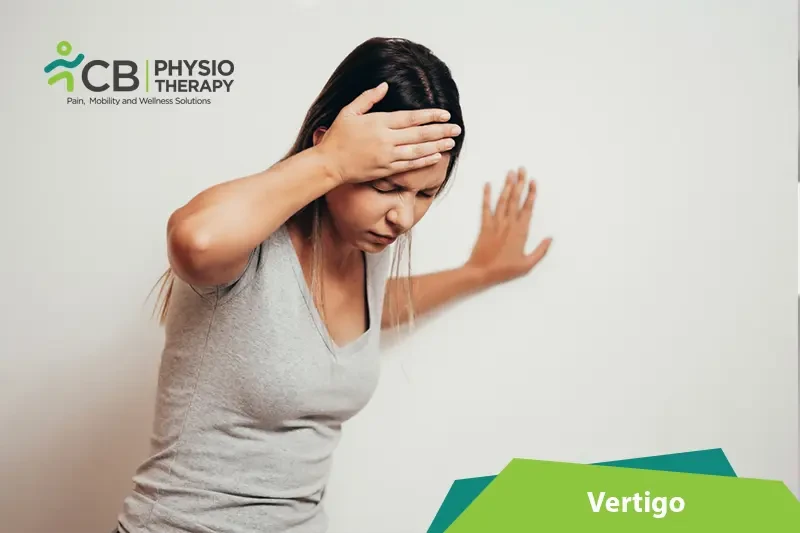
Make these exercises yours — a CB physio personalizes, doses and tracks your plan week by week.
Get my personalized planGeneral guidance only — stop if an exercise increases your pain, and check with your physio before starting a new routine.
Get Vertigo treatment near you
Certified physiotherapists at a clinic near you or at home — same-day slots, assessment-led care.
Request received!
We'll call you within 10 minutes to confirm your home visit.We'll call you within 10 minutes to confirm your slot.
Chat with us on WhatsAppVertigo, answered
Vertigo is a type of dizziness in which the patient experiences the perception of motion (usually a spinning motion) due to dysfunction of the vestibular system. The vestibular system is the sensory system that provides the sense of balance and orientation to coordinate movement with balance.
Types of vertigo:
Depending on the location of dysfunction of the vestibular pathway, vertigo is classified into peripheral or central.
Peripheral: Vertigo is caused due to problems in the inner ear or vestibular system, which is composed of semicircular canals, the vestibule, and the vestibular nerve.
Central: Vertigo that occurs from injury to the balance centers of the central nervous system (CNS), caused by a lesion i.e wound or injury in the brainstem or cerebellum. It is usually associated with less prominent movement illusion and nausea.
Symptoms vary from person to person depending on the actual cause of vertigo. Some of the symptoms are listed below:
- Nausea or vomiting,
- Unsteadiness,
- Postural instability,
- Blurred vision,
- Difficulty in speaking,
- Lowered level of consciousness,
- Hearing loss,
- Motion sickness.
Pathology
Vertigo is a symptom and a type of dizziness. It arises because of asymmetry in the vestibular system due to damage or dysfunction of the labyrinth, central vestibular structures in the brainstem, or vestibular nerve.
Inner ear complications are the most common causes of vertigo, some other contributors are:
Benign Paroxysmal Positional Vertigo (BPPV) also known as "loose crystals", is the most common type of vertigo. BPPV occurs due to small crystals of calcium that loosen in the inner ear and travel into the semicircular canals, disturbing the fluid and creating the sensation of movement.
- BPPV is commonly felt when a person shifts the head to a different position, which can occur when tilting the head or getting in or out of bed.
- Old aged, and especially women, over the age of 60,
- Inner-ear infections,
- Head or neck injuries,
- Common cold, Influenza, and bacterial infections,
- Vestibular neuritis,
- Migraines,
- Tumors,
- Stroke,
- Meniere's disease.
Tests for vertigo are done to elicit nystagmus and to differentiate vertigo from other causes of dizziness such as hyperventilation syndrome, presyncope, disequilibrium, or psychiatric causes of lightheadedness.
Medical History:
To diagnose vertigo, medical history is taken from the patient, including details about the symptoms. The patient may be asked what the sensation of movement or dizziness is felt, how frequently it occurs, whether it occurs while moving in a particular way, certain times of the day, and whether hearing loss or ringing in the ears is also felt. Family history and history of the condition affecting balance, hearing or any infection, injury, or surgery in the ear or brain.
Physical Examination:
Physical examination is done to look for signs and symptoms of vertigo. Eye movements are checked or the patient is asked to track an object from one point in space to another. If the patient has trouble with this task or experiences rapid eye movements or blurred vision then the patient is referred for more tests.
Hearing Tests
Hearing tests also help to assess whether there is a problem with the nerve that connects the inner ear to the brain and whether dysfunction affects both ears.
Videonystagmography Testing:
Videonystagmography is done to evaluate the function of the inner ear using visual and sensory tests. Videonystagmography testing takes place in a testing suite within an audiologist's office. A variety of shapes, objects, and spots of light appear on the screen, and the patient is asked to perform certain tasks with eyes while keeping his head still. The infrared goggles worn by the patient records eye movements while caloric testing takes place. Followed by the audiologist analysis, the eye movement data is obtained by the goggles and also looks for patterns indicating an inner ear disorder as the cause of vertigo.
Rotational Chair Testing:
Audiologists use rotational chair testing to obtain information about whether vertigo is of peripheral or central origin. The patient is seated in a mechanized chair that slowly rotates. The patient wears special goggles that record the eye movements while the patient is in the chair.
Audiologists analyzes eye movements and interpret how they relate to the health of the inner ear.
Electrocochleography:
Electrocochleography helps to determine if fluid buildup causes excess pressure in the inner ear, which can also lead to vertigo symptoms. These tests are utilized to measure the response of the inner ear to sound stimuli.
Magnetic resonance imaging (MRI) Scans:
Magnetic resonance imaging (MRI) Scans helps to obtain a closer look at the inner ear and its surrounding structures. This scan uses a magnetic field and radio waves to create computerized, three-dimensional images of the ear and the nerve that carries signals from the inner ear to the brain. A magnetic resonance imaging scan may reveal a buildup of fluid or inflammation in the inner ear or a growth on the nerve.
Neurological Testing:
Neurological testing uses to indicate vertigo of central origin.
Medication: Anticholinergics, Anticonvulsants, Antihistamines, Beta blockers, Corticosteroids etc.
Note: Medication should not be taken without the doctor's prescription.
Surgery:
Treatment depends on the actual cause of vertigo. If the symptoms continue for more than 12 months, and conservative treatment does not reduce the symptoms then an operation may be needed.
Physiotherapy involves repositioning procedure:
Epley maneuver:
- Epley maneuver that employs gravity to move calcium build-up that causes benign positional paroxysmal vertigo. It is performed as:
- The patient is in a long sitting position, head rotated 45 degrees to the affected side.
- The patient is rapidly reclined to a supine position with the neck slightly extended. Hold this position for 30 seconds or until nystagmus and dizziness subside.
- Then rotate the head to 90 degrees to the opposite side. Hold position this position for 20 seconds, or until nystagmus and dizziness subside.
- Patient rotates 90 degrees from supine to side-lying. Hold this position for 20 seconds or until nystagmus and dizziness subside.
- Bring the patient up into short-sitting. The patients should complete this maneuver, for which 1to 3 visits are required for resolution of symptoms.
Liberatory or Semont maneuver:
- Patient is asked to sit in a short sitting, head rotated to 45 degrees towards the unaffected ear.
- Physiotherapist places one hand under the bottom of the shoulder while the other hand supports the neck.
- Then the patient rapidly moves into side-lying to the affected side, face towards the ceiling. Hold this position for 30 seconds.
- Without any head movement, the patient is asked to move to the side-lying on the opposite side of the body, face towards the bed. Hold this position for 30 seconds.
Gufoni Maneuver:
Treatment for horizontal/lateral canal BPPV.
- Patient is taken from sitting to side-lying on the affected or unaffected side
- Geotropic nystagmus: unaffected
- Apogeotropic: affected
- Turn the patient's head towards the ground i.e 45-60 degrees, hold this position for 2 minutes.
- Last of all patient returns to sitting with his head maintained in that position.
Balance therapy:
This therapy helps to make your balance system less sensitive to motion. This physiotherapy technique is called vestibular rehabilitation. This therapy promotes vestibular adaptation, enhances gaze stability, postural stability, and improves activities of daily living. It also facilitates substitution by the other eye-movement systems, substitution by vision, somatosensory cues, other postural strategies, and habituation.
The patient is advised while feeling dizzy, the patient should not drive, walk or operate heavy machinery. The patient should move slowly when moving from one position to another position, get up slowly from sitting or lying down, sit or lie down right away if feeling dizzy. Drink plenty of water to help prevent dehydration. Vestibular exercises should be continued to maintain balance and strength, these exercises help to decrease vertigo and improve balance.
Don't let Vertigo decide your day.
Get assessed today — find the cause, get a plan, and know when you'll feel better.