Manual Therapy — How It Works & What It Treats
Also known as Manual Therapy. What Manual Therapy is, how it works and what it treats — explained by CB Physiotherapy's clinical team.
How Manual Therapy works
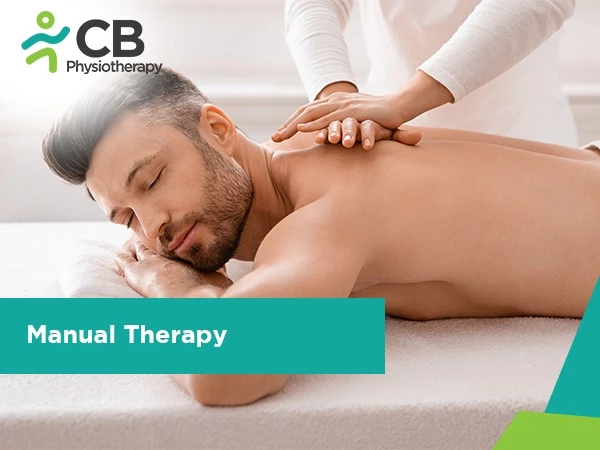
Manual therapy is skilled, hands-on treatment: joint mobilisation and manipulation, soft-tissue techniques, muscle-energy methods and nerve mobilisation. Where machines apply energy and exercises build capacity, manual therapy changes how joints and tissues move right now — restoring glide to a stiff joint, easing protective muscle tone, calming an irritated segment.
Its honest role in modern practice is the opener, not the whole show: hands-on treatment produces a window of better movement and less pain, and what fills that window — retraining, strengthening, habit change — decides whether the improvement lasts. That pairing is exactly how CB delivers it.
Manual Therapy — techniques & equipment
What the treatment actually involves — your plan combines the pieces your assessment calls for.
Joint mobilisation
Graded, rhythmic glides that restore movement to stiff joints — dosage from gentle to firm, always within comfort.
Manipulation (HVLA)
The quick, precise thrust with the audible click — used selectively, only where assessment indicates it.
Soft-tissue techniques
Targeted release of muscles and fascia guarding a problem area — deeper and more specific than massage.
Nerve mobilisation
Gentle gliding techniques for irritated nerves that need movement without provocation.
Muscle-energy techniques
Your own gentle contractions, positioned and resisted precisely to reset length and joint position.
Conditions Manual Therapy treats
Where it fits best — your assessment confirms whether it belongs in your plan.
- ✓ Cervical Spondylosis →
- ✓ Frozen Shoulder →
- ✓ Achilles Tendon Rupture →
- ✓ Carpal Tunnel Syndrome (cts) →
- ✓ Arthritis →
- ✓ Knee Bursitis →
- ✓ Joints that feel stiff, locked or "not quite right"
- ✓ Pain with protective muscle guarding around it
- ✓ Movement that improves noticeably after hands-on work
- ✓ Early-stage rehab where exercise alone is too provocative
What a Manual Therapy session looks like
Step by step — from screening to treatment to what comes next.
Movement diagnosis
Finding the stiff, guarded or irritated segments — and confirming manual treatment suits them.
Hands-on treatment
The techniques your findings call for, graded to comfort — you stay in control throughout.
Use the window
Exercise in the same session, while movement is freer — this is where lasting change is made.
Wean by design
Hands-on input reduces as your own capacity grows — independence is the planned end-point.
Benefits of Manual Therapy
- ✓ Often the fastest route to moving and hurting less
- ✓ Relief without medicines
- ✓ Reaches stiffness that exercise alone cannot unlock
- ✓ Makes early rehab tolerable for irritable problems
- ✓ Always paired with exercise so gains are kept
Safety & contraindications
How CB Physiotherapy delivers Manual Therapy
Hands-on care at CB Physiotherapy comes with a rule attached: every manual technique buys movement, and every session spends that movement on retraining before you leave. It is also honest about scope — manipulation is used selectively, techniques are matched to findings, and the goal from day one is a body that no longer needs our hands.
Your response is tracked on Fizo IQ™, and the balance of hands-on to active work shifts deliberately as you progress.
Real published prices from our physiotherapists for Manual Therapy in India — your exact quote is confirmed after assessment, before you commit. Packages save 10%.
Get Manual Therapy near you
Certified physiotherapists at a clinic near you or at home — same-day slots, assessment-led care.
Request received!
We'll call you within 10 minutes to confirm your home visit.We'll call you within 10 minutes to confirm your slot.
Chat with us on WhatsAppManual Therapy, answered
SOFT TISSUE TECHNIQUES:
Soft Tissue Mobilization: Soft tissue mobilization works by mobilizing muscles and therefore breaking up scar tissue. The mobilization also helps to remove waste products from the damaged area which increases the speed of the healing process. Soft tissue mobilization helps to release the tension in the muscle which increases the range of motion and flexibility. .Different techniques used by the therapist are sustained pressure, direct oscillations, perpendicular mobilization, and parallel mobilization.
Massage: Massage serves the purpose of moving the fluid and if applied cautiously and gently to injured tissue, may assist in preventing adhesions. Tendinous lesions are treated with a gentle dosage applied transverse to the fibers to smooth roughened surfaces or to maintain mobility of the tendon within its sheath. When applied the tendon is kept taut and when treating a muscle lesion, the muscle is usually kept in its shortened position in order not to separate the healing breach.
Scar Mobilization: A deep tissue massage breaks up the adhesions and the collagen fibers that are limiting your movement. Adhesions are broken down within deep tissue. Massage techniques used are friction massage, acupressure, and trigger point.
Myofascial Release ( MRT): Myofascial release, a hands-on technique that applies prolonged light pressure with specific directions into the fascia system, may be used as an adjunct to almost any treatment prescribed for the patient. The treatment is aimed at the fascia which is a tough connective tissue that has an elastic component, a collagenous or plastic component, and a matrix or ground substance, which under normal conditions is a gelatin-like substance. Cross-restriction can occur for any number of reasons within the fascia.
Strain Counterstrain or (PRT): Also known as positional release technique. It is a gentle technique aimed at relieving musculoskeletal pain and related dysfunction, its action for the treatment moves the patient’s body passively away from the painful and restricted directions of motion. Or passive positioning of the spasmed muscles and joints towards a comfortable position and simultaneously releasing the tissues.
Active Release Technique (ART): Manual therapy aims to correct the soft tissue restrictions by breaking down scar tissue and adhesions thus decreasing pain, stiffness muscle, and dysfunction. The patient actively moves the affected structure muscle or ligament while the therapist presses or maintains contact with the injured area. This allows the therapist to feel the structure as it moves under their contact and thus effectively treat those restricted soft tissue structures.
Manual Lymph Drainage (MLD): It is a gentle skin stretching massage technique that helps promote the movement of lymphatic fluid out of the swollen limbs or decrease various types of edema. The techniques used are stationary circles, scoop technique, pump technique, and rotatory technique.
JOINT TECHNIQUES:
Joint Mobilization: Passive traction or gliding movements applied to joint surfaces that maintain or restore the joint play (distraction, sliding, compression, rolling, and spinning) normally allowed by the capsule so that normal roll-slide joint mechanics can occur as a person moves.
Joint Manipulation/Thrust/Mobilization: Passive skilled manual therapy techniques applied to joints and related soft tissues at varying speeds and amplitudes using physiologic or accessory motions, for therapeutic purposes.
Muscle Energy Techniques: Muscle Energy Technique (MET) is a form of manual therapy that uses the muscle’s own energy in the form of gentle isometric contractions to relax the muscles via autogenic or reciprocal inhibition and lengthen the muscle. Types of contractions used in MET are isometric contraction- hypertonic shortened muscle, isotonic contraction- inhibited weakened muscle, concentric contraction- mobilizes joint against its motion barriers, eccentric contraction- isolytic contraction- fibrosed muscles.
Traction: The process of drawing or pulling. Traction is a manual technique designed to reduce the pressure on the affected area, thus reducing pain.
- Neck Pain: Disc Pathology, Muscle spasm, Post-Surgical neck pain, Rib hypomobility.
- Lower Back Pain: Disc Pathology, Post-Surgical Back Pain, Spinal Stenosis.
- Thoracic Spine or Mid-Back Spine
- Headaches / Migraines
- Hip Pain: Hip impingement, Myofascial hip pain, Hip Bursitis, Post-Surgical Hip replacements.
- Knee Pain: Total Knee Replacements, IT band Tendonitis.
- Ankle Pain: Ankle Sprains, Chronic Ankle pain, Ankle Arthritis, Post-Surgical Ankle Pain
- Shoulder Pain: Frozen Shoulder, Impingement Syndrome, Post-Surgical Shoulder, Rotator cuff syndrome.
- Trigger points In Muscles.
- Ankle pain: Ankle sprain, Fused joints.
- Wrist pain: Wrist pathologies.
- Elbow pain: Tennis elbow, Golfers elbow.
- Temporomandibular joint Dysfunction
- Fibromyalgia
- Open wound
- Skin Infections
- Osteoporosis
- Malignancy
- Vertebral Artery Insufficiency
- Hypermobility
- Undiagnosed pain
- Recent fracture.
Ready to start your recovery?
Get assessed today — find the cause, get a plan, and know when you'll feel better.