
Knee Bursitis — Symptoms, Causes & Treatment
Also known as Knee Bursitis. Causes, symptoms and how physiotherapy treats Knee Bursitis — without surgery or medicines.
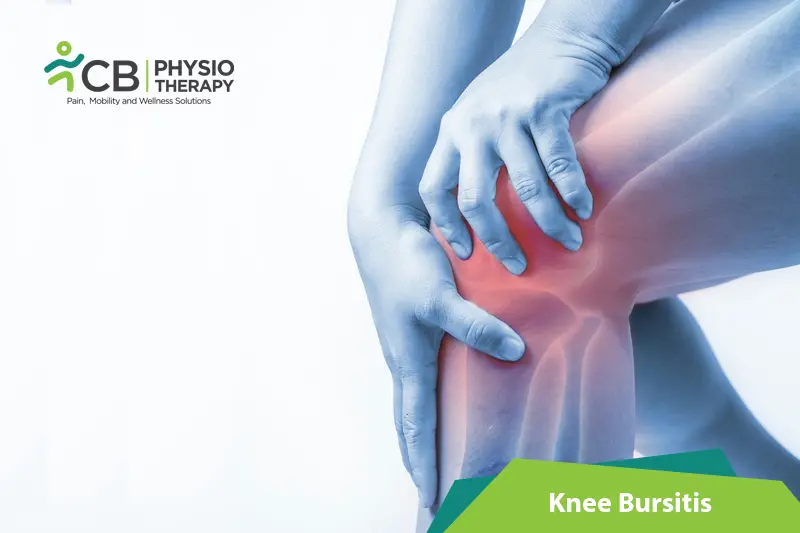
Understanding Knee Bursitis
Knee Bursitis can arrive suddenly or build over months, and how much it hurts is a poor guide to how serious it is — minor strains can hurt intensely, while slow-building problems stay quiet until they start limiting you.
Physiotherapy approaches Knee Bursitis by treating the cause rather than chasing the symptom: a detailed movement assessment first, then a plan combining hands-on treatment, targeted exercise and the habit changes that stop it returning.
Causes & risk factors of Knee Bursitis
What commonly drives it — your assessment pins down which of these apply to you.
Old injuries and compensations
A previous injury that never fully rehabilitated often leaves a movement pattern that overloads something else.
Sudden spikes in activity
A new sport, a new gym program, a long trek — tissue adapts to gradual change and protests when change is sudden.
Muscle strain and overload
A sudden lift, an awkward movement or simply more load than the tissues were prepared for — the most common trigger.
Posture and long static hours
Desks, driving and screens keep the same structures loaded for hours at a stretch — comfortable at first, aching later.
Joint stiffness and age-related change
Joints that move less start to hurt more; age-related wear is normal, but painful stiffness is not something to simply accept.
When physiotherapy is the right call
If any of these sound like you, an assessment is the right first step.
- ✓ Knee Bursitis that keeps returning or hasn't settled within two weeks
- ✓ Pain or stiffness that limits work, sleep or daily activities
- ✓ You want to avoid long-term painkillers — or surgery has been mentioned
- ✓ You've been diagnosed with Knee Bursitis and told to "rest and see"
- ✓ Movement feels restricted, weak or guarded compared to before
Your treatment journey
Step by step — from your first assessment to a tracked recovery plan.
A detailed first assessment
History, movement testing and strength checks — a focused session to find what is actually driving your Knee Bursitis.
A diagnosis you understand
Your physiotherapist explains the findings in plain language — what is affected, why it happened and what that means for you.
Active, tracked treatment
Hands-on therapy, the right modalities and graded exercise — progressed session by session and tracked on Fizo IQ™.
Prevention, built in
The final phase rebuilds strength and habits so the same problem does not come back — with a home plan you keep.
What recovery looks like
- ✓ A clear diagnosis and a timeline you can plan around
- ✓ Strength and movement rebuilt, not just pain reduced
- ✓ Lower chance of recurrence, with a prevention plan
- ✓ Care without long-term medicines — at a clinic near you or at home
- ✓ Relief that comes from treating the cause, not masking it
When to see a doctor — red flags
How CB Physiotherapy treats Knee Bursitis
At CB Physiotherapy, treatment for Knee Bursitis starts with finding its cause: a structured, physiotherapist-led assessment before anything is prescribed. Your plan then combines hands-on therapy, targeted exercise and the right modalities — delivered at a clinic near you or at home, and coordinated with your doctor where medical care is involved.
Every case runs on Fizo IQ™, our recovery engine: diagnosis, root cause, plan, milestones and goals, tracked session by session. You always know where you are in your recovery — and what comes next.
Exercises that help with Knee Bursitis
 Top 5 Exercises For Knee Bursitis
Steps & precautions →
Top 5 Exercises For Knee Bursitis
Steps & precautions →
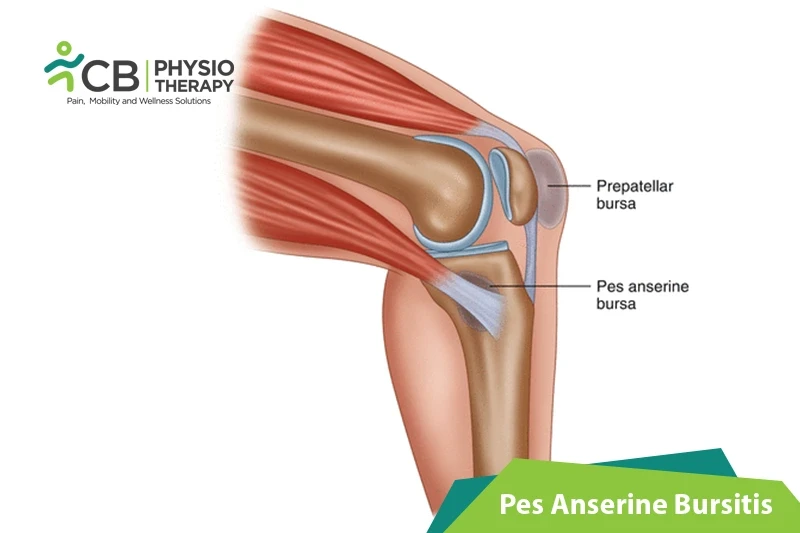 Top 5 Exercises For Pes Anserine Bursitis
Steps & precautions →
Top 5 Exercises For Pes Anserine Bursitis
Steps & precautions →
Make these exercises yours — a CB physio personalizes, doses and tracks your plan week by week.
Get my personalized planGeneral guidance only — stop if an exercise increases your pain, and check with your physio before starting a new routine.
Get Knee Bursitis treatment near you
Certified physiotherapists at a clinic near you or at home — same-day slots, assessment-led care.
Request received!
We'll call you within 10 minutes to confirm your home visit.We'll call you within 10 minutes to confirm your slot.
Chat with us on WhatsAppKnee Bursitis, answered
Bursitis is an inflammation of the small fluid-filled sac or bursae near the joints in the body. The inflammation occurs when too much pressure is put on one of these sacs. It can be very painful and also limit mobility. The bursa is made of connective tissue and filled with synovial fluid, they cushion various parts of the body like the elbow, which are often exposed to friction and pressure. Knee bursitis most commonly occurs over the kneecap or on the inner side of the knee below the knee joint.
If a bursa becomes inflamed, more fluid builds up inside it than usual. Knee bursitis symptoms may vary, depending on the site of the bursa affected and the cause of inflammation. These involve:
- Swelling seen and felt from outside, especially if the inflamed bursa is exactly under the skin,
- Painful when moved or when pressure is applied from outside,
- Pain even at rest,
- The affected portion of the knee might feel warm,
- Tenderness present,
- Red and warm,
- The patient may develop a fever and feel unwell.
Pathology:
Bursitis is the inflammation of a bursa. Bursae are saclike structures present between the skin and the bone or between tendons, ligaments, and bone and are lined by synovial tissue, which produces fluid that lubricates and reduces friction between these structures. Bursitis occurs when the synovial lining becomes thickened, producing excessive fluid, leading to localized swelling and pain.
The initial inflammation is a natural response from the body, this process allows cells and nutrients to gather around the injury to start the healing process. The various causes of knee bursitis can be:
- Heavy blow during a fall,
- Direct impact on the bursa,
- Excessive friction or pressure,
- Frequent or prolonged kneeling also known as housemaid's knee,
- Overuse or strenuous activity,
- Bacteria can enter the bursa, causing inflammation,
- Inflammatory diseases such as osteoarthritis, rheumatoid arthritis, and gout,
- Some jobs in which they work often involve kneeling on the hard floor,
- Occupations include carpenters, cleaners, roofers, gardeners,
- Working for a prolonged period on the computer,
- Sports like runners, volleyball, wrestling, football, etc,
- Obesity.
Physical examination:
The examiner compares the condition of both knees, particularly if only one is painful, then gently the areas of the knee are palpated to detect the warmth, swelling, and the source of pain. The examiner inspects the skin over the tender area for redness or other signs of infection. The patient is then asked to move the legs and knees to determine the knee's range of motion and whether it hurts to bend or flex it.
X-ray:
X-ray helps to reveal any problem with bone or arthritis.
Magnetic resonance imaging (MRI):
Magnetic resonance imaging (MRI) uses radio waves and a strong magnetic field to produce detailed images of structures in the body. This imaging helps to visualize soft tissues, such as bursae.
Ultrasound:
Ultrasound uses sound waves to produce images in real-time, ultrasound can help the examiner to better visualize swelling in the affected bursa.
Laboratory tests:
Laboratory tests are done to find out if any inflammation is caused by bacteria. If the patient also suffers from fever or a wound close to the inflamed area, then it can be a bacterial infection. For confirmation, the examiner takes some fluid from the bursa using a cannula and gets it tested in the laboratory.
Blood tests:
Blood tests are done to detect the signs of inflammation or show whether the inflammation is being caused by a disease such as gout.
Medication: Non-steroidal anti-inflammatory drugs (NSAIDs) such as naproxen sodium aspirin, ibuprofen, antibiotics, topical medications like sprays, creams, gel, and patches.
Note: Medication should not be taken without the doctor's prescription.
Corticosteroid injection:
A corticosteroid drug is injected into an affected bursa to reduce inflammation. The inflammation usually subsides rapidly, but the patient might feel pain and swelling due to the injection for a couple of days.
Aspiration:
Bursa is aspirated to reduce excess fluid and treat inflammation. A needle is inserted into the affected bursa and the fluid is drawn into the syringe. Aspiration can cause short-term pain and swelling, and the patient might need to wear a knee immobilizer for a short period after the injection to reduce the chance of recurrent swelling.
Surgery:
In case the severe chronic or recurrent bursitis does not respond to other treatments, then surgery such as arthroscopic bursectomy under local anesthesia is recommended to remove the bursa.
Rest:
Activity that has caused knee bursitis, should be discontinued, and also avoid movements that worsen the pain. Rest reduces the metabolic demands of the injured tissue and avoids increased blood flow.
Ice:
An ice pack should be applied to the knee for 20 minutes several times a day until the pain goes away and the knee no longer feels warm to the touch. Ice causes a decrease in the temperature of the tissues and causes vasoconstriction and limitation of the bleeding. It also decreases the pain because cold causes an increase in the threshold levels in the free nerve endings and at synapses.
Compression:
A compressive wrap or knee sleeve is used to reduce swelling. Compression decreases the intramuscular blood flow to the affected area and also reduces the swelling
Elevation:
The affected knee is elevated and kept on pillows to help reduce swelling in the knee. Elevation ensures a decrease in the hydrostatic pressure and also reduces the accumulation of interstitial fluid. It is a part of Rice-principle, r-rice, i- ice, c-compression, and e-elevation.
Transcutaneous electrical nerve stimulation (TENS):
Transcutaneous electrical nerve stimulation (TENS) or EMS (electrical muscle stimulation) is very effective for treating knee pain.
Ultrasound therapy is used to treat the painful knee. Its deep micro-massage effect and tissue thermal effectiveness are found to be effective to reduce pain and swelling.
Low-level laser therapy (LLLT):
Low-level laser therapy is the application of red light over the injured area to stimulate cellular repair. LLLT has a powerful anti-inflammatory effect and also a healing effect on inflamed bursae and surrounding soft tissues.
KT Tape:
KT tape helps to relieve pressure off of the inflamed bursae and also increases the circulation to the area. As a result, the pain reduces and also reduces the healing time.
Manual therapy involves soft tissue massage and joint mobilization by a physiotherapist to regain mobility and range of motion of the knee.
Stretching Exercises:
Once the initial inflammation is reduced stretching is given, the initial focus should be on pain-free movement, and stretching exercises generally start with gentle stretching to improve flexibility. It also promotes healing of the affected area and reduces the friction between the skin and the patella tendon. When the patella tendon is more flexible less friction is produced. Stretching exercises like a seated hamstring stretch, calf stretch, posterior knee capsule stretch, etc are recommended.
Light strengthening exercises are initiated to restore full motion and improve strength to reduce stress on the tendons and knee joints. Static contraction of the quadriceps is done 1 to 3 times a day so that the patient can resume everyday activities. To check if the exercise is working, fingers are placed on the inner side of the quadriceps to feel the muscle tighten during the contraction of the muscle. The patient is asked to hold his/ her contraction for 5 seconds but should be pain-free, and can be repeated 10 times as hard as possible. Light strengthening exercises like straight-leg raises in supine and side-lying, ankle-toe movements, etc are recommended.
The physiotherapist advises the patient to use knee pads for kneeling activities, to avoid activities that worsen the knee pain, avoid excessive repetitious bending of the knees like excessive squatting. And also take rest before the patient feels pain.
Don't let Knee Bursitis decide your day.
Get assessed today — find the cause, get a plan, and know when you'll feel better.