
Transcutaneous Electrical Nerve Stimulation(tens) Therapy — How It Works & What It Treats
Also known as Transcutaneous Electrical Nerve Stimulation(tens) Therapy. What Transcutaneous Electrical Nerve Stimulation(tens) Therapy is, how it works and what it treats — explained by CB Physiotherapy's clinical team.
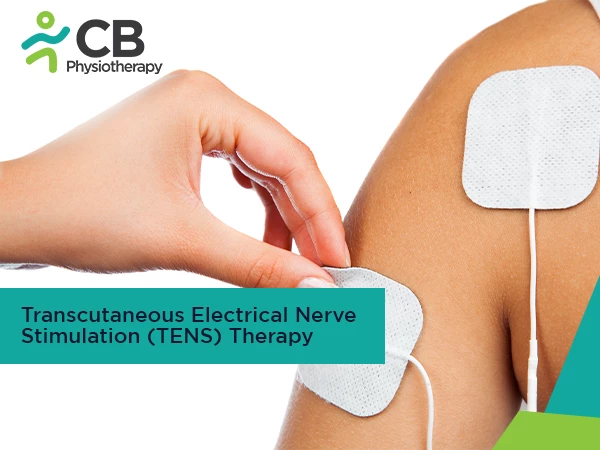
How Transcutaneous Electrical Nerve Stimulation(tens) Therapy works
Transcutaneous Electrical Nerve Stimulation(tens) Therapy is one of the treatment approaches our physiotherapists draw on — always as part of an assessment-led plan, never as a standalone fix.
What makes any therapy work is the decision-making around it: whether it fits your diagnosis, at what dose, and combined with what. At CB Physiotherapy, Transcutaneous Electrical Nerve Stimulation(tens) Therapy is prescribed after a movement assessment and paired with active rehabilitation, because passive treatment alone rarely produces lasting change.
Transcutaneous Electrical Nerve Stimulation(tens) Therapy — techniques & equipment
What the treatment actually involves — your plan combines the pieces your assessment calls for.
Assessment before application
Your physiotherapist first confirms Transcutaneous Electrical Nerve Stimulation(tens) Therapy suits your diagnosis — and screens for anything that rules it out.
Targeted application
The treatment is applied to the specific structures your assessment identified, at a dose set for your case.
Paired with active rehab
Exercise and movement retraining run alongside, so the gains each session makes are kept.
Reviewed and progressed
Your response is checked every session; the plan is adjusted rather than repeated on autopilot.
Conditions Transcutaneous Electrical Nerve Stimulation(tens) Therapy treats
Where it fits best — your assessment confirms whether it belongs in your plan.
- ✓ Frozen Shoulder →
- ✓ Achilles Tendon Rupture →
- ✓ Carpal Tunnel Syndrome (cts) →
- ✓ Arthritis →
- ✓ Knee Bursitis →
- ✓ Ankle Sprain →
- ✓ Pain or stiffness that has not settled with rest
- ✓ As part of a wider, assessment-led recovery plan
- ✓ When your assessment identifies the specific problem Transcutaneous Electrical Nerve Stimulation(tens) Therapy addresses
What a Transcutaneous Electrical Nerve Stimulation(tens) Therapy session looks like
Step by step — from screening to treatment to what comes next.
Screening and consent
A quick reassessment and safety screen — you will know what the session involves and why before it starts.
The treatment itself
Transcutaneous Electrical Nerve Stimulation(tens) Therapy applied to the targeted area — most patients find sessions comfortable, and you can speak up at any point.
Active follow-through
Exercise or movement work right after, while the treatment effect is fresh.
Response check
What changed and for how long — the answer shapes your next session and the plan.
Benefits of Transcutaneous Electrical Nerve Stimulation(tens) Therapy
- ✓ Always combined with active rehab, for results that last
- ✓ Available at CB clinics near you — and at home where equipment allows
- ✓ Drug-free support for pain relief and recovery
- ✓ Delivered by certified physiotherapists, never unsupervised
- ✓ Dosed to your case after a proper assessment
Safety & contraindications
How CB Physiotherapy delivers Transcutaneous Electrical Nerve Stimulation(tens) Therapy
You will not walk into CB Physiotherapy and simply receive Transcutaneous Electrical Nerve Stimulation(tens) Therapy — you will receive an assessment, and Transcutaneous Electrical Nerve Stimulation(tens) Therapy if your case calls for it. That order matters: it is how we make sure every session moves you towards a goal rather than just filling a slot.
Your plan runs on Fizo IQ™ — diagnosis, root cause, milestones, goals — and Transcutaneous Electrical Nerve Stimulation(tens) Therapy is combined with hands-on care and exercise as indicated, at a clinic near you or at home where the equipment allows.
Real published prices from our physiotherapists for Transcutaneous Electrical Nerve Stimulation(tens) Therapy in India — your exact quote is confirmed after assessment, before you commit. Packages save 10%.
Get Transcutaneous Electrical Nerve Stimulation(tens) Therapy near you
Certified physiotherapists at a clinic near you or at home — same-day slots, assessment-led care.
Request received!
We'll call you within 10 minutes to confirm your home visit.We'll call you within 10 minutes to confirm your slot.
Chat with us on WhatsAppTranscutaneous Electrical Nerve Stimulation(tens) Therapy, answered
It is broadly categorized into 3 types:
- Conventional TENS (HIGH): It involves the application of low-intensity / high-frequency current to produce a strong but comfortable sensation, Its duration is 30 min.
- Acupuncture-like TENS (LOW): It involves the application of high-intensity / low-frequency current over muscles or acupuncture points to produce a strong but comfortable sensation. Its duration is less than 20 min.
- Brief Intense TENS: It involves the application of high-intensity / high-frequency current. It lasts for not more than 5 minutes.
Nociceptive nerve endings may be stimulated by the chemicals released by tissue injury or accumulated as a result of metabolic activity, and thus creating an electrical potential. The degree of stimulation produced is governed by the number of chemicals present. It is postulated that the removal of these chemicals from the area may help reduce the level of nociceptive stimulation and thus the physiotherapeutic agents (ice and heat) affecting the circulation may help achieve this. The nociceptive stimulus is carried to the cord along with either a slow-conducing, non-myelinated C fiber or a faster-myelinated Ad (delta) fiber. Both will eventually enter the cord via the posterior route. It is postulated that as both of these fibers have a maximum frequency at which they can conduct that if a higher frequency of stimulation is applied, a physiological block o conduction might occur. TENS produces this required frequency and so has this effect.
- Chronic pain syndromes
- Period Pain
- Labor Pain
- Postoperative Pain
- Joint Pain
- Muscular pain
- Ligamentous pain
- Tendinitis pain
- Neck and Back Pain
- Endometriosis
- Arthritis
- Sports Injury
- Multiple Sclerosis
- Fibromyalgia
- Myofascial trigger points
- Painful Diabetic Neuropathy
- Spinal Cord Injury
- Amputation
- The electrical impulse of a TENS may cause a buzzing, tingling, or prickling sensation, which might be uncomfortable for some.
- Some people may be allergic to adhesive pads. Anyone who experiences skin redness and irritation can switch to hypoallergenic ones.
- Electrodes should never be placed on the front of the neck as it may lower blood pressure or Over the eyes, as it may cause injury.
The above recommendation applies to the following people:
- Pregnant Women: She should avoid using it in the abdominal and pelvis regions
- People with Epilepsy: Applying electrodes to the head or neck of people with epilepsy may induce a sudden disturbance in the brain
- People with Heart Problems
- People with a pacemaker or another type of electrical or metal implant
- Pulse shape - usually rectangular.
- Pulse width - is measured in microseconds and is between 100 and 500us.
- Frequency - can be as low as 2 Hz or as high as 60 Hz. A frequency of 150 Hz is commonly used. The frequency can be selected and altered by the therapist.
- Intensity – can be varied from 0 to 60 milliamps (mA) on many units. The patient or therapist can control the intensity and a tingling sensation should be felt.
Positioning of Electrodes
A number of approaches may be used. Electrodes can be placed over
- Acupuncture points, motor points, or trigger points.
- Area of greatest intensity of pain
- Appropriate dermatome or spinal segment
- Appropriate peripheral nerve
Ready to start your recovery?
Get assessed today — find the cause, get a plan, and know when you'll feel better.