Ultrasound Therapy — How It Works & What It Treats
Also known as Therapeutic Ultrasound. What Ultrasound Therapy is, how it works and what it treats — explained by CB Physiotherapy's clinical team.
How Ultrasound Therapy works
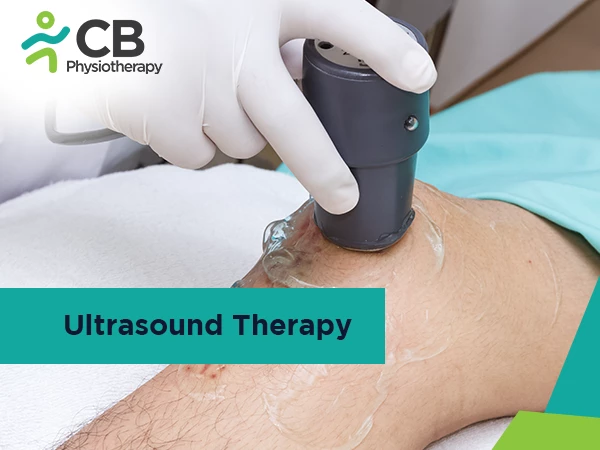
Therapeutic ultrasound applies high-frequency sound waves — far above hearing — through a gel-coupled probe into muscles, tendons and ligaments. Depending on the settings, it works thermally, warming deep tissue to improve blood flow and stretchiness, or mechanically, using pulsed vibration to stimulate cellular repair without heat. You feel gentle probe movement and, at most, mild warmth.
Ultrasound is one of physiotherapy\'s oldest tools, and honest practice treats it accordingly: a useful adjunct for specific soft-tissue problems, prescribed with clear intent and reviewed for effect — never the centrepiece of a modern rehabilitation plan, and never a substitute for the loading work that actually rebuilds tissue capacity.
Ultrasound Therapy — techniques & equipment
What the treatment actually involves — your plan combines the pieces your assessment calls for.
Gel-coupled probe application
Slow circular passes over the target area — the gel carries the sound into the tissue.
Thermal mode
Continuous output warms deep tissue before stretching or mobilisation — useful where tightness limits progress.
Pulsed (non-thermal) mode
Interval output for mechanical stimulation without heat — the setting for more irritable tissue.
Dose parameters
Frequency, intensity and time set per tissue depth and goal — parameters, not habit, drive the treatment.
Conditions Ultrasound Therapy treats
Where it fits best — your assessment confirms whether it belongs in your plan.
- ✓ Cervical Spondylosis →
- ✓ Frozen Shoulder →
- ✓ Carpal Tunnel Syndrome (cts) →
- ✓ Arthritis →
- ✓ Knee Bursitis →
- ✓ Anterior Cruciate Ligament Tear(acl) →
- ✓ Localized tendon and ligament problems
- ✓ Soft-tissue tightness limiting stretch or mobilisation
- ✓ Scar-tissue and healing-support phases after injury
- ✓ Cases needing a gentle adjunct alongside active rehab
What a Ultrasound Therapy session looks like
Step by step — from screening to treatment to what comes next.
Indication check
Ultrasound has specific use-cases — your assessment confirms it adds value for yours.
Five to ten quiet minutes
Gel, slow probe passes, mild warmth at most — many patients feel nothing but the movement.
Immediately useful window
Warmed, more compliant tissue is stretched or mobilised right after — the reason for the timing.
Effect review
Kept, adjusted or dropped based on measured response over a defined number of sessions.
Benefits of Ultrasound Therapy
- ✓ Comfortable, painless deep-tissue treatment
- ✓ Prepares tight tissue for stretching and mobilisation
- ✓ A gentle option for irritable, healing structures
- ✓ No downtime — minutes per session
- ✓ Used honestly: as an adjunct with intent, reviewed for effect
Safety & contraindications
How CB Physiotherapy delivers Ultrasound Therapy
You will find ultrasound at CB Physiotherapy in its correct, modest place: chosen when the assessment says deep warming or gentle mechanical stimulation genuinely helps your case, timed so the treated tissue is used immediately, and dropped without ceremony if review shows it adding nothing.
The centre of your plan stays active — assessment-led exercise and hands-on care, tracked on Fizo IQ™ — with ultrasound serving that plan when indicated.
Real published prices from our physiotherapists for Ultrasound Therapy in India — your exact quote is confirmed after assessment, before you commit. Packages save 10%.
Get Ultrasound Therapy near you
Certified physiotherapists at a clinic near you or at home — same-day slots, assessment-led care.
Request received!
We'll call you within 10 minutes to confirm your home visit.We'll call you within 10 minutes to confirm your slot.
Chat with us on WhatsAppUltrasound Therapy, answered
This therapy involves the application of Ultrasound waves above the range of human hearing to treat various types of injuries. The application of Ultrasound Therapy helps in increasing the blood flow of a localized area to reduce the swelling and inflammation in that area. It is also used to enhance the healing of a bone fracture.
It is generally categorized into 2 types:
1. Thermal Ultrasound Therapy
This therapy involves the continuous transfer of sound waves resulting in small vibrations in the deep tissue molecules. These vibrations increase heat and friction in the molecules. This heating effect results in increases in the metabolism of the tissue cells resulting in the healing of the soft tissues.
The local rise in the temperature could be used to accelerate healing. It is generally used in cases of Myofascial pain, muscle strain or sprain, scars, or adhesion.
2. Mechanical Ultrasound therapy
This therapy uses a single vibration of sound waves to penetrate tissue. It causes the expansion and contraction in the tiny gas bubbles of the soft tissues which then helps to reduce the inflammation, reducing tissue swelling and thus decreasing pain in the tissue.
It is generally used if you have Pain and Swelling such as with Carpal Tunnel Syndrome,
Ultrasound may be used in a continuous mode where the treatment head continuously produces ultrasonic energy or pulsed where the treatment head continuously produces ultrasonic energy or pulsed where the periods of ultrasound are separated by periods of silence.
The unit of intensity when using ultrasound is the watt.
a: Space averaged intensity where the average intensity over a specified area is given, e.g. watts per square centimeter (Wcm-2).
b: Time-averaged/space-averaged intensity can be used when the ultrasound is being applied in a pulsed mode and gives the average intensity over the whole treatment time (per second for a specified area Wcm-2).
2: Pulsed mark: space ratio
When ultrasound is applied in its pulsed mode, the ratio of the time on to time off should be expressed. This is the mark: space ratio, the mark being the time ultrasound is on space being the silence, both being measured in milliseconds eg 2: 8, 1: 7.
3: Reflection of ultrasound
Air does not transmit ultrasonic waves, so in ultrasonic treatment, great care is taken to avoid leaving air between the treatment head and the patient, to minimize reflection. Though there will always be some reflection at each interface that the ultrasound beam encounters. This gives rise to acoustic impedance. When the acoustic impedance is low, the transmission is high, and vice versa.
4: Transmission of ultrasound
If the ultrasound beam encounters an interface between two media and is transmitted, it may be refracted. As refraction does not occur when the incident waves travel along the normal, treatment should be given with the majority of waves traveling along with the normal, whenever possible.
5: Attenuation of ultrasound
Attenuation is the term used for the gradual reduction in the intensity of the ultrasonic beam once it has left the treatment head. Two major factors contribute to attenuation.
6: Absorption
Ultrasound is absorbed by the tissues and converted to heat at that point. This constitutes the thermal effect of ultrasound.
7: Scatter
This occurs when the normally cylindrical ultrasonic beam is deflected from its path by reflection at interfaces, bubbles, or particles in its path. The overall effect of these two is such that the ultrasonic beam is reduced in intensity the deeper it passes. Therefore, when treating deep structures consideration needs to be given to the frequency and intensity of ultrasound chosen.
8: Ultrasonic fields
The depth of penetration and intensity of the ultrasonic beam is the division of the beam into a near and a far-field. The near and far-fields arise because the wavefronts from different parts of the source have to travel different distances and consequently there is interference between adjacent fronts. At some points, the interference is constructive at other points the interference is destructive. The extent of the near field is of significance in that it is more intense than the far field and may have a more profound effect in the treatment of certain conditions. The frequency of the ultrasound and radius of the transducer may need to be considered when treating tissues at a depth greater than 6.5cm.
9: Coupling media
Ultrasonic waves are not transmitted by air, thus some couplant that does transmit them must be imposed between the treatment head (transducer) and the patient's skin. No couplant affords perfect transmission and only a percentage of the original intensity is transmitted to the patient. Air reflects the ultrasonic beam into the treatment head and thus produces standing waves that might damage the crystal. The treatment head is never left switched on when not in contact with a transmission medium.
Ultrasound therapy involves the use of a metallic probe. The procedure begins with the application of gel either on the head of the probe or directly to the skin. This gel helps the sound waves to penetrate the skin evenly. After the gel is applied, this probe is then continuously moved over the selected area for over 5 to 10 min. The intensity or the power of an Ultrasound is adjusted as per the desired effect. Some people may feel a mild pulsing during this therapy while others may feel a slight warmth in the selected area.
Ultrasound Therapy has numerous benefits as it can be used for a vast range of issues. However its most commonly used for:
1: Heating and relaxing the muscles to alleviate the pain.
2: Increasing the blood flow i.e. lymph (lymph: a fluid that carries white blood cells throughout the body) to enhance the healing process not only of muscles but also joints and ligaments.
3: Softening of any existing scar tissue.
4: A low-intensity Pulsed Ultrasound (LIPUS) is used for fracture repair.
5: Management of the Knee Osteoarthritis (OA)
The most common conditions that can be treated using Ultrasound therapy are:
1: TENDONITIS / TENDINITIS:
It is a general term that is used to define the inflammation of the tendon tissue that connects the muscle to the bone. This is the most common cause of soft-tissue pain. It can occur at any age but it is more common in adults who do a lot of sports. Old-age people are also prone to it as the tendons tend to lose their elasticity and become weaker with age. Its common types are:
1: Tennis Elbow
2: Golfer's Elbow
3: Tendinitis (Achilles, Wrist, supraspinatus, bicipital)
4: Jumper's Knee
5: Swimmer's Shoulder
6: Trigger Finger or Thumb
7: Ganglion
2: Other conditions that can be treated with Therapeutic Ultrasound are:
1: Joint Swelling
2: Muscle spasm
3: Pain
4: Fractures
5: Muscle or ligament injury(ACL, PCL, MCL, LCL, etc )
6: Sprains and Strains ( ankle, knee, lower back, etc)
7: Knee Bursitis
8: Osteoarthritis
9: Rheumatoid arthritis
10: Myofascial pain
11: Carpal Tunnel Syndrome
12: Low back pain
13: Phantom Limb Pain
14: Varicose ulcers
15: Herpes zoster
16: Pressure sores
17: Frozen shoulder
18: Temporomandibular joint disorder
19: Prolapsed intervertebral disc
20: Dupuytren's contracture
21: Meniscal injury
It's important to note that therapeutic ultrasound is just one component of a comprehensive treatment plan. It is often used in conjunction with other physiotherapy modalities, exercises, and lifestyle modifications to achieve optimal results.
1: Skin Burns: Prolonged or incorrect application of therapeutic ultrasound may cause burns to the skin. Proper technique, appropriate coupling agents (such as ultrasound gel), and monitoring of the treatment area can help prevent burns.
2: Hypersensitivity Reactions: Some individuals may be sensitive to the coupling agent (ultrasound gel) used during the procedure, leading to skin irritation or allergic reactions. Using hypoallergenic gels can help minimize this risk.
·3: Cavitation: In rare cases, the formation of gas-filled bubbles (cavitation) in tissues due to ultrasound waves may lead to tissue damage. This risk is generally low when the equipment is used correctly.
Before starting any therapeutic ultrasound treatment, it's crucial to consult with a physiotherapist who can assess your specific condition, provide personalized recommendations, and ensure that the treatment is safe and suitable for you.
1: People with cardiovascular issues.
2: Over the abdomen, pelvic regions, or lower back in pregnant or menstruating women.
3: Over broken skin or healing fractures.
4: Around the eyes, breasts, or sexual organs.
5: Over the areas with plastic implants and cardiac pacemakers.
6: Over or near the areas with malignant tumors.
7: Acute sepsis.
8: Over spina bifida or after laminectomy.
9: Radiated area for at least six months after irradiation.
Therapeutic Ultrasound Physiotherapy should not be used without a prescription from a doctor/physiotherapist & administration should be done by a physiotherapist unless allowed by a medical doctor.
Ready to start your recovery?
Get assessed today — find the cause, get a plan, and know when you'll feel better.