
Ganglion Cyst — Symptoms, Causes & Treatment
Also known as Ganglion Cyst. Causes, symptoms and how physiotherapy treats Ganglion Cyst — without surgery or medicines.
Understanding Ganglion Cyst
Ganglion Cyst affects people differently, and the right care starts with understanding how it affects you. Its day-to-day impact — on movement, strength, energy and confidence — is where physiotherapy does its work.
Our role in Ganglion Cyst is practical: protect and rebuild movement and daily function with a plan set after a careful assessment, in coordination with your doctor wherever medical management is involved. No two plans look the same, because no two cases behave the same.
Causes & risk factors of Ganglion Cyst
What commonly drives it — your assessment pins down which of these apply to you.
More than one possible driver
Ganglion Cyst can have several contributing factors — a careful history and physical assessment separate them rather than guessing.
Reduced movement and deconditioning
Whatever the trigger, less movement quickly adds weakness and stiffness of its own — usually the most reversible part.
Daily-life load and habits
Work posture, repeated tasks, sleep and stress all shape how a condition behaves day to day.
General health and history
Overall health, previous injuries and existing conditions influence both the picture and the plan — the assessment takes all of it in.
When physiotherapy is the right call
If any of these sound like you, an assessment is the right first step.
- ✓ A new diagnosis of Ganglion Cyst and you want a clear rehabilitation start point
- ✓ Daily tasks, walking or stairs are getting harder than they used to be
- ✓ Strength, stamina or balance has visibly dropped
- ✓ You want a structured clinic + home program with measurable milestones
- ✓ Family members need guidance to support you safely
Your treatment journey
Step by step — from your first assessment to a tracked recovery plan.
A detailed first assessment
History, movement testing and strength checks — a focused session to find what is actually driving your Ganglion Cyst.
A diagnosis you understand
Your physiotherapist explains the findings in plain language — what is affected, why it happened and what that means for you.
Active, tracked treatment
Hands-on therapy, the right modalities and graded exercise — progressed session by session and tracked on Fizo IQ™.
Prevention, built in
The final phase rebuilds strength and habits so the same problem does not come back — with a home plan you keep.
What recovery looks like
- ✓ More independence in daily tasks
- ✓ Better strength, balance and stamina
- ✓ Fewer setbacks, with red flags monitored
- ✓ A program your family understands and can support
- ✓ Progress measured milestone by milestone on Fizo IQ™
When to see a doctor — red flags
How CB Physiotherapy treats Ganglion Cyst
We treat Ganglion Cyst the way we treat everything: assessment first, plan second, treatment third. It sounds obvious, but it is the difference between sessions that fill a slot and sessions that move you towards a goal. Care is delivered by certified physiotherapists at a clinic near you or at home.
Your whole journey is tracked on Fizo IQ™ — the diagnosis, the root cause, the milestones and the goals — so progress is measured, not guessed, and the plan adapts the moment your response calls for it.
Exercises that help with Ganglion Cyst
Make these exercises yours — a CB physio personalizes, doses and tracks your plan week by week.
Get my personalized planGeneral guidance only — stop if an exercise increases your pain, and check with your physio before starting a new routine.
Get Ganglion Cyst treatment near you
Certified physiotherapists at a clinic near you or at home — same-day slots, assessment-led care.
Request received!
We'll call you within 10 minutes to confirm your home visit.We'll call you within 10 minutes to confirm your slot.
Chat with us on WhatsAppGanglion Cyst, answered
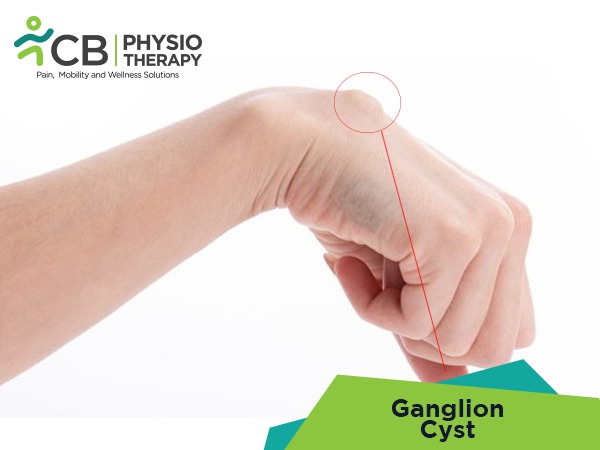
A ganglion is a subcutaneous lump or nodule of accumulated fluid produced from an adjacent joint capsule or tendon sheath. It is most frequently located around the dorsum of the wrist and the fingers. The most common site is along with the extensor carpi radialis brevis because it passes over the dorsum of the wrist joint. It is found especially in the scapholunate area. The size of the cyst can change with time and it can also disappear completely. Eventually, the cyst can expand in size, grow larger with increased wrist activity and the fluid cannot flow freely back into the synovial cavity whereas, with rest, the lump typically becomes smaller.
The cyst can expand in size or grow larger with increased wrist activity and the fluid cannot flow freely back into the synovial cavity whereas, with rest, the lump typically becomes smaller. The causes for its formation are:
- It occurs due to overuse of the wrist joint.
- Common in younger people 15-40 years.
- Women likely between 40- 70 years are commonly affected.
- Common among gymnasts occurs due to repeated stress to the wrist.
- Associated with osteoarthritis.
- Occurs prior to trauma, synovial herniation, and internal derangement.
or the piso triquetral joint, and between the A1 and A2 pulleys. Depending on the location of the cyst, patients may be present with a variety of symptoms such as:
- Dull aching pain,
- Swelling,
- Tingling,
- Tenderness,
- Muscle weakness,
- Visible lump,
- Changes in size,
- Limited movement,
- Tenderness,
- Sensory nerve dysfunction.
Pathology
Ganglion grows out of the tissues surrounding a joint, such as tendon sheaths, ligaments, and joint linings. Inside the ganglion is a thick, slippery fluid, it is similar to the fluid that lubricates the joints.
MRI scans:
Magnetic resonance imaging (MRI) is used to locate a ganglion cyst.
Gangliography:
Gangliography is a method used to evaluate the size and extent of a ganglion cyst. After the injection of a contrast dye, a radiograph is obtained, and the extent of the lesion is easily visible.
Visualized ultrasound:
Ultrasound is used for assessing and detecting the presence of cysts.
X-ray:
X-rays do not show a ganglion cyst, they can be used to rule out other conditions, such as a bone tumor or arthritis.
Aspiration can be one of the treatments, during this method a needle is placed into the cyst, with which the liquid material is drawn out, and then a steroid compound is injected into the empty cavity.
The surgical techniques include excision of the ganglion complex, which consists of a cyst, pedicle, and a cuff of the adjacent joint capsule. After the surgery, the wrist is sometimes kept in a splint to immobilize it.
Medication
Ibuprofen (Advil, Motrin IB, others) or naproxen sodium (Aleve).
NOTE: The medication should not be taken without the doctor's prescription.
The main goal of physiotherapy is to restore the normal movement and full mobility of the hand.
Immobilization:
The wrist is immobilized by using a brace, or compression bandage.
Ultrasound therapy can be used to decrease inflammation.
Laser therapy is used to decrease pain and inflammation.
Active range of motion exercise
Active range of motion exercises are given after surgical treatment to reduce edema relief and scar tissue reduction. Metacarpal, proximal interphalangeal, distal interphalangeal joints, and the wrist joints i.e. radiocarpal and mediocarpal joint are given exercised.
Passive range of motion exercises
Passive range of motion exercises for the hand and wrist are given to initialize the movement of the hand.
Resisted exercise:
Resisted exercises are used to strengthen the muscles of the fingers, this can be done by using squeeze ball, rubber bands, etc.
Proprioceptive neuromuscular facilitation (PNF) exercises:
The finger is kept in a flexion position by the therapist. The patient is then asked to maintain the same position for a few seconds and then asked to relax the finger. He is then asked to repeat.
Tendon gliding exercises:
The patient is asked to do tendon gliding exercises from wrist flexion with finger extension to wrist extension with finger flexion.
Blocking exercises:
The patient is asked to perform blocking exercises by laying the hand palm side up on a table. With the opposite hand, he is asked to grasp and hold the affected finger at the middle section just below the end joint. Then he bends and straightens the finger at the end joint while holding the rest of the finger straight. He is asked to repeat the same exercises for all joints and fingers.
Scar mobilization:
Scar tissue mobilization is used to restore functional mobility, it improves range of motion and also decreases pain. Stretching is done to realign the collagen fibers allowing them to return to normal. This realignment of the collagen fibers helps the tissue to tolerate the forces that are placed on it during the day.
Massage can also be given to mobilize the scar tissue. This can also loosen the adhesions between the scar and the underlying tissue and fascia. Both stretching and massage increases flexibility and ensures proper remodeling takes place.
Don't let Ganglion Cyst decide your day.
Get assessed today — find the cause, get a plan, and know when you'll feel better.