Open today · 8 AM–8 PM · Same-day slots
CB Physiotherapy
Same-day appointments

Ganglion Cyst Treatment Doctors in Bangalore

Whether it's a dull ache, a sharp catch, or pain that keeps coming back — we find the root cause of your Ganglion Cyst and fix it, at a clinic near you or at home.

Precision Care, Proven Recovery
ACCURATE DIAGNOSIS
ROOT CAUSE ASSESSMENT
COMPREHENSIVE RECOVERY PLAN
MILESTONE TRACKING
GOALS ACHIEVED
STAYING ACTIVE
See how it works ↓
Move pain-free Avoid drugs & surgery
4.9 / 5 · 13 Google reviews Verified on Google

Request received!

We'll call you within 10 minutes to confirm your home visit.We'll call you within 10 minutes to confirm your slot.

Chat with us on WhatsApp

Book in 30 seconds

Visit your nearest CB clinic. Tell us your concern and a preferred time — we'll confirm your slot by call within 10 minutes.

Same-day booking by default. We'll confirm your exact slot by call.
+91
No spam · Your number is safe with us
Prefer to talk now? Call +08047093099
Understanding your ganglion cyst

Does this sound like you?

Common triggers include muscle strain, joint stiffness, poor posture and long desk hours. If two or more of these fit, a physiotherapy assessment can identify exactly what's driving it.

  • A dull ache or sharp, burning ganglion cyst that keeps returning
  • Discomfort that worsens with movement, lifting or long sitting hours
  • Morning stiffness that eases as you move
  • Pain that limits work, sport or everyday activities
  • Recurring episodes that keep coming back

Most ganglion cyst improves without surgery or long-term medication — the key is finding the cause first.

⚠ When to seek urgent medical care

Ganglion Cyst rarely signals something serious, but see a doctor immediately if it comes with:

  • Fever, unexplained weight loss, or a history of cancer
  • Numbness or weakness that keeps getting worse
  • Loss of bladder or bowel control
  • Pain after a major fall or accident

Our physios screen for these red flags at every first assessment and refer you to the right doctor if needed.

Assessment-led treatment

How we treat ganglion cyst

We start with an AI-based assessment to find the root cause — then follow a clear, four-phase plan.

Phase 1

Ease the pain

Hands-on therapy and advanced modalities to calm pain and inflammation fast.

Phase 2

Restore movement

Mobility work and posture correction so everyday movement feels normal again.

Phase 3

Build strength

Targeted strengthening that protects you — in-clinic or in our physio gym.

Phase 4

Return to activity

Back to work, sport and life — with a home program that prevents relapse.

Your physiotherapist, with Fizo IQ™

Every recovery, planned and proven

One patient record, stage by stage: your physiotherapist pinpoints the diagnosis, finds the root cause and builds your in-clinic plan — while Fizo IQ™, our AI decision-support engine, tracks every milestone until your goals are met and you leave with an exercise plan to stay active.

Physio Expert @CB with Fizo IQ™ — recovery engine
TRACKING
ACCURATE DIAGNOSIS
L4–L5 disc bulge · nerve-root irritation, pinpointed at the first movement assessment
ROOT CAUSE ASSESSMENT
Poor sitting posture, weak core–hip chain · quietly loading that disc
COMPREHENSIVE RECOVERY PLAN
24 clinic sessions · manual therapy + spinal decompression · guided exercise therapy, reviewed weekly
MILESTONE TRACKING
Sitting pain-free ✓ · stairs ✓ · next: the morning 5 km walk
GOALS ACHIEVED
Pain 7 → 3 in six weeks · back to daily life, moving freely
STAYING ACTIVE
A personalized exercise plan, yours to keep · so the pain doesn't come back
Example recovery journey · every plan is built around you
Move better

Exercises that help with Ganglion Cyst

More exercises →

Make these exercises yours

Get my personalized plan

General guidance only — stop if an exercise increases your pain, and check with your physio before starting a new routine.

Meet your care team

Licensed experts who treat hundreds like you every month

Every CB physio is a qualified BPT/MPT clinician. You don't need to choose one — our lead physiotherapist reviews your case and assigns the specialist best suited to treat it.

Dr. Anup Brahmbhatt, physiotherapist in Jp Nagar Verified

Dr. Anup Brahmbhatt

Physiotherapist · BPT

5.0 (6)
Jp Nagar
cb physiotherapy clinic kanakapura road
11 yrs experience
Ortho Spine Sports Physiotherapy Center
Dr. Bela Brahmbhatt, physiotherapist in Gottigere Verified

Dr. Bela Brahmbhatt

Physiotherapist

4.8 (4)
Gottigere
cb physiotherapy clinic kanakapura road
12 yrs experience
Ortho Spine Sports Physiotherapy Center
Not sure who to see? You don't have to decide. Our lead physiotherapist reviews every case and assigns the physio best suited to it — based on your condition and availability.
Patient stories

Ganglion Cyst recoveries, verified on Google

Rated 4.9 / 5 across 13 verified patient reviews in Bangalore.

Verified

“For sure you all should come to his physiotherapy center. Everyone out here are so polite and helpful....all of my Chiro sessions by Dr. Anup were so helpful to cure my rounded shoulder. I was treated by Dr. Nadia. She was so kind and of course so well skilled. You should try this physiotherapy center for sure...”

SV
Sunil Verma Verified patient · Treated at CB · 3 months ago
Verified

“Thanks so much, Dr. Bella, for your services. I'm so pleased with every session I got from you for my cervical pain. My cervical pain is almost gone, and I can move my neck freely after treatment. recommended for all.”

PM
Pammi Malhotra Verified patient · Treated at CB · 3 months ago
Verified

“Thanks so much Dr.anup for the treatment. My back issue is resolved to some extent after couple of sessions. I had good experience at cb physiotherapy clinic.👍👍”

SM
Srikant Manik Verified patient · Treated at CB · 3 months ago
Verified

“Dr Bela and team has healing hand. She is Best physio and Chiro I ever met thank you. Amazing results in just 1 week of treatment for 10 year old condition.”

PA
Purna Acharya Verified patient · Treated at CB · 4 months ago
Verified

“For sure you all should come to this physiotherapy center. Everyone out here are so polite and helpful....all of my Chiro sessions by Dr. Anup were so helpful to cure my rounded shoulder. He was so kind and ofcourse so well skilled.”

HJ
Himanshu Jain Verified patient · Treated at CB · 4 months ago
Verified

“Dr. Madhusudan is a excellent Physio.He listen, understands the problems of the patient very carefully. He suggests genuine therapy for the patients. I highly recommend this doctor.”

SM
Sudipta Mishra Verified patient · Treated at CB · 4 months ago
Good to know

Ganglion Cyst, answered

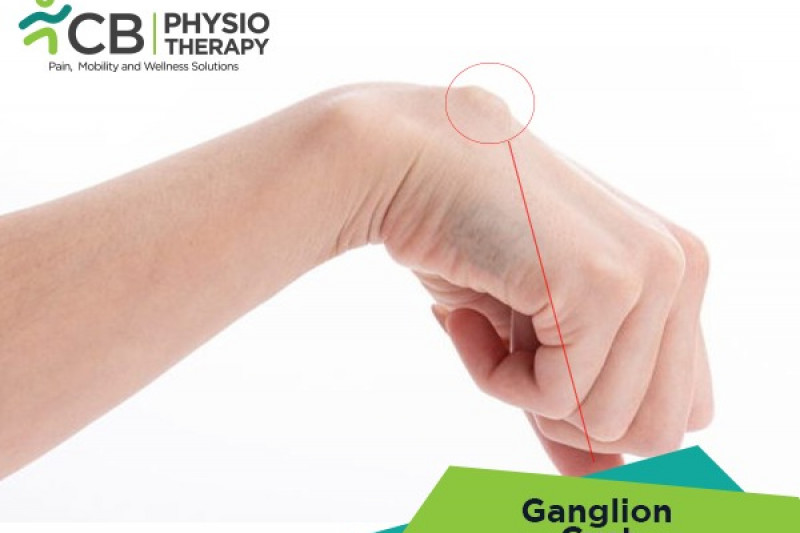
A ganglion is a subcutaneous lump or nodule of accumulated fluid produced from an adjacent joint capsule or tendon sheath. It is most frequently located around the dorsum of the wrist and the fingers. The most common site is along with the extensor carpi radialis brevis because it passes over the dorsum of the wrist joint. It is found especially in the scapholunate area. The size of the cyst can change with time and it can also disappear completely. Eventually, the cyst can expand in size, grow larger with increased wrist activity and the fluid cannot flow freely back into the synovial cavity whereas, with rest, the lump typically becomes smaller.

The cyst can expand in size or grow larger with increased wrist activity and the fluid cannot flow freely back into the synovial cavity whereas, with rest, the lump typically becomes smaller. The causes for its formation are:

  • It occurs due to overuse of the wrist joint.
  • Common in younger people 15-40 years.
  • Women likely between 40- 70 years are commonly affected.
  • Common among gymnasts occurs due to repeated stress to the wrist.
  • Associated with osteoarthritis.
  • Occurs prior to trauma, synovial herniation, and internal derangement.

or the piso triquetral joint, and between the A1 and A2 pulleys. Depending on the location of the cyst, patients may be present with a variety of symptoms such as:

  • Dull aching pain,
  • Swelling,
  • Tingling,
  • Tenderness,
  • Muscle weakness,
  • Visible lump,
  • Changes in size,
  • Limited movement,
  • Tenderness,
  • Sensory nerve dysfunction.

Pathology

Ganglion grows out of the tissues surrounding a joint, such as tendon sheaths, ligaments, and joint linings. Inside the ganglion is a thick, slippery fluid, it is similar to the fluid that lubricates the joints.

MRI scans:

Magnetic resonance imaging (MRI) is used to locate a ganglion cyst.

Gangliography:

Gangliography is a method used to evaluate the size and extent of a ganglion cyst. After the injection of a contrast dye, a radiograph is obtained, and the extent of the lesion is easily visible.

Visualized ultrasound:

Ultrasound is used for assessing and detecting the presence of cysts.

X-ray:

X-rays do not show a ganglion cyst, they can be used to rule out other conditions, such as a bone tumor or arthritis.

Aspiration can be one of the treatments, during this method a needle is placed into the cyst, with which the liquid material is drawn out, and then a steroid compound is injected into the empty cavity.

The surgical techniques include excision of the ganglion complex, which consists of a cyst, pedicle, and a cuff of the adjacent joint capsule. After the surgery, the wrist is sometimes kept in a splint to immobilize it.

Medication

Ibuprofen (Advil, Motrin IB, others) or naproxen sodium (Aleve).

NOTE: The medication should not be taken without the doctor's prescription.

The main goal of physiotherapy is to restore the normal movement and full mobility of the hand.

Immobilization:

The wrist is immobilized by using a brace, or compression bandage.

Ultrasound

Ultrasound therapy can be used to decrease inflammation.

Laser therapy

Laser therapy is used to decrease pain and inflammation.

Active range of motion exercise

Active range of motion exercises are given after surgical treatment to reduce edema relief and scar tissue reduction. Metacarpal, proximal interphalangeal, distal interphalangeal joints, and the wrist joints i.e. radiocarpal and mediocarpal joint are given exercised.

Passive range of motion exercises

Passive range of motion exercises for the hand and wrist are given to initialize the movement of the hand.

Resisted exercise:

Resisted exercises are used to strengthen the muscles of the fingers, this can be done by using squeeze ball, rubber bands, etc.

Proprioceptive neuromuscular facilitation (PNF) exercises:

The finger is kept in a flexion position by the therapist. The patient is then asked to maintain the same position for a few seconds and then asked to relax the finger. He is then asked to repeat.

Tendon gliding exercises:

The patient is asked to do tendon gliding exercises from wrist flexion with finger extension to wrist extension with finger flexion.

Blocking exercises:

The patient is asked to perform blocking exercises by laying the hand palm side up on a table. With the opposite hand, he is asked to grasp and hold the affected finger at the middle section just below the end joint. Then he bends and straightens the finger at the end joint while holding the rest of the finger straight. He is asked to repeat the same exercises for all joints and fingers.

Scar mobilization:

Scar tissue mobilization is used to restore functional mobility, it improves range of motion and also decreases pain. Stretching is done to realign the collagen fibers allowing them to return to normal. This realignment of the collagen fibers helps the tissue to tolerate the forces that are placed on it during the day.

Massage can also be given to mobilize the scar tissue. This can also loosen the adhesions between the scar and the underlying tissue and fascia. Both stretching and massage increases flexibility and ensures proper remodeling takes place.

Ready when you are

Don't let the pain decide your day.

Get assessed today — find the cause, get a plan, and know when you'll feel better.

📞 Call 💬 WhatsApp Book now