
Laser Therapy — How It Works & What It Treats
Also known as Laser Therapy. What Laser Therapy is, how it works and what it treats — explained by CB Physiotherapy's clinical team.
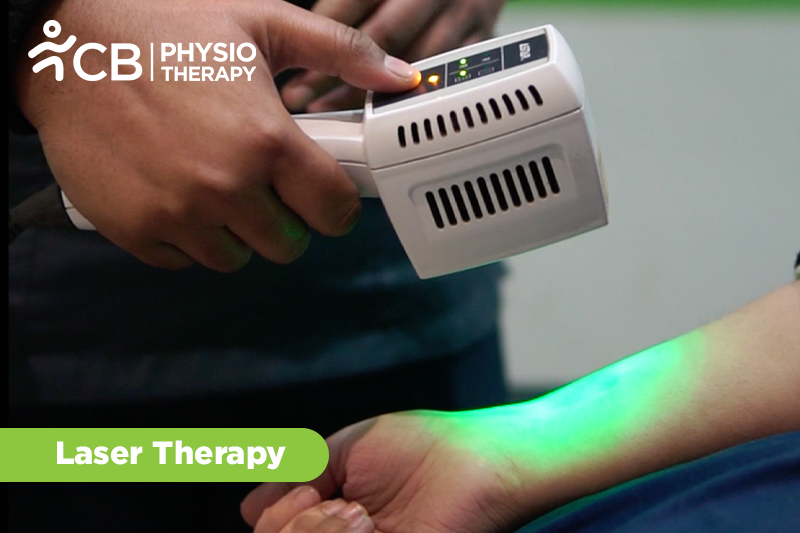
How Laser Therapy works
Laser therapy — low-level laser therapy (LLLT), or photobiomodulation — applies focused light at specific wavelengths to injured tissue. The light penetrates a few centimetres and is absorbed by cellular structures, nudging cells toward better energy production, modulating inflammation and supporting tissue repair. It is painless: most patients feel nothing at all, or the mildest warmth.
It is a genuine adjunct rather than a cure-all: useful for tendinopathies, small-joint arthritis and soft-tissue injuries where calming irritable tissue lets loading work begin sooner. At CB it is prescribed off the back of an assessment, in a defined course with its effect reviewed — not as an open-ended machine ritual.
Laser Therapy — techniques & equipment
What the treatment actually involves — your plan combines the pieces your assessment calls for.
Calibrated therapeutic lasers
Class 3B/4 devices with wavelength and dose set per tissue and depth — parameters matter more than the brand.
Point and scanning application
The probe treats precise points or sweeps small areas — minutes per site, entirely painless.
Dose planning
Energy per point, points per session, sessions per course — planned upfront and reviewed against response.
Eye protection
Goggles for you and the therapist are standard — the one real hazard, fully managed.
Conditions Laser Therapy treats
Where it fits best — your assessment confirms whether it belongs in your plan.
- ✓ Frozen Shoulder →
- ✓ Achilles Tendon Rupture →
- ✓ Carpal Tunnel Syndrome (cts) →
- ✓ Arthritis →
- ✓ Knee Bursitis →
- ✓ Ankle Sprain →
- ✓ Tendon problems — tennis elbow, Achilles, plantar fascia
- ✓ Small-joint pain and osteoarthritis flare-ups
- ✓ Soft-tissue injuries where tissue stays irritable
- ✓ Cases where medicines are unsuitable and drug-free relief matters
What a Laser Therapy session looks like
Step by step — from screening to treatment to what comes next.
Assessment and dose plan
Confirming laser suits your diagnosis, then setting wavelength, energy and course length.
Goggles on, laser applied
Minutes per treatment site; you feel little or nothing — no downtime afterwards.
Paired active work
The session's exercise component continues as tissue settles — laser supports loading, never replaces it.
Course review
Response checked at a set point; the course continues, adapts or stops based on measured change.
Benefits of Laser Therapy
- ✓ Painless, drug-free support for tissue healing
- ✓ No downtime — sessions take minutes
- ✓ Lets loading programs start sooner on irritable tissue
- ✓ Useful where medicines are limited or unsuitable
- ✓ Prescribed in defined, reviewed courses — never open-ended
Safety & contraindications
How CB Physiotherapy delivers Laser Therapy
CB Physiotherapy uses laser the way an adjunct should be used: prescribed off an assessment, dosed with intent, delivered in a defined course, and reviewed against measured change — while the exercise and hands-on work that actually rebuild capacity carry on around it.
If your tissue does not respond within the planned course, the plan changes — on Fizo IQ™, visibly, with you in the conversation.
Real published prices from our physiotherapists for Laser Therapy in India — your exact quote is confirmed after assessment, before you commit. Packages save 10%.
Get Laser Therapy near you
Certified physiotherapists at a clinic near you or at home — same-day slots, assessment-led care.
Request received!
We'll call you within 10 minutes to confirm your home visit.We'll call you within 10 minutes to confirm your slot.
Chat with us on WhatsAppLaser Therapy, answered
CLASSIFICATION BASED ON AEL (Accessible Emission Light)
Class levels 1-4
Class 1- incapable of producing damaging radiation levels
Class 2- power visible lasers (400-700nm wavelength,1nW)
Class 3- medium-power lasers need eye protection
Class 4- high power lasers(more than 500nW)
a. Surgical lasers
b. Hard lasers
c. Thermal lasers
d. Energy (3000-10000 Mw) lasers
Low lasers
a. Medical lasers
b. Soft lasers
c. Subthermal lasers
d. Energy 1-500 mW lasers
e. Therapeutic (cold) lasers produce a maximum output of 90mW or less
f. 600- 1000nm light
High-power lasers
High-power lasers are known as hot lasers because of the thermal response they generate. They are used in surgical cutting, and coagulation conditions, destroy tumors, and coagulate tissues.
Low-power lasers(Cold LASER)
Low power lasers act according to the Arndt-Schulz principle which states that if a stimulus is too weak, no effect is seen. Increased stimulation and optimal dose lead to the optimal effect, while further dose increase leads to a decreased effect and increase leads to inhibition of stimulation is also known as photobiomodulation, used in wound healing and pain management. Low laser is a pain-free, non-invasive method. It has the properties of monochromaticity (same color), collimation (all rays are parallel to each other and do not diverge significantly even over long distances), and coherence (all the light waves are in phase both spatially and temporally).
This procedure is generally safe, effective and non-invasive to use. Although you will feel the laser device touching your skin but the procedure is painless, no vibration or heat is felt. The non-thermal photons of light that are emitted from the Laser, pass through the skin layers. Once the light passes through the layers of the skin and reaches the target area. The body tissue then absorbs the light and initiates a series of events in the cell resulting in the healing of damaged or injured tissue, reduction in pain and inflammation, and an overall reduction in healing time by increasing intracellular metabolism.
1. Reduce pain
2. Increases ATP (Adenosine Triphosphate) which accelerates the repair process of the cell. Some molecules that increase inflammation are reduced and beneficial antioxidants are increased.
3. Faster wound healing. Laser Therapy is effective on open wounds also.
4. Recovery from nerve injury Reduces aches and pains by decreasing nerve sensitivity.
5. It reduces the formation of Fibrous/Scar tissue. It also improves the vascular activity in the body.
6. Promotes bone and cartilage formation
Most commonly used lasers:
1. Helium-neon (He-Ne) In this laser, a mixture of helium gas and neon is used in a pressurized tube. This creates a laser in the red portion of the electromagnetic spectrum with a wavelength of 632.8nm.
2. Gallium arsenide (Ga-As) It uses a diode to produce an infrared invisible laser at a wavelength of 904nm. Diode lasers are composed of semiconductor silicon that is cut and layered. An electrical source is applied to each side and lasing action is produced at the junction of the two surfaces. The surfaces function as partially reflecting surfaces that produce coherent light. This laser is given in pulsed form because of the heat produced by it.
The skin to be treated is cleaned to lower the skin resistance. Gel sprays or water is applied to the skin to lower the resistance
Calculation of doses
The tissue dose is expressed by energy density measured in Joules per cm2. Produced energy is obtained by multiplying the laser output power in milliwatts by exposition time in seconds. E.g. irradiation area is 0.5cm2, 2 J is divided by 0.5cm2. The time of exposure and the dose becomes 4J/CM2.
The dose is most affected by the size of the laser probe, a slim probe will result in high doses of joules per cm2, but this does not mean that energy applied on the tissue is high, although the intensity of the light the energy emitted at the end of the slim probe is high, but not the dose in the depth
Depth of penetration
He-Ne laser energy: Absorbed rapidly in the superficial structures, especially within the first 2-5mm of tissue. The He-Ne has an indirect effect on the tissues up to 8-10mm.
GaAs laser energy: Ga-As laser which has a longer wavelength is directly absorbed in tissues at depths of 1-2cm and has an indirect effect up to 5cm.
Contact technique: Gas is only given for trigger points and around wounds
Non-contact technique: For He-Ne and Ga-As for healing of wounds and for stimulation of wound beds.
1. General Chronic Pain
2. Tennis elbow
3. Plantar fasciitis
4. Shoulder impingement
5. Frozen shoulder
6. Disc herniation
7. Sciatica
8. Pelvic Dysfunction
9. Osteoarthritis of the knee, hip, and ankle
10. Rheumatoid arthritis
11. Tendonitis
12. Tennis Elbow
13. Temporomandibular Joint
14. Diabetic Neuropathy
15. Hip or shouder bursitis
1. Redness: The treated area might appear slightly red, similar to a mild sunburn, but this usually dissipates within a few hours.
2. Tingling or warmth: Some patients may feel a tingling or warm sensation during or after the treatment, which is generally mild and temporary.
3. Skin irritation: In rare cases, there may be a slight irritation or rash at the treatment site, but this is uncommon and typically resolves on its own.
It's important to note that serious side effects are rare, but individuals with certain conditions or medications may need to consult with their healthcare provider before undergoing laser therapy.
Typically, a course of laser therapy might involve multiple sessions scheduled over several weeks. Physiotherapists will assess the progress and adjust the treatment plan accordingly. The frequency of sessions may decrease as the patient experiences improvement. It's essential to follow the therapist's recommendations for the most effective outcomes. Our physiotherapy experts recommend 3 to 4 sessions per week for 20 to 25 minutes for optimum results.
1. Protective Eyewear: Always wear appropriate protective eyewear designed for the specific type of laser being used. This helps prevent accidental exposure to laser radiation, which can be harmful to the eyes.
2. Skin Protection: Use protective measures, such as gloves, to avoid direct skin contact with the laser. This is especially important when treating individuals with compromised skin integrity or infections.
3. Skin Sensitivity: Be cautious when treating individuals with hypersensitivity to light or those with skin conditions. Adjust the laser settings or consider alternative treatments if necessary.
4. Communication: Encourage open communication between the person receiving the treatment and the practitioner. Ensure the patient feels comfortable expressing any concerns or discomfort during the session.·
2. Cancer: Do not use it over the cancerous part of the body.
3. Epileptics: Do not use in epileptic patients.
4. Pregnancy: The laser rays should not reach the fetus.
Ready to start your recovery?
Get assessed today — find the cause, get a plan, and know when you'll feel better.