Verified
Dr. Asif Alam
Physiotherapist · BPT
See clinics, physiotherapists and prices for your city.
Whether it's a dull ache, a sharp catch, or pain that keeps coming back — we find the root cause of your Ganglion Cyst and fix it, at a clinic near you or at home.
Precision Care, Proven RecoveryWe'll call you within 10 minutes to confirm your home visit.We'll call you within 10 minutes to confirm your slot.
Chat with us on WhatsAppCommon triggers include muscle strain, joint stiffness, poor posture and long desk hours. If two or more of these fit, a physiotherapy assessment can identify exactly what's driving it.
Most ganglion cyst improves without surgery or long-term medication — the key is finding the cause first.
Ganglion Cyst rarely signals something serious, but see a doctor immediately if it comes with:
Our physios screen for these red flags at every first assessment and refer you to the right doctor if needed.
We start with an AI-based assessment to find the root cause — then follow a clear, four-phase plan.
Hands-on therapy and advanced modalities to calm pain and inflammation fast.
Mobility work and posture correction so everyday movement feels normal again.
Targeted strengthening that protects you — in-clinic or in our physio gym.
Back to work, sport and life — with a home program that prevents relapse.
One patient record, stage by stage: your physiotherapist pinpoints the diagnosis, finds the root cause and builds your in-clinic plan — while Fizo IQ™, our AI decision-support engine, tracks every milestone until your goals are met and you leave with an exercise plan to stay active.
Make these exercises yours — a CB physio personalizes, doses and tracks your plan week by week.
Get my personalized planGeneral guidance only — stop if an exercise increases your pain, and check with your physio before starting a new routine.
Every CB physio is a qualified BPT/MPT clinician. You don't need to choose one — our lead physiotherapist reviews your case and assigns the specialist best suited to treat it.
Verified
Physiotherapist · BPT
Verified
Physiotherapist · BPT
Verified
Physiotherapist · BPT
Verified
Physiotherapist · BPT
Verified
Physiotherapist · MPT (Orthopaedics)
Rated 5.0 / 5 across 20 verified patient reviews in Ghaziabad.
“मुझे फिजियोथेरेपी करवानी है होम सर्विस आपके पास अवेलेबल है”
“VERY Best physiotherapist and good experience”
“I recently had the pleasure of receiving physiotherapy treatment from Dr. Asif, and I cannot praise his skills and dedication enough. As a physiotherapist, he possesses a unique blend of expertise, compassion, and professionalism that sets him apart from others in his field.”
“I recently had the privilege of being treated by Dr. Asif Alam, and I cannot speak highly enough of his exceptional care and expertise as a physiotherapist. His ability to diagnose and explain the root causes of my issues was truly impressive. He provided me with a clear understanding of my condition His hands-on techniques were precise and effective, providing me with immediate relief and tangible results. He continuously monitored my progress and adjusted the treatment plan accordingly, ensuring that I was on track to a full recovery.”
“I have no words to express how good Dr. Asif was for post-knee rehabilitation. Every session I had was excellent. Day by day, I'm improving. I can walk without support. Thanks so much! All praise for you!🙏”
“Thank you, Dr. shally for your outstanding service!👍🏼”
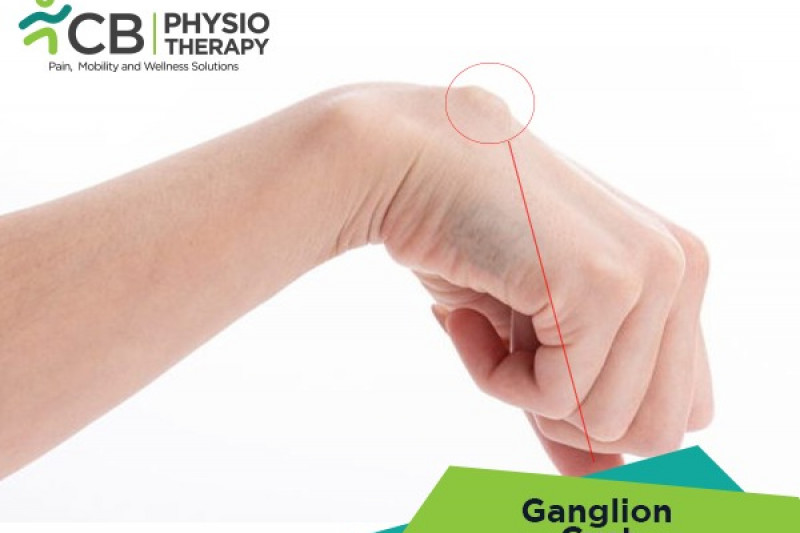
A ganglion is a subcutaneous lump or nodule of accumulated fluid produced from an adjacent joint capsule or tendon sheath. It is most frequently located around the dorsum of the wrist and the fingers. The most common site is along with the extensor carpi radialis brevis because it passes over the dorsum of the wrist joint. It is found especially in the scapholunate area. The size of the cyst can change with time and it can also disappear completely. Eventually, the cyst can expand in size, grow larger with increased wrist activity and the fluid cannot flow freely back into the synovial cavity whereas, with rest, the lump typically becomes smaller.
The cyst can expand in size or grow larger with increased wrist activity and the fluid cannot flow freely back into the synovial cavity whereas, with rest, the lump typically becomes smaller. The causes for its formation are:
or the piso triquetral joint, and between the A1 and A2 pulleys. Depending on the location of the cyst, patients may be present with a variety of symptoms such as:
Pathology
Ganglion grows out of the tissues surrounding a joint, such as tendon sheaths, ligaments, and joint linings. Inside the ganglion is a thick, slippery fluid, it is similar to the fluid that lubricates the joints.
MRI scans:
Magnetic resonance imaging (MRI) is used to locate a ganglion cyst.
Gangliography:
Gangliography is a method used to evaluate the size and extent of a ganglion cyst. After the injection of a contrast dye, a radiograph is obtained, and the extent of the lesion is easily visible.
Visualized ultrasound:
Ultrasound is used for assessing and detecting the presence of cysts.
X-ray:
X-rays do not show a ganglion cyst, they can be used to rule out other conditions, such as a bone tumor or arthritis.
Aspiration can be one of the treatments, during this method a needle is placed into the cyst, with which the liquid material is drawn out, and then a steroid compound is injected into the empty cavity.
The surgical techniques include excision of the ganglion complex, which consists of a cyst, pedicle, and a cuff of the adjacent joint capsule. After the surgery, the wrist is sometimes kept in a splint to immobilize it.
Medication
Ibuprofen (Advil, Motrin IB, others) or naproxen sodium (Aleve).
NOTE: The medication should not be taken without the doctor's prescription.
The main goal of physiotherapy is to restore the normal movement and full mobility of the hand.
Immobilization:
The wrist is immobilized by using a brace, or compression bandage.
Ultrasound therapy can be used to decrease inflammation.
Laser therapy is used to decrease pain and inflammation.
Active range of motion exercise
Active range of motion exercises are given after surgical treatment to reduce edema relief and scar tissue reduction. Metacarpal, proximal interphalangeal, distal interphalangeal joints, and the wrist joints i.e. radiocarpal and mediocarpal joint are given exercised.
Passive range of motion exercises
Passive range of motion exercises for the hand and wrist are given to initialize the movement of the hand.
Resisted exercise:
Resisted exercises are used to strengthen the muscles of the fingers, this can be done by using squeeze ball, rubber bands, etc.
Proprioceptive neuromuscular facilitation (PNF) exercises:
The finger is kept in a flexion position by the therapist. The patient is then asked to maintain the same position for a few seconds and then asked to relax the finger. He is then asked to repeat.
Tendon gliding exercises:
The patient is asked to do tendon gliding exercises from wrist flexion with finger extension to wrist extension with finger flexion.
Blocking exercises:
The patient is asked to perform blocking exercises by laying the hand palm side up on a table. With the opposite hand, he is asked to grasp and hold the affected finger at the middle section just below the end joint. Then he bends and straightens the finger at the end joint while holding the rest of the finger straight. He is asked to repeat the same exercises for all joints and fingers.
Scar mobilization:
Scar tissue mobilization is used to restore functional mobility, it improves range of motion and also decreases pain. Stretching is done to realign the collagen fibers allowing them to return to normal. This realignment of the collagen fibers helps the tissue to tolerate the forces that are placed on it during the day.
Massage can also be given to mobilize the scar tissue. This can also loosen the adhesions between the scar and the underlying tissue and fascia. Both stretching and massage increases flexibility and ensures proper remodeling takes place.

Get assessed today — find the cause, get a plan, and know when you'll feel better.