
Shockwave Therapy — How It Works & What It Treats
Also known as Extracorporeal Shockwave Therapy (ESWT). What Shockwave Therapy is, how it works and what it treats — explained by CB Physiotherapy's clinical team.
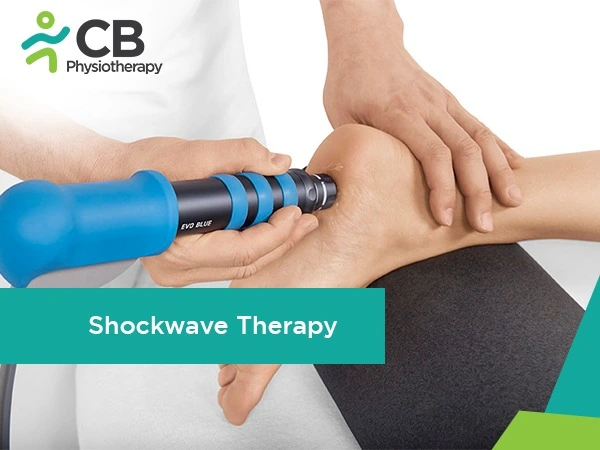
How Shockwave Therapy works
Shockwave therapy (extracorporeal shockwave therapy, ESWT) delivers high-energy acoustic pulses into tissue that has stalled mid-healing — most famously chronic tendon problems like plantar fasciitis, tennis elbow and calcific shoulder tendinopathy. The pulses create controlled micro-stimulation that restarts the local repair response: fresh blood-vessel activity, renewed cell signalling, and a recalibration of over-sensitised nerve endings.
It is best understood as a restart button for chronic, stubborn tendinopathy — not a first-line treatment for fresh injuries. The evidence base is strongest exactly where problems have outlasted months of other care, and it works best when the course is paired with the progressive loading program the restarted tissue needs.
Shockwave Therapy — techniques & equipment
What the treatment actually involves — your plan combines the pieces your assessment calls for.
Radial shockwave device
Acoustic pulses delivered through a handpiece over the affected tendon — a rapid tapping sensation.
Localisation by feedback
The most tender point guides placement — your feedback literally aims the treatment.
Dose and course structure
Pulses, pressure and frequency set per protocol; typically 3–6 weekly sessions with effect building between them.
Paired loading program
Progressive tendon loading alongside the course — the restarted healing needs direction.
Conditions Shockwave Therapy treats
Where it fits best — your assessment confirms whether it belongs in your plan.
- ✓ Frozen Shoulder →
- ✓ Achilles Tendon Rupture →
- ✓ Carpal Tunnel Syndrome (cts) →
- ✓ Tennis Elbow →
- ✓ Osteoarthritis →
- ✓ Plantar Fasciitis →
- ✓ Plantar fasciitis that has outlasted months of other care
- ✓ Tennis or golfer's elbow that keeps relapsing
- ✓ Calcific shoulder tendinopathy
- ✓ Chronic Achilles, hamstring or gluteal tendinopathy
What a Shockwave Therapy session looks like
Step by step — from screening to treatment to what comes next.
Confirm the diagnosis
Shockwave helps specific chronic tendon problems — the assessment confirms yours is one of them.
The treatment
A few thousand pulses over minutes; briefly uncomfortable on the tender spot, quickly over, no anaesthesia needed.
Between sessions
Mild soreness for a day or two is normal; your loading program continues with guidance on flare management.
Course and review
Typically 3–6 weekly sessions; effect often builds for weeks after the course — reviewed at defined checkpoints.
Benefits of Shockwave Therapy
- ✓ A genuine option for tendinopathy that resisted months of care
- ✓ No injections, no anaesthesia, no downtime
- ✓ Sessions take minutes; effect builds over weeks
- ✓ Can help avoid steroid injections or surgery in suitable cases
- ✓ Strong evidence base for its core indications
Safety & contraindications
How CB Physiotherapy delivers Shockwave Therapy
CB Physiotherapy reserves shockwave for the cases it is actually for: chronic tendinopathies with the right story and findings, confirmed at assessment. The course is defined up front, paired with progressive loading, and judged at review checkpoints on measured change — pain scores, load tolerance, function.
If your problem is better served by loading alone, or needs a different route entirely, you will hear that at the assessment — before spending on a course.
Real published prices from our physiotherapists for Shockwave Therapy in India — your exact quote is confirmed after assessment, before you commit. Packages save 10%.
Get Shockwave Therapy near you
Certified physiotherapists at a clinic near you or at home — same-day slots, assessment-led care.
Request received!
We'll call you within 10 minutes to confirm your home visit.We'll call you within 10 minutes to confirm your slot.
Chat with us on WhatsAppShockwave Therapy, answered
Shockwave therapy is a non-invasive treatment that uses low-energy acoustic waves and a coupling medium to transmit sound waves to the tissues for the treatment. These sound waves produce a therapeutic effect causing a decrease in pain thus increasing mobility and functionality by triggering the body's healing process. This modality is more commonly used while treating many musculoskeletal conditions, involving connective tissues such as ligaments and tendons.
- It is a non-invasive method for treating acute and chronic pain
- The treatment does not require anesthesia
- Decreases pain
- Increases mobility
- It has limited side effects
- It is commonly used for the treatment of musculoskeletal conditionsShockwave therapy is cost-effective
- Electrohydraulic Generation Principle
- Piezoelectric Generation Principle
- Electromagnetic Generation Principle
- Radial or Ballistic Generation Principle
Four generating principles in the field of shock waves are Electrohydraulic, Electromagnetic sources, and Piezoelectric sources, and the Radial or Ballistic Generation Principles. The shock wave emitted by most of the equipment has a focal zone that is several centimeters ahead of the generator. The therapeutic effects occur where most sonic waves are gathered in the focal zone, so this is often the action spot. The shock wave is transmitted through the coupling medium into the tissue creating a focal zone. It is necessary to make sure that the target area is in the focal zone during the shock wave treatment.
The energy flux density (EFD) of the focused shock wave used for the treatment of muscular trigger points is between 0.05 and 0.25 mJ/mm2. To avoid tissue damage the shock wave frequency applied to the trigger point should not exceed 4 Hz. Based on the thickness and depth of the muscle, the energy flux density (mJ/mm2) is selected. The energy flux density should be selected in such a way that the pain induced by the shock waves is tolerable for the patient. For the radial shock waves, the same method applies. Extreme caution should be taken while using small surface shock transmitters with a small surface as they generate high peak pressures, to avoid hematomas. The shock wave frequency is 10 to 15 Hz, 15 Hz frequency generally causes less pain. When using a combination of focused and radial shock waves in trigger point therapy, the trigger points are first treated by applying 200 to 400 focused shock waves. It is then followed by the radial shock wave transmitter, applying 3000 to 4000 radial shock waves.
Frequency: It is ideal to give one session per week for most patients. These intervals give muscles time to recover from the irritation, which the patient might feel for up to three days.
The whole process does not produce any thermal effect, it promotes revascularization, stimulating proliferation and osteoprogenitor differentiation, increases leukocyte infiltration, and amplifies growth factor and protein synthesis to stimulate collagen synthesis and tissue remodeling.
APPLICATION
The patient is assessed by the physiotherapist during his first visit to confirm that he is an appropriate candidate for shockwave therapy. The treatment is started by applying gel to the treatment area. The applicator or therapy head is directly placed on the area. A medium of gel is required for the transmission of the waves through the patient's skin. The parameters are set and the intensity is applied according to the comfort of the patient (there is no standardized protocol for the treatment of musculoskeletal conditions). It can be used in conjunction with treatment-specific exercises, and activity modification. Depending on the results, the patient is advised to take the shockwave therapy once a week for 3-6 weeks.
- Acute and chronic muscular pain in cervical and lumbar spine regions.
- Chronic tendinopathy
- Calcific tendinosis of rotator cuff muscles
- Frozen shoulder
- Dorsalgia
- Tennis elbow
- Golfers elbow
- Carpal tunnel syndrome
- Sciatic pain
- Tensor fascia late syndrome
- Iliotibial band friction syndrome
- Greater trochanteric pain syndrome
- Avascular necrosis of the femoral head
- Medial tibial stress syndrome
- Osteoarthritis of the knee
- Patellar tendonitis
- Jumper's knee
- Bursitis
- Metarsalgia
- Tibialis anterior syndrome
- Achilles tendonitis
- Plantar fasciitis
- Heel spurs
- Fracture
- Exostosis of small joints
- Repetitive strain and overuse injuries.
The patient experiences temporary tenderness, soreness, or swelling for a few days after the treatment shockwaves stimulate an inflammatory response. The patient returns to regular activities immediately after the completion of the treatment.
- Pacemakers
- Implanted devices
- Joint replacements
- Pregnancy
- Tumor
- Infection
- Open wounds
- Circulation or nerve disorder.
Ready to start your recovery?
Get assessed today — find the cause, get a plan, and know when you'll feel better.