
Interferential Therapy (ift) — How It Works & What It Treats
Also known as Interferential Therapy (ift). What Interferential Therapy (ift) is, how it works and what it treats — explained by CB Physiotherapy's clinical team.
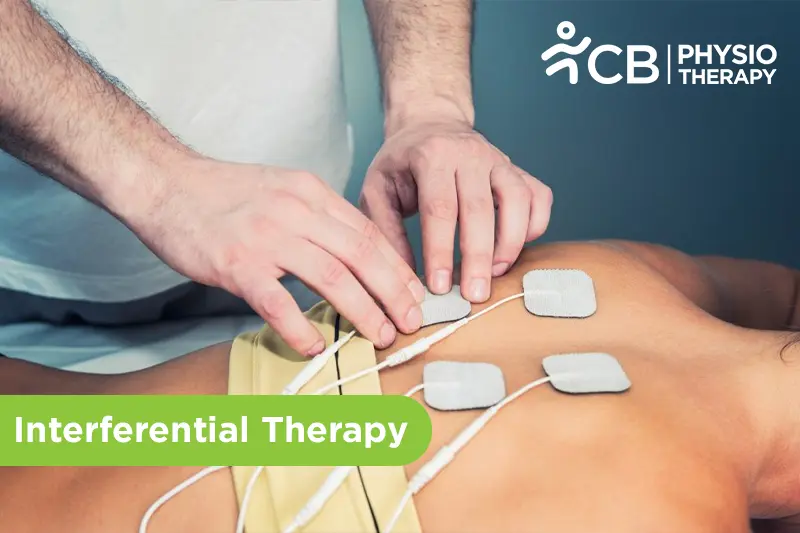
How Interferential Therapy (ift) works
Interferential Therapy (ift) is one of the treatment approaches our physiotherapists draw on — always as part of an assessment-led plan, never as a standalone fix.
What makes any therapy work is the decision-making around it: whether it fits your diagnosis, at what dose, and combined with what. At CB Physiotherapy, Interferential Therapy (ift) is prescribed after a movement assessment and paired with active rehabilitation, because passive treatment alone rarely produces lasting change.
Interferential Therapy (ift) — techniques & equipment
What the treatment actually involves — your plan combines the pieces your assessment calls for.
Assessment before application
Your physiotherapist first confirms Interferential Therapy (ift) suits your diagnosis — and screens for anything that rules it out.
Targeted application
The treatment is applied to the specific structures your assessment identified, at a dose set for your case.
Paired with active rehab
Exercise and movement retraining run alongside, so the gains each session makes are kept.
Reviewed and progressed
Your response is checked every session; the plan is adjusted rather than repeated on autopilot.
Conditions Interferential Therapy (ift) treats
Where it fits best — your assessment confirms whether it belongs in your plan.
- ✓ Cervical Spondylosis →
- ✓ Frozen Shoulder →
- ✓ Achilles Tendon Rupture →
- ✓ Carpal Tunnel Syndrome (cts) →
- ✓ Arthritis →
- ✓ Chondromalacia Patella →
- ✓ Pain or stiffness that has not settled with rest
- ✓ As part of a wider, assessment-led recovery plan
- ✓ When your assessment identifies the specific problem Interferential Therapy (ift) addresses
What a Interferential Therapy (ift) session looks like
Step by step — from screening to treatment to what comes next.
Screening and consent
A quick reassessment and safety screen — you will know what the session involves and why before it starts.
The treatment itself
Interferential Therapy (ift) applied to the targeted area — most patients find sessions comfortable, and you can speak up at any point.
Active follow-through
Exercise or movement work right after, while the treatment effect is fresh.
Response check
What changed and for how long — the answer shapes your next session and the plan.
Benefits of Interferential Therapy (ift)
- ✓ Dosed to your case after a proper assessment
- ✓ Always combined with active rehab, for results that last
- ✓ Available at CB clinics near you — and at home where equipment allows
- ✓ Drug-free support for pain relief and recovery
- ✓ Delivered by certified physiotherapists, never unsupervised
Safety & contraindications
How CB Physiotherapy delivers Interferential Therapy (ift)
You will not walk into CB Physiotherapy and simply receive Interferential Therapy (ift) — you will receive an assessment, and Interferential Therapy (ift) if your case calls for it. That order matters: it is how we make sure every session moves you towards a goal rather than just filling a slot.
Your plan runs on Fizo IQ™ — diagnosis, root cause, milestones, goals — and Interferential Therapy (ift) is combined with hands-on care and exercise as indicated, at a clinic near you or at home where the equipment allows.
Real published prices from our physiotherapists for Interferential Therapy (ift) in India — your exact quote is confirmed after assessment, before you commit. Packages save 10%.
Get Interferential Therapy (ift) near you
Certified physiotherapists at a clinic near you or at home — same-day slots, assessment-led care.
Request received!
We'll call you within 10 minutes to confirm your home visit.We'll call you within 10 minutes to confirm your slot.
Chat with us on WhatsAppInterferential Therapy (ift), answered
It is basically used for the treatment of Chronic, Post Traumatic, and Post-surgical pains. The basic principle involves the utilization of effects of low frequencies (<250pps) without painful or unpleasant side effects. The major advantage of IFT is that it produces effects in the tissue, exactly where required without unnecessary and uncomfortable skin stimulation. This technique is widely used to elicit muscle contraction, promote healing and reduce edema.
The interference field is rotated to an angle of 450 in each direction, the field thus covers a wider area. This is useful in diffuse pathology or if the site of the lesion cannot be accurately localized.
Frequency swings
Some equipment allows a variation in the speed of the frequency swing. A rhythmic mode may be a continuous swing from 0 to 100 Hz in 5-10s and back in a similar time or it may hold for 1-6s at one frequency followed by 1-6s at another frequency with a variable time to swing between the two.
Constant frequency
Some treatments may be carried out with the interference fixed at a certain frequency. Rhythmic frequency is useful if several types of tissues are to be treated at once. A variation in the frequency also overcomes the problem of tissue accommodation where the response of a particular tissue decreases with time.
Frequency sweep
The principle of using the sweep is that the machine is set to automatically vary the stimulation frequency, it uses either pre-set or user-set sweep ranges. The sweep range should be appropriate to the desired physiological effects.
The pattern of the sweep makes a significant difference in the stimulation received by the patient. Most machines offer several sweep patterns:
- Triangular sweep pattern.
- Rectangular Sweep Pattern.
- Trapezoidal Sweep Pattern.
Rectangular sweep is a different stimulation pattern in which the base and top frequencies are set, but the machine then 'switches' between these two specific frequencies rather than gradually changing from one to the other
One will deliver a full range of stimulation frequencies between the set frequency levels and the other will switch from one frequency to the other. The 'trapezoidal' sweep is effectively a combination of these two.
A frequency between 1 and 100 Hz is used to contract the normal innervated muscles. Different types of frequencies cause different contractions, a low frequency, causes a twitch, a frequency between 5 and 20 Hz causes a partial tetany contraction and a frequency from 30 to 100 Hz causes a tetanic contraction. IFT also helps to reduce edema 100Hz frequency promotes vasodilation, thus decreasing edema. And a frequency of 10 Hz activates the musculoskeletal pump, used to promote venous and lymphatic return causing a reduction of edema. The neurons that make up the autonomic nervous system, are small and poorly myelinated like the Aδ and C fibers of the peripheral nervous system and to stimulate the autonomic nervous system, lower frequencies are utilized to increase the blood flow.
- Frequency
- Intensity of current
- Electrode placement
100-150Hz constant or 90-100Hz rhythmic: These frequencies are useful for pain relief, IFT acts on large myelinated fibers in the dorsal horn, blocking off small pain fibers. The higher frequencies have a triggering effect on the endogenous opiates in the mid-brain which inhibit pain.
0-10Hz rhythmic or 10- 50Hz rhythmic: These frequencies are useful for muscle stimulation. They produce stimulation of deep, normally innervated muscle tissue with little sensory stimulation. As the frequency increases the contraction changes from a twitch to a tetanic contraction.
0-100Hz rhythmic: The range of frequencies produces vasodilatation. This is stimulation and relaxation of vessel walls, giving a sinusoidal effect.
Intensity of current
The current is increased till the patient feels tingling, further as accommodation occurs the intensity is increased slowly to the point of muscle stimulation. The duration of treatment varies between 10 - 20 minutes.
Electrode placement
The patient is placed in a comfortable position and the skin is prepared for the treatment. The skin is cleaned, in case of any skin lesion, the area is insulated with petroleum jelly. Vacuum electrodes or pad electrodes are placed accurately at the treatment site and the two pairs of electrodes are positioned so that the crossing point of the two currents is over or within the lesion.
1: Pain Relief in conditions such as causalgia, herpes zoster, and neuralgia.
2: Cervical spondylosis.
3: Osteoarthritis of the knee.
4: Ankylosing spondylitis
5: Rheumatoid arthritis.
6: Frozen shoulder.
7: Disc herniation.
8: Spinal canal stenosis.
9: Muscle Stimulation - prevent muscle wastage, re-education, maintain range of motion stress incontinence
10: Reduction of Edema (Condition involving the excess collection of watery fluid in the cavities or tissues)
11: Muscle injuries
12: Ligamentous injuries
Effects of Interferential Therapy:
1: Reduces pain and inflammation.
2: Increases blood circulation.
3: Causes vasodilation.
4: Removes waste substances from the affected area.
5: Increases metabolic rate.
6: Decreases blood pressure.
7: Treats chronic ligamentous lesions.
8: Cures edema and hematoma.
9: Improves restricted movements of joints.
10: Increases muscle stimulation.
11: Restores the lost movement of muscles.
1: Infective condition
2: Malignancy.
3: Pacemakers.
4: Loss of sensation.
5: Danger of Hemorrhage
6: Large open wounds.
7: Dermatological Conditions.
8: Pregnant Uterus.
9: Arterial disease.
10: Febrile condition.
11: Deep vein thrombosis.
12: During menstruation.
13: Unreliable patient.
14: Fewer.
Ready to start your recovery?
Get assessed today — find the cause, get a plan, and know when you'll feel better.