
Stroke Or Cerebrovascular Accident (cva) — Symptoms, Causes & Treatment
Also known as Stroke Or Cerebrovascular Accident (cva). Causes, symptoms and how physiotherapy treats Stroke Or Cerebrovascular Accident (cva) — without surgery or medicines.
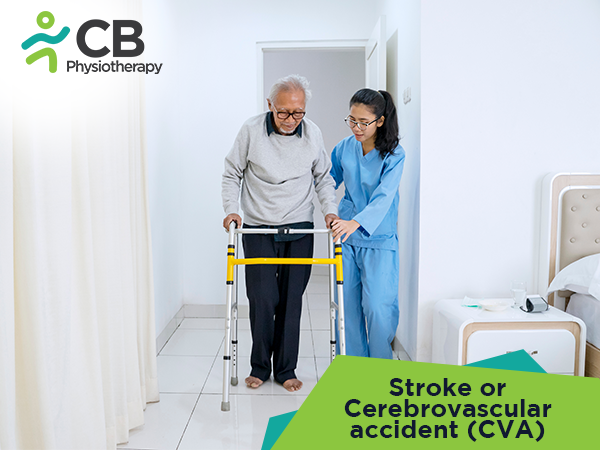
Understanding Stroke Or Cerebrovascular Accident (cva)
Stroke Or Cerebrovascular Accident (cva) affects the nervous system's control of movement — and while the diagnosis itself is made and managed by your doctor, physiotherapy shapes what daily life looks like with it. Strength, balance, walking and everyday tasks can all improve with the right rehabilitation, at almost any stage.
Neuro-rehabilitation works because of neuroplasticity: with repeated, task-specific practice the nervous system re-learns. A structured program targets what matters to you — transfers, walking, stairs, confidence — and measures progress milestone by milestone.
Causes & risk factors of Stroke Or Cerebrovascular Accident (cva)
What commonly drives it — your assessment pins down which of these apply to you.
The underlying neurological event
Conditions like Stroke Or Cerebrovascular Accident (cva) begin in the nervous system — diagnosis and medical management sit with your doctor and neurologist.
Reduced activity after diagnosis
Fear, fatigue and difficulty shrink movement — and inactivity then adds its own layer of weakness and stiffness.
Muscle weakness and tone changes
Altered signals change how muscles fire — some weaken, some tighten — reshaping movement patterns over time.
Balance and confidence
Balance changes raise fall risk, and fear of falling quietly cuts activity further — a loop rehabilitation is designed to break.
When physiotherapy is the right call
If any of these sound like you, an assessment is the right first step.
- ✓ A new diagnosis of Stroke Or Cerebrovascular Accident (cva) and you want a clear rehabilitation start point
- ✓ Daily tasks, walking or stairs are getting harder than they used to be
- ✓ Strength, stamina or balance has visibly dropped
- ✓ You want a structured clinic + home program with measurable milestones
- ✓ Family members need guidance to support you safely
Your treatment journey
Step by step — from your first assessment to a tracked recovery plan.
A detailed first assessment
History, movement testing and strength checks — a focused session to find what is actually driving your Stroke Or Cerebrovascular Accident (cva).
A diagnosis you understand
Your physiotherapist explains the findings in plain language — what is affected, why it happened and what that means for you.
Active, tracked treatment
Hands-on therapy, the right modalities and graded exercise — progressed session by session and tracked on Fizo IQ™.
Prevention, built in
The final phase rebuilds strength and habits so the same problem does not come back — with a home plan you keep.
What recovery looks like
- ✓ More independence in daily tasks
- ✓ Better strength, balance and stamina
- ✓ Fewer setbacks, with red flags monitored
- ✓ A program your family understands and can support
- ✓ Progress measured milestone by milestone on Fizo IQ™
When to see a doctor — red flags
How CB Physiotherapy treats Stroke Or Cerebrovascular Accident (cva)
At CB Physiotherapy, treatment for Stroke Or Cerebrovascular Accident (cva) starts with finding its cause: a structured, physiotherapist-led assessment before anything is prescribed. Your plan then combines hands-on therapy, targeted exercise and the right modalities — delivered at a clinic near you or at home, and coordinated with your doctor where medical care is involved.
Every case runs on Fizo IQ™, our recovery engine: diagnosis, root cause, plan, milestones and goals, tracked session by session. You always know where you are in your recovery — and what comes next.
Exercises that help with Stroke Or Cerebrovascular Accident (cva)
Make these exercises yours — a CB physio personalizes, doses and tracks your plan week by week.
Get my personalized planGeneral guidance only — stop if an exercise increases your pain, and check with your physio before starting a new routine.
Get Stroke Or Cerebrovascular Accident (cva) treatment near you
Certified physiotherapists at a clinic near you or at home — same-day slots, assessment-led care.
Request received!
We'll call you within 10 minutes to confirm your home visit.We'll call you within 10 minutes to confirm your slot.
Chat with us on WhatsAppStroke Or Cerebrovascular Accident (cva), answered
Stroke, an acute onset of neurological dysfunction due to an abnormality in cerebral circulation with resultant signs and symptoms that involve focal areas of the brain. Motor deficits are characterized by paralysis (hemiplegia) or weakness (hemiparesis), typically on the side of the body opposite the side of the lesion.
Stroke can be classified into mild (13-15), moderate (9-12) and severe (3-8) using a Glasgow Coma Scale. Glasgow Coma Scale (GCS) is a neurological scale used to provide a reliable way for the assessment of the patient.
RESPONSE
SCORE
Eye opening
Spontaneously
4
To speech
3
To pain
2
None
1
Verbal response
Oriented
5
Confused
4
Inappropriate
3
Incomprehensible
2
None
1
Motor response
Obeys commands
6
Localizes to pain
5
Withdraws from pain
4
Flexion to pain
3
Extension to pain
2
None
1
Glasgow Coma Scale is the combined score (which ranges from 3 to 15) and the score of each test (E for eye, V for Verbal, and M for Motor). For each test, the value should be based on the best response that the person being examined can provide. The score is expressed in the form "GCS 9 = E2 V4 M3 =2+4+3=9. Patients with scores of 3-8 are usually considered to be in a coma.
· Ischemic stroke, a blood clot that stops the blood from flowing to the brain.
· Hemorrhagic stroke, rupture of the blood vessels in the brain thus spilling of the blood into the surrounding tissues.
· Transient ischemic attack (TIA), temporary blockage of the blood flow to the brain.
All types of stroke can cause similar symptoms as the symptoms are due to the blockage of the blood flow to the brain:
· Weakness of the one side of the body.
· Sudden numbness or pain in any area of the body.
· Decreased sensations.
· Horizontal nystagmus (An involuntary eye movement which may cause the eye to rapidly move from side to side, up and down or in a circle, and may slightly blur vision)
· Lack of coordination.
· Difficulty in swallowing and speaking.
· Difficulty in walking
Ischemic stroke can be experienced by anyone, but there are certain groups who are more prone to stroke attacks:
· Old age over 65.
· Diabetes.
· Hypertension.
· Atherosclerosis.(build-up of fats, cholesterol, and other substances in and on the artery walls)
· Smoking.
· Alcohol consumption.
· Obesity.
Computerized tomography (CT)
The most commonly used imaging technique, an intravenous iodinated contrast dye may be used to enhance the density of intravascular blood.
Magnetic resonance imaging (MRI)
MRI measures nuclear particles as they interact with a powerful magnetic field, greater resolution of the brain and its structural detail is obtained with MRI than with CT.
Positron emission tomography (PET)
It allows imaging of regional blood flow and localized cerebral metabolism, thus used to determine the lesion location.
Cerebral angiography
It is invasive and involves the injection of radiopaque dye into blood vessels with radiography.
Physical examination
History and complete neurological examination help the therapist to access stroke. During a physical examination, your therapist observes and does some neurological examinations like
· Altered sensations
· Vision
· Weakness
· Altered muscle tone
· Abnormal reflexes
· Altered coordination
· Altered motor programming
· Posture, control, and balance
· Speech-language and swallowing
· Perception and cognition
Medication
Anticoagulants, anti-platelets, tissue plasminogen activator, statins. (should be taken as prescribed by the doctor).
Cryotherapy in combination with PROM exercises( exercise done to increase the range of motion of a joint with the assistance of a physiotherapist or a caregiver ) , elevation, and massage or compression wrapping is used to decrease edema, developed due to inactivity or loss of voluntary movements.
Thermotherapy can be used in combination with ROM exercises (exercises done actively to increase the joint range of motion. The exercise is performed by the patient himself, actively without assistance.) with sustained stretching technique (20 – 30minutes).
Neuromuscular Electrical Stimulation (NMES):
Neuromuscular stimulations facilitate voluntary motor control, muscle strength and reduce spasticity.
Techniques used to improve upper extremity control:
· Early mobilization, ROM exercises, and positioning with stimulation of shoulder stabilizers, elbow extensors, wrist, and fingers.
· Weight-bearing activities can be performed in sitting or standing positions, progression to weight shifting, and reaching movements.
· Using techniques of the hold after positioning, push-pull, and modified hold relax technique, slow reversals. The posture can be altered to a more challenging one reaching forward and downward picking up objects off the floor.
· Functional movements like a hand to mouth and hand to opposite shoulder should be included for feeding, bathing and dressing.
Techniques used to improve the lower limb control:
· Activities like bridging, supine knee flexion with a hip extension over the side of the mat or standing, modified plantigrade with knee flexion. Hip adduction during flexion movements of the hip and knee, while hip abduction during extension movements should be done.
· Pelvic control can be promoted through lower trunk rotation activities, forward pelvic rotation during side-lying, supine, modified hook lying with the affected leg pushing off, kneeling, standing, sitting on a Swiss ball, and pelvic shifting.
· Dorsi flexors can be activated in sitting by first having the patient hold and slowly letting the foot move down, then pull the foot up.
· Control of knee function therapist assists controlled, small range flexion and extension movements.
Techniques used to improve balance:
Once initial stability control of body segments is achieved in upright postures, the patient is ready to practice dynamic balance activities.
· The patient is instructed to explore his or her limits of stability through low-frequency weight shifting. The patient learns how to align the Center of gravity within the base of support to maintain upright stability. The patient is trained on an equilibrium board or gymnastic ball.
· Activities like in kneeling patient can perform reaching and cone stacking, sit to stand transitions, turning 360 o and floor to standing transitions, standing while catching or kicking a ball, walking while carrying an object.
Techniques used to improve gait:
Early walking prevents and minimizes the development of indirect impairments e.g DVT, deconditioning.
· One should be careful as it can increase the risk of falls, parallel bars and ambulation aids like Hemi- walkers, quad- canes help in early gait stability and safety.
· Exercises like walking forward, backward, sidewards, and in a crossed pattern.
· Elevation activities, stepping up, stair climbing, step over step, over, and around should be practiced.
Techniques used to improve breathing:
Patients on prolonged bed rest with marked deconditioning, paralysis or dysarthria may experience impaired or shallow breathing patterns.
· Improved chest expansion can be achieved by diaphragmatic, basal, lateral costal expansion breathing.
· Respiratory activities can be combined with movement patterns PNF patterns.
Techniques used to improve facial palsy:
The patient is instructed to purse lips and hold a tongue depressor between the lips.
· Tongue movements in all directions are practiced and can be resisted manually.
· Cheek exercises include practice in puffing, blowing bubbles, and drinking thick liquids through a straw.
· Jaw movements can be stimulated by vibrating or pressing above the upper lip for closure and under the lower lip for opening.
Techniques used to improve feeding:
Food should be positioned at an appropriate height and distance from the patient and should be in the visual field.
Adapted utensils, plate guards, and nonslip mats can be used to assist in the transfer of food to the mouth.
Stroke represents a major health crisis for patients and their families. Family members should regularly participate in therapy sessions to learn exercises and activities, designed to support the patient’s independence. Fall risk factors should be eliminated or minimized. Home modifications should be done for the easy movements of the patient. Patients should be assisted in the resumption of social and recreational activities.
Don't let Stroke Or Cerebrovascular Accident (cva) decide your day.
Get assessed today — find the cause, get a plan, and know when you'll feel better.