
Cerebral Palsy — Symptoms, Causes & Treatment
Also known as Cerebral Palsy. Causes, symptoms and how physiotherapy treats Cerebral Palsy — without surgery or medicines.
Understanding Cerebral Palsy
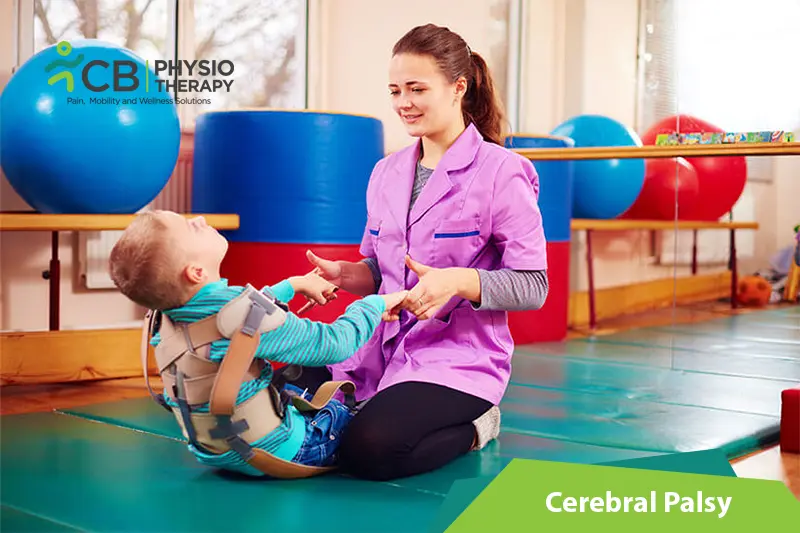
Cerebral Palsy affects the nervous system's control of movement — and while the diagnosis itself is made and managed by your doctor, physiotherapy shapes what daily life looks like with it. Strength, balance, walking and everyday tasks can all improve with the right rehabilitation, at almost any stage.
Neuro-rehabilitation works because of neuroplasticity: with repeated, task-specific practice the nervous system re-learns. A structured program targets what matters to you — transfers, walking, stairs, confidence — and measures progress milestone by milestone.
Causes & risk factors of Cerebral Palsy
What commonly drives it — your assessment pins down which of these apply to you.
The underlying neurological event
Conditions like Cerebral Palsy begin in the nervous system — diagnosis and medical management sit with your doctor and neurologist.
Reduced activity after diagnosis
Fear, fatigue and difficulty shrink movement — and inactivity then adds its own layer of weakness and stiffness.
Muscle weakness and tone changes
Altered signals change how muscles fire — some weaken, some tighten — reshaping movement patterns over time.
Balance and confidence
Balance changes raise fall risk, and fear of falling quietly cuts activity further — a loop rehabilitation is designed to break.
When physiotherapy is the right call
If any of these sound like you, an assessment is the right first step.
- ✓ A new diagnosis of Cerebral Palsy and you want a clear rehabilitation start point
- ✓ Daily tasks, walking or stairs are getting harder than they used to be
- ✓ Strength, stamina or balance has visibly dropped
- ✓ You want a structured clinic + home program with measurable milestones
- ✓ Family members need guidance to support you safely
Your treatment journey
Step by step — from your first assessment to a tracked recovery plan.
A detailed first assessment
History, movement testing and strength checks — a focused session to find what is actually driving your Cerebral Palsy.
A diagnosis you understand
Your physiotherapist explains the findings in plain language — what is affected, why it happened and what that means for you.
Active, tracked treatment
Hands-on therapy, the right modalities and graded exercise — progressed session by session and tracked on Fizo IQ™.
Prevention, built in
The final phase rebuilds strength and habits so the same problem does not come back — with a home plan you keep.
What recovery looks like
- ✓ More independence in daily tasks
- ✓ Better strength, balance and stamina
- ✓ Fewer setbacks, with red flags monitored
- ✓ A program your family understands and can support
- ✓ Progress measured milestone by milestone on Fizo IQ™
When to see a doctor — red flags
How CB Physiotherapy treats Cerebral Palsy
At CB Physiotherapy, treatment for Cerebral Palsy starts with finding its cause: a structured, physiotherapist-led assessment before anything is prescribed. Your plan then combines hands-on therapy, targeted exercise and the right modalities — delivered at a clinic near you or at home, and coordinated with your doctor where medical care is involved.
Every case runs on Fizo IQ™, our recovery engine: diagnosis, root cause, plan, milestones and goals, tracked session by session. You always know where you are in your recovery — and what comes next.
Exercises that help with Cerebral Palsy
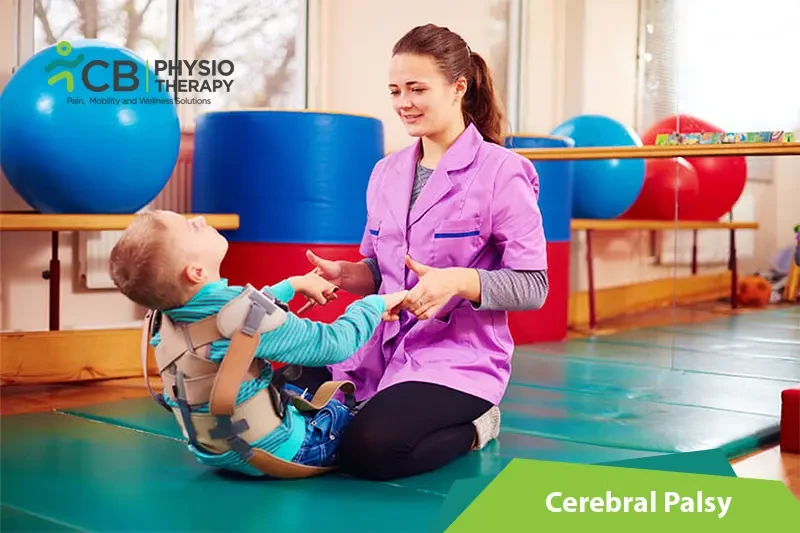
Make these exercises yours — a CB physio personalizes, doses and tracks your plan week by week.
Get my personalized planGeneral guidance only — stop if an exercise increases your pain, and check with your physio before starting a new routine.
Get Cerebral Palsy treatment near you
Certified physiotherapists at a clinic near you or at home — same-day slots, assessment-led care.
Request received!
We'll call you within 10 minutes to confirm your home visit.We'll call you within 10 minutes to confirm your slot.
Chat with us on WhatsAppCerebral Palsy, answered
Cerebral Palsy is a group of permanent disorders that affect the development of movement and causes a limitation of activity. Cerebral palsy causes disability in children. It is the outcome of non-progressive disturbances that occur in an infant's brain or developing fetus. The degree and impairment of functional capabilities vary depending on the cause.
Types: Cerebral palsy is characterized by the type of tone abnormality and motor abnormalities. Types of cerebral palsy are: -
Spastic diplegic: In this, the patient has spasticity and motor difficulties and the arms are more affected than the legs.
Spastic hemiplegic: In this type, the patient is spastic with motor difficulties affecting one side of the body, also the arms are affected more than the legs.
Spastic quadriplegic: The patient with spastic quadriplegia is spastic and motor difficulties affect all the extremities.
Dyskinetic/ hyperkinetic: These patients have involuntary excessive movements, characterized by a combination of contraction of muscles and slow writhing movements.
Dystonic: The patient with dystonia has involuntary sustained muscle contractions causing twisted and repetitive movements.
Ataxic : Ataxic patient has unsteadiness and incoordination and is often hypotonic.
Symptoms of the patient vary from patient to patient depending upon the type of Cerebral palsy the patient has. A few of these symptoms are listed below:
- Micro or Macrocephaly,
- Hypertonia or Hypotonia,
- Spasticity,
- Dystonia,
- Muscle Weakness,
- Fixed joints,
- Abnormal neck or truncal tone,
- Clonus,
- Ankle/foot clonus,
- Wrist clonus,
- Underdeveloped or lacking postural and protective reflexes,
- Hyperreflexia,
- An asymmetrical posture that is the right and left limbs will not mirror one another,
- Excessive irritability,
- Gross motor function defects like the limited capability of accomplishing common physical skills such as walking, running, jumping, and maintaining balance,
- Fine motor function defects like impairment in grasping small objects, holding objects between thumb and forefinger, setting objects down gently, using crayons, turning pages in a book,
- Oral motor impairment can affect breathing, articulating, voicing, apraxia, dysarthria, drooling,
- Difficulty in balancing,
- Unable to sit without support,
- Gait disturbances include limping in-toeing, out-toeing, toe walking, propulsive gait, waddling gait, spastic gait, scissor gait, steppage gait,
- Incoordination.
Pathology:
Cerebral palsy is the damage to the upper motor neuron or lower motor neuron. The pathology in CP is in the upper motor neurons, including neurons in the brain and spinal cord (central nervous system) that control the movement of muscles, causing neurological disorders permanent defects in body movement and muscle coordination that appear in infancy or early childhood.
Damage to fetal or infant's brain or abnormal development causes cerebral palsy. Brain injury causing cerebral palsy. It is non-progressive and can occur in prenatal, perinatal, and postnatal periods. There are many causes for its occurrence such as:
- Prematurity,
- Congenital brain damage,
- Intrauterine infections,
- Intrauterine stroke,
- Chromosomal abnormalities,
- Hypoxic ischemia,
- Infection of the Central nervous system,
- Trauma,
- Anoxic insults,
- Multiple gestations,
- Intrauterine growth restriction,
- Maternal substance abuse,
- Preeclampsia,
- Abnormal placental pathology,
- Perinatal hypoglycemia.
Physical examination:
Physical examination and patient's clinical history combined with neuroimaging and standardized development assessments are used to make a diagnosis of cerebral palsy.
Magnetic resonance imaging (MRI):
Magnetic resonance imaging is the preferred imaging modality as it has higher diagnostic results than CT. For early detection of cerebral palsy, developmental assessments along with neuroimaging should be done.
General Movement Assessment (GM):
Cerebral palsy is detected by checking the quality of spontaneous movement in infants while lying supine. Cerebral palsy patients are characterized by cramped synchronized general movements and the absence of fidgety movements between 9 to 20 months.
Hammersmith Infant Neurological Exam (HINE):
This is a standardized neurological assessment that can be administered between the ages of 2 to 24 months. It consists of 37 items and is divided into 3 sections: physical examination, motor development documentation, and behavior evaluation.
Medication: Benzodiazepine, Gabapentin, Carbidopa- levodopa, Oral and injectable like botulinum toxin, etc.
Note: Medication should not be taken without the doctor's prescription.
Heat therapy helps to relax the spastic muscles and thus helps in attaining more range of motion.
Ultrasound therapy can be used to break the adhesions, increase circulation, and thus helps increase joint movement.
Neuromuscular Electrical Stimulation (NMES):
This involves the application of transcutaneous electrical currents that causes muscle contraction. NMES helps to increase muscle strength by increasing the cross-sectional area of the muscle and by increasing the recruitment of type 2 muscle fibers.
Functional Electrical Stimulation:
It is the application of electrical stimulation during a given task or activity when a specific muscle is expected to be contracting.
Soft tissue mobilization and joint mobilization:
Soft tissue mobilization like kneading of the muscles relaxes the muscles increases blood circulation, breaks the contractures, and thus increases the flexibility of the joints. Joint mobilization breaks the adhesion in fused joints and thus improves the range of motion.
Range of Motion Exercises:
A cerebral palsy patient can benefit from the range of motion exercises. Passive range of motion exercises can be done by the physiotherapist, the therapist moves the patient's body, helping the patient to stretch the muscles, gain motion in their joints, and promote flexibility and circulation. The patient with more muscle control is encouraged to practice range of motion exercises actively, on their own. This may help in strengthening. Even active assistive range of motion exercises are done to help the individual with cerebral palsy to complete the targeted motion. This technique allows the individual to do the movement as much as they can, while the physiotherapist helps them move farther than they can independently to gain more active motion.
Strengthening Exercises:
Strengthening exercises are essential for cerebral palsy because they help to increase muscle power, flexibility, posture, and balance. When these functions are attained, individuals are more likely to be active and perform daily activities on their own.
Constraint-Induced Movement Therapy:
Constraint-Induced Movement Therapy (CIMT) is used in individuals with hemiplegic cerebral palsy to improve the use of an affected upper limb.
Passive stretching:
Passive stretching is a manual application to spastic muscles to relieve soft tissue tightness. Manual stretching may reduce spasticity, increase the range of movements, or improve walking efficiency in children with spasticity. Types of stretching techniques include fast/quick, prolonged, and maintained.
Fast/quick stretching:
This type of stretching is used for facilitation, by producing a short-lived contraction of the agonist's muscle and short-lived inhibition of the antagonist muscle which facilitates a muscle contraction.
Prolonged stretching:
Prolonged stretching normalizes the tone and maintains soft tissue length. This stretching technique may be achieved through several methods which include:
Manual stretching:
Prolonged manual stretch may be applied manually by using machines or splints or by using the effect of body weight and gravity or mechanically.
Weight-bearing:
Weight-bearing helps to reduce the contracture in the lower limb by the use of tilt-tables and standing frames through a prolonged stretch.
Splinting:
Splints and casts are external devices, which are designed to apply, distribute or remove forces to or from the body in a controlled manner.
Serial casting:
Serial casting is a common technique, most effective in managing spasticity-related contractures and increase the range of joint motion.
Functional exercise:
Functional training programs on a treadmill or static bicycles are beneficial for gait and gross motor development but have not been found to have any effect on spasticity.
Gait training:
Gait training focuses specifically on improving walking functions. Many patients with CP may walk with an abnormal gait due to spasticity in the legs. During gait training, the physiotherapist focuses on increasing walking speed or correcting walking patterns. Correcting abnormal gait patterns is essential because the poor form can compromise function and lead to the development of chronic pain. Types of equipment such as walkers, bodyweight supporting treadmills, and parallel bars can be used to help patients practice walking without losing stability. Even orthotics such as a leg brace to support correct musculoskeletal alignment and gently stretch spastic muscles can be recommended.
Hydrotherapy:
Hydrotherapy is a form of physiotherapy that takes place in a pool. The patient is submerged in water so that the person feels weightless, which enables the person to focus on developing the form without straining the joints, also moving against the resistance of the water helps to strengthen the muscles.
The patient should be encouraged to self-care and promote life skills. The patient should be advised to increase social and peer interaction, and maximize independence and self-sufficiency, this, in turn, enhances the quality of life and well-being.
Don't let Cerebral Palsy decide your day.
Get assessed today — find the cause, get a plan, and know when you'll feel better.