Verified
Dr. Anup Brahmbhatt
Physiotherapist · BPT
See clinics, physiotherapists and prices for your city.
Whether it's a dull ache, a sharp catch, or pain that keeps coming back — we find the root cause of your Tennis Elbow and fix it, at a clinic near you or at home.
Precision Care, Proven RecoveryWe'll call you within 10 minutes to confirm your home visit.We'll call you within 10 minutes to confirm your slot.
Chat with us on WhatsAppCommon triggers include muscle strain, joint stiffness, poor posture and long desk hours. If two or more of these fit, a physiotherapy assessment can identify exactly what's driving it.
Most tennis elbow improves without surgery or long-term medication — the key is finding the cause first.
Tennis Elbow rarely signals something serious, but see a doctor immediately if it comes with:
Our physios screen for these red flags at every first assessment and refer you to the right doctor if needed.
We start with an AI-based assessment to find the root cause — then follow a clear, four-phase plan.
Hands-on therapy and advanced modalities to calm pain and inflammation fast.
Mobility work and posture correction so everyday movement feels normal again.
Targeted strengthening that protects you — in-clinic or in our physio gym.
Back to work, sport and life — with a home program that prevents relapse.
One patient record, stage by stage: your physiotherapist pinpoints the diagnosis, finds the root cause and builds your in-clinic plan — while Fizo IQ™, our AI decision-support engine, tracks every milestone until your goals are met and you leave with an exercise plan to stay active.
These symptoms respond well to Tennis Elbow — tap one to see how we treat it near you.
Make these exercises yours — a CB physio personalizes, doses and tracks your plan week by week.
Get my personalized planGeneral guidance only — stop if an exercise increases your pain, and check with your physio before starting a new routine.
Every CB physio is a qualified BPT/MPT clinician. You don't need to choose one — our lead physiotherapist reviews your case and assigns the specialist best suited to treat it.
Verified
Physiotherapist · BPT
Verified
Physiotherapist
Verified
Physiotherapist · BPT
Verified
Physiotherapist · BPT
Verified
Physiotherapist
Rated 4.9 / 5 across 13 verified patient reviews in Bangalore.
“For sure you all should come to his physiotherapy center. Everyone out here are so polite and helpful....all of my Chiro sessions by Dr. Anup were so helpful to cure my rounded shoulder. I was treated by Dr. Nadia. She was so kind and of course so well skilled. You should try this physiotherapy center for sure...”
“Thanks so much, Dr. Bella, for your services. I'm so pleased with every session I got from you for my cervical pain. My cervical pain is almost gone, and I can move my neck freely after treatment. recommended for all.”
“Thanks so much Dr.anup for the treatment. My back issue is resolved to some extent after couple of sessions. I had good experience at cb physiotherapy clinic.👍👍”
“Dr Bela and team has healing hand. She is Best physio and Chiro I ever met thank you. Amazing results in just 1 week of treatment for 10 year old condition.”
“For sure you all should come to this physiotherapy center. Everyone out here are so polite and helpful....all of my Chiro sessions by Dr. Anup were so helpful to cure my rounded shoulder. He was so kind and ofcourse so well skilled.”
“Dr. Madhusudan is a excellent Physio.He listen, understands the problems of the patient very carefully. He suggests genuine therapy for the patients. I highly recommend this doctor.”
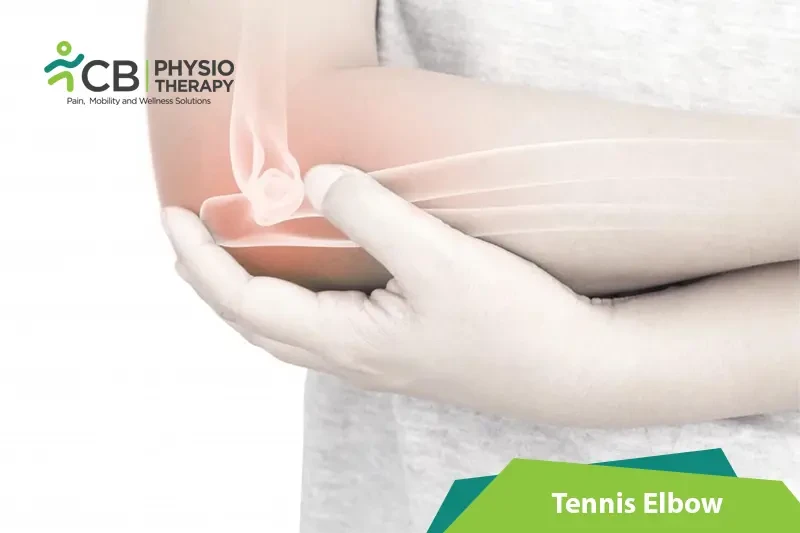
Tennis elbow or lateral epicondylitis is a condition in which the outer part of the elbow becomes sore and tender. It is commonly caused by non inflammatory, chronic degenerative changes (Enthesopathy) in the tendon that attach forearm muscle extensor carpi radialis brevis (ECRB) to elbow. It is most prevalent in middle age and in men more than women. The disease is idiopathic, benign, and self-limiting.
· Pain in the outer part of elbow (lateral epicondyle).
· Point tenderness over the lateral epicondyle – a prominent part if bone on the outside of elbow.
· Pain from gripping and the movements of the wrist, especially wrist extension and lifting movements.
· Pain from activities that use the muscles that extend the wrist (e.g. pouring a container of liquid, lifting with the palm down, sweeping, especially where wrist movement bus required.
· Morning stiffness.
· Symptoms associated with tennis elbow include radiating pain from the outside of the elbow to the forearm and wrist, weakness of forearm, painful grip while shaking hands and not being able to hold relatively heavy items in the hand.
Tennis elbow is often an overuse injury primarily from repetitive strain from tasks and activities that involve loaded and repeated gripping and/or wrist extension. It historically occurs in tennis players but can result from any sports that requires repetitive extension of wrist, radial deviation, and/or forearm supination.
James Cyriax, 'father of orthopedic medicine', proposes one explanation of how tennis elbow may come about. The hypothesis states that there are microscopic and macroscopic tears between the common extensor tendon and the periosteum of the lateral humeral epicondyle. An operation conducted in this study showed that 28 out of 39 patients showed tearing at the tendon cuff.
To diagnose tennis elbow, the physician performs a battery of tests in which he places pressure on affected area while asking the patient to move the elbow, wrist and fingers.
X-rays can confirm and distinguish possibilities of existing causes of pain that are unrelated to tennis elbow, such as fracture or arthritis.
MRI screening can confirm excess fluid and swelling in the affected region in the elbow, such as the connecting point between the forearm bone and the extensor carpi radialis brevis.
Diagnosis is made by clinical signs and symptoms that are discrete and characteristic. With the elbow fully extended, the patient feels points of tenderness over the affected point on the elbow. There is also pain with passive wrist flexion and resistive wrist extension (Cozen’s test).
The management approach of tennis elbow is known as Lateral Epicondyle Tendinopathy, is adapted from general principles of Tendinopathy rehabilitation. For the benefit of achieving long term goals and to meet individuals need, rehabilitation should be a multi-modal perspective. This includes education, exercise, tissue loading management, manual therapy, steroid injection and taping.
· Patient education: Educating patients on their condition, prognosis, management options and self-management may be effective with long term if used in combination with other measures for the management of Tennis elbow.
Smoking, high consumption of processed and fatty food and obesity can delay recovery.
· Exercises: Exercise for Tendinopathy rehabilitation is eccentric contraction. They are considered to be an effective measure for tendon overuse injuries.
Gradual progression of exercise is essential to increase tendon tolerance to loads. The following are the different ways to progress your exercise;
Elbow and forearm position: begin with flexed elbow and forearm in supination, then progress by increase elbow extension angle.
Fingers flexion vs extension: Beginning with fingers in flexion, then progressing to extension to load the long extensors.
. Adding weights: whether by an exercise band or dumbbells.
. Weight bearing exercises.
· Load management: Reduction of load on the tendon is an effective management strategy which has to go hand in hand with building tissue resilience to allow for gradual progression to target load by training the mechanical properties of the tendon. A good way of altering the load is to ask patients to work under the pain threshold and engage them in exercises that load the tendon below the level of exaggerated pain.
· Manual therapy: Mobilization with movement can be utilized with other measures to reduce pain and facilitate exercise. Mulligan’s mobilization with movement in TE has proved to be effective.
· Steroid injection: Corticosteroid injection has good outcome for short term use only (only 6 weeks). It’s long term use resulted in high recurrence. However, the short-term benefit of pain relief can be sought to encourage patient’s engagement with exercise program.
· Taping: Taping has a good placebo pain relief effect and pain-free grip strength in patients with chronic tennis elbow. Studies support that a combination of kinesio tape and exercise is very effective.

Get assessed today — find the cause, get a plan, and know when you'll feel better.