Dr. Shafiya
Physiotherapist
See clinics, physiotherapists and prices for your city.
Whether it's a dull ache, a sharp catch, or pain that keeps coming back — we find the root cause of your Shoulder And Arm Fractures and fix it, at a clinic near you or at home.
Precision Care, Proven RecoveryWe'll call you within 10 minutes to confirm your home visit.We'll call you within 10 minutes to confirm your slot.
Chat with us on WhatsAppCommon triggers include muscle strain, joint stiffness, poor posture and long desk hours. If two or more of these fit, a physiotherapy assessment can identify exactly what's driving it.
Most shoulder and arm fractures improves without surgery or long-term medication — the key is finding the cause first.
Shoulder And Arm Fractures rarely signals something serious, but see a doctor immediately if it comes with:
Our physios screen for these red flags at every first assessment and refer you to the right doctor if needed.
We start with an AI-based assessment to find the root cause — then follow a clear, four-phase plan.
Hands-on therapy and advanced modalities to calm pain and inflammation fast.
Mobility work and posture correction so everyday movement feels normal again.
Targeted strengthening that protects you — in-clinic or in our physio gym.
Back to work, sport and life — with a home program that prevents relapse.
One patient record, stage by stage: your physiotherapist pinpoints the diagnosis, finds the root cause and builds your in-clinic plan — while Fizo IQ™, our AI decision-support engine, tracks every milestone until your goals are met and you leave with an exercise plan to stay active.
These symptoms respond well to Shoulder And Arm Fractures — tap one to see how we treat it near you.
Top 5 Exercises For Shoulder And Arm Fractures
Steps & precautions →
Top 5 Exercises For Frozen Shoulder
Steps & precautions →
Make these exercises yours — a CB physio personalizes, doses and tracks your plan week by week.
Get my personalized planGeneral guidance only — stop if an exercise increases your pain, and check with your physio before starting a new routine.
Every CB physio is a qualified BPT/MPT clinician. You don't need to choose one — our lead physiotherapist reviews your case and assigns the specialist best suited to treat it.
Physiotherapist
Verified
Physiotherapist
Rated 5.0 / 5 across 23 verified patient reviews in Jammu And Kashmir.
“Received treatment at Cb Anantnag clinic where Dr. Athar treated me she was highly skilled and professional. Her treatment approach is effective, and I noticed significant improvement in my knee pain within a short time. I highly recommend her for quality physiotherapy care. in Anantnag”
“Excellent physiotherapist, Dr. Athar! Her expertise and customized care assisted me in recovering swiftly. from back issue, I strongly recommend her..”
“I had an excellent experience with Dr. Shafiya. My back pain recovery was made easier and less stressful thanks to her knowledge and kind attitude. Thank you for your incredible care. Doctor Shafiya.”
“Dr. Shafiya is an excellent physiotherapist! Her expertise, concern, and dedication enabled me to heal fast and painlessly. I definitely recommend her to anyone looking for efficient physiotherapy treatment.”
“Dr. Athar un Nisa is a wonderful physical therapist who honestly cares about her patients. She devised a treatment regimen that helped me restore mobility and strength following my injury. Her treatment sessions were quite successful and motivational. I am incredibly appreciative for her effort and support.”
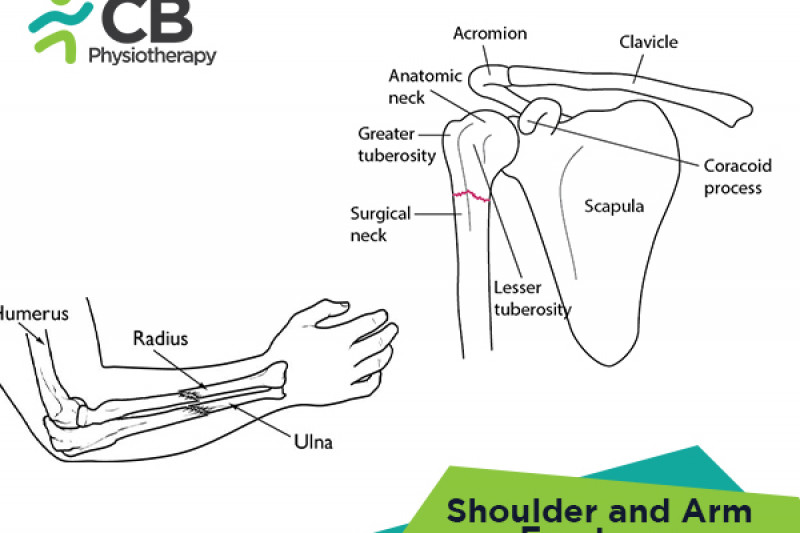
The shoulder joint connects the arm to the body. The shoulder bones include the humerus, scapula, and clavicle. The upper end of the humerus has a ball-like shape that connects with the glenoid. Problem with any part of the shoulder can create difficulty with its function.
TYPES OF SHOULDER AND ARM FRACTURE
Some types include:
· Clavicle Fractures: Most common shoulder fracture, which frequently occurs due to a fall.
· Scapula Fractures: This type of fracture rarely occurs. They occur due to high-energy trauma such as a far fall or motor vehicle accidents.
· Proximal humerus fractures: This type of fracture occurs in the upper part of the humerus. There can be sometimes simple (comminuted) fractures or cracks in the bone but they are not moved much from their normal position and occur close to the shoulder joint and can be located at different levels.
· Humerus shaft fracture: Humerus shaft fracture is the one that occurs at the mid-portion of the upper arm.
A broken arm is a common injury and the causes for the fracture are usually:
Symptoms vary depending on the type of fracture, it may include:
Pathology
A bone fracture is a complete or incomplete discontinuity of bone caused by a direct or indirect force.
X-rays
X-ray images reveal the location of a fractured bone. Also helps to determine whether the break is through the bone or just affects the surface.
Computed tomography scan
CT scan reveals that where the fracture has occurred or whether the pieces of bones have separated from each other or not.
MRI Scan
If a shoulder or arm fracture is severe, it is suspected that the injury has affected nearby tendons, ligaments, or nerves. It helps to take detailed images of the soft tissue and also reveals whether there are torn or strained ligaments or tendons. The scan also indicates whether the nerve is getting compressed by the bone fragment.
Surgery involves internal fixation like screws, wires, or plates, often done if the glenoid is injured if the bone is broken into pieces and is out of place. Splints or casts are used for immobilization. Mobilization with physiotherapy is begun immediately after surgery once it is pain-free. Immediately after surgery, elbow exercises are started, while shoulder exercises may be delayed for a few weeks. The physiotherapy treatment plan depends upon the location and severity of the fracture and also upon the patient's activity. The recovery depends upon the use of physiotherapy to assist in improving motion and strength.
Medication
Codeine, Acetaminophen, Tylenol, Cetafen, etc
Note: Medication should be taken under the prescription of the doctor.
Immobilization
Shoulder immobilizer or sling with no shoulder mobility for the first two weeks. For comfort and arm, support patient is usually given a sling.
Cryotherapy is given to decrease the swelling.
Range of motion exercises
Physiotherapy is started by recommending weekly exercises to slowly increase the shoulder range of motion. Once the cast or sling is removed, though it may take several weeks or months for the broken arm to heal completely, physiotherapy is started. Physiotherapy involves gradually increasing the activities to restore joint motion, muscle strength, and flexibility. Rehabilitation will continue until the muscles, ligaments and other soft tissues perform normally.
Exercises to move the shoulder joint through its full range of motion, such as Codman exercises (pendulum exercises), even if the fractured arm is in a sling, range of motion exercises should be started.
Strengthening exercises
Finger movements and static contractions for muscles working over the immobilized joints should be started immediately and should be continued throughout the period.
Functional exercises
These exercises are done to meet the patient's needs during home, work, leisure. In preparing a patient to return to work, the therapist trains in a way that the patient may have to work all day according to the type of work involved e.g. heavy laboring, industrial work on a production bench requiring repetitive movements of the hand or foot or both.

The patient's cooperation is necessary for the rehabilitation process. The patient must complete range of motion, strengthening, and other exercises prescribed by the physiotherapist daily.
Get assessed today — find the cause, get a plan, and know when you'll feel better.