
Cubital Tunnel Syndrome — Symptoms, Causes & Treatment
Also known as Cubital Tunnel Syndrome. Causes, symptoms and how physiotherapy treats Cubital Tunnel Syndrome — without surgery or medicines.
Understanding Cubital Tunnel Syndrome
Cubital Tunnel Syndrome is one of the conditions our physiotherapists treat most often — and one of the most treatable when the actual driver is found. Two people with Cubital Tunnel Syndrome rarely share the same underlying cause, which is why one-size-fits-all treatment so often disappoints.
What matters clinically is the pattern: how it started, what makes it better or worse, and how it behaves through the day. That pattern — mapped in a structured assessment — tells us which structures are involved and which treatment will actually move the needle.
Causes & risk factors of Cubital Tunnel Syndrome
What commonly drives it — your assessment pins down which of these apply to you.
Old injuries and compensations
A previous injury that never fully rehabilitated often leaves a movement pattern that overloads something else.
Sudden spikes in activity
A new sport, a new gym program, a long trek — tissue adapts to gradual change and protests when change is sudden.
Muscle strain and overload
A sudden lift, an awkward movement or simply more load than the tissues were prepared for — the most common trigger.
Posture and long static hours
Desks, driving and screens keep the same structures loaded for hours at a stretch — comfortable at first, aching later.
Joint stiffness and age-related change
Joints that move less start to hurt more; age-related wear is normal, but painful stiffness is not something to simply accept.
When physiotherapy is the right call
If any of these sound like you, an assessment is the right first step.
- ✓ Cubital Tunnel Syndrome that keeps returning or hasn't settled within two weeks
- ✓ Pain or stiffness that limits work, sleep or daily activities
- ✓ You want to avoid long-term painkillers — or surgery has been mentioned
- ✓ You've been diagnosed with Cubital Tunnel Syndrome and told to "rest and see"
- ✓ Movement feels restricted, weak or guarded compared to before
Your treatment journey
Step by step — from your first assessment to a tracked recovery plan.
A detailed first assessment
History, movement testing and strength checks — a focused session to find what is actually driving your Cubital Tunnel Syndrome.
A diagnosis you understand
Your physiotherapist explains the findings in plain language — what is affected, why it happened and what that means for you.
Active, tracked treatment
Hands-on therapy, the right modalities and graded exercise — progressed session by session and tracked on Fizo IQ™.
Prevention, built in
The final phase rebuilds strength and habits so the same problem does not come back — with a home plan you keep.
What recovery looks like
- ✓ Care without long-term medicines — at a clinic near you or at home
- ✓ Relief that comes from treating the cause, not masking it
- ✓ A clear diagnosis and a timeline you can plan around
- ✓ Strength and movement rebuilt, not just pain reduced
- ✓ Lower chance of recurrence, with a prevention plan
When to see a doctor — red flags
How CB Physiotherapy treats Cubital Tunnel Syndrome
We treat Cubital Tunnel Syndrome the way we treat everything: assessment first, plan second, treatment third. It sounds obvious, but it is the difference between sessions that fill a slot and sessions that move you towards a goal. Care is delivered by certified physiotherapists at a clinic near you or at home.
Your whole journey is tracked on Fizo IQ™ — the diagnosis, the root cause, the milestones and the goals — so progress is measured, not guessed, and the plan adapts the moment your response calls for it.
Exercises that help with Cubital Tunnel Syndrome
Make these exercises yours — a CB physio personalizes, doses and tracks your plan week by week.
Get my personalized planGeneral guidance only — stop if an exercise increases your pain, and check with your physio before starting a new routine.
Get Cubital Tunnel Syndrome treatment near you
Certified physiotherapists at a clinic near you or at home — same-day slots, assessment-led care.
Request received!
We'll call you within 10 minutes to confirm your home visit.We'll call you within 10 minutes to confirm your slot.
Chat with us on WhatsAppCubital Tunnel Syndrome, answered
Cubital tunnel syndrome or ulnar neuritis or ulnar nerve compression occurs when the ulnar nerve, which passes through the cubital tunnel on the inside of the elbow, is injured, compressed, and becomes inflamed, and irritated. The cubital tunnel is the space behind the medial epicondyle, where the ulnar nerve runs.
In many cases, the cause is not known. Cubital tunnel syndrome can occur due to the following reasons:
- When a person often bends or leans on the elbow.
- Constant pulling, lifting, reaching, may be one of the reasons.
- Arthritis, bone spurs, and previous fractures or dislocations of the elbow.
- Pressure to the nerve
- Elbow bent for a prolonged period.
- Stretching of the ulnar nerve
- Diabetes
- Fluid retention during pregnancy
The symptoms may vary from person to person, but the most common symptoms of cubital tunnel syndrome may include:
- Pain that feels a lot like a hit to the "funny bone" in the elbow.
- Numbness
- Hand pain
- Weak grip
- Aching pain
- Pain is most felt when the elbow is bent, such as while talking on the phone.
- Loss of sensation
- Clumsiness due to muscle weakness
- Aches on side of the elbow
- Difficulty bending or straightening fingers
Pathology
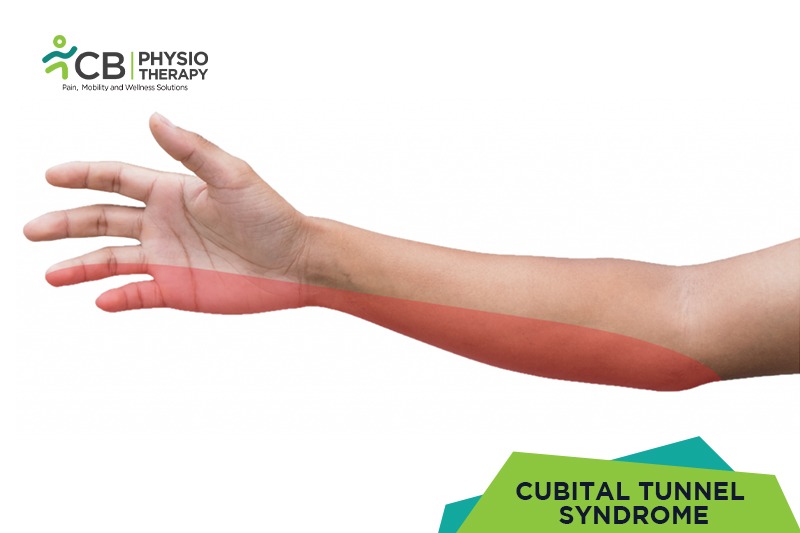
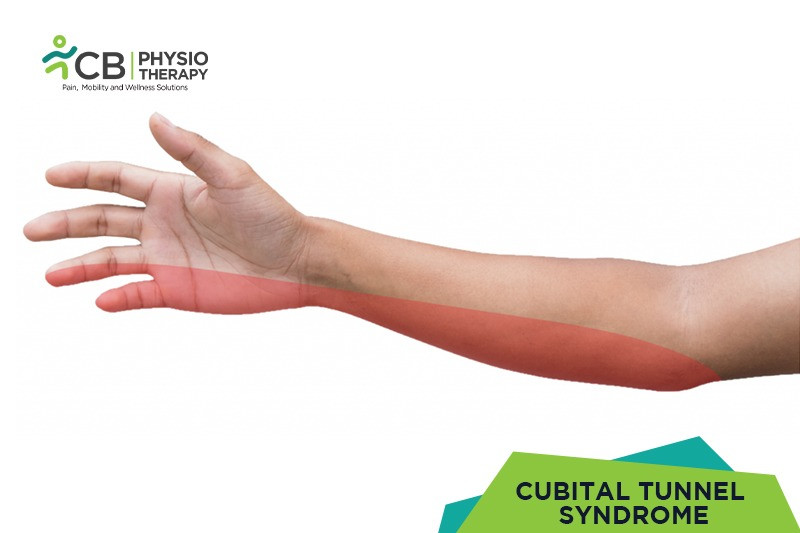
Cubital tunnel syndrome is neuropathy of the ulnar nerve which causes shooting pain and numbness along the medial side of the forearm and the medial half of the 4th digit and the 5th digit, caused by compression of the ulnar nerve at the elbow region.
Nerve conduction test:
This test is used to find out the conduction of the signal down the nerve to check if there is a compression of the nerve.
Electromyogram (EMG:
This test checks muscle and nerve function. It may be also used to test the forearm muscles controlled by the ulnar nerve. Any problems in the muscles indicate that there is a problem with the ulnar nerve.
X-ray:
X-ray helps to check the bones of the elbow and see if there is any bone spur or arthritis in the elbow.
Medication: Non-steroidal anti-inflammatory medications (NSAIDs), Anti-inflammatory medicines - ibuprofen or naproxen, steroid injections.
NOTE: Medication should not be taken without the doctor's prescription.
Non- surgical treatment
Cubital tunnel syndrome can be treated by non-surgical treatment with rest and medicines to help with pain and inflammation. Activities that aggravate the condition, such as bending the elbow should be stopped. Exercises may help too.
Surgical Treatment
If Non-surgical treatments are failed surgical treatment is the other option. The surgery may involve removing a small part of the bone or releasing the nerve or moving the nerve to the front part of the elbow to relieve the pressure. Surgical treatment includes the following procedures:
- Cubital Tunnel Release Surgery
- Ulnar Nerve Anterior Transposition Surgery
Physiotherapy is one of the most common forms of treatment for cubital tunnel syndrome treatment. It helps to relieve pressure off of the elbow and ensure light movements to prevent any strain to it and is usually recommended after surgery. The physiotherapist recommends exercises and techniques to reduce the symptoms of cubital tunnel syndrome and helps to develop a treatment plan that meets the specific needs.
Immobilization:
An Elbow brace or splint is worn at night to reduce irritation and limit movement. For protection, an elbow pad can be used to protect against chronic irritation from hard surfaces.
Apply cold compresses to the affected area for 5-10 minutes, multiple times daily. Cold packs can help relieve pain in the affected area and also enhance the process of healing.
Heat therapy compresses help improve blood flow in the affected area, and thus alleviate pain and speed up recovery.
Massage therapy
Massage therapy can be effective for cubital tunnel syndrome, it may help in managing the symptoms of the syndrome.
Manipulation
Joint manipulation helps to manage and alleviate symptoms.
Range of motion exercises
Range of motion exercises help reduce the pressure and improve elbow function. The patient is asked to relax the arm while not using it.
Light free weight exercises
Flexion and extension of the elbow with weight in hand and other simple elbow range of motion exercises with dumbbells and weights.
Nerve gliding exercises
Nerve gliding techniques are the most commonly recommended exercises for cubital tunnel syndrome. This technique helps to stretch the ulnar nerve and also encourages movement.
Don't let Cubital Tunnel Syndrome decide your day.
Get assessed today — find the cause, get a plan, and know when you'll feel better.