Varicose Veins — Symptoms, Causes & Treatment
Also known as Varicose Veins. Causes, symptoms and how physiotherapy treats Varicose Veins — without surgery or medicines.
Understanding Varicose Veins
Varicose Veins affects people differently, and the right care starts with understanding how it affects you. Its day-to-day impact — on movement, strength, energy and confidence — is where physiotherapy does its work.
Our role in Varicose Veins is practical: protect and rebuild movement and daily function with a plan set after a careful assessment, in coordination with your doctor wherever medical management is involved. No two plans look the same, because no two cases behave the same.
Causes & risk factors of Varicose Veins
What commonly drives it — your assessment pins down which of these apply to you.
More than one possible driver
Varicose Veins can have several contributing factors — a careful history and physical assessment separate them rather than guessing.
Reduced movement and deconditioning
Whatever the trigger, less movement quickly adds weakness and stiffness of its own — usually the most reversible part.
Daily-life load and habits
Work posture, repeated tasks, sleep and stress all shape how a condition behaves day to day.
General health and history
Overall health, previous injuries and existing conditions influence both the picture and the plan — the assessment takes all of it in.
When physiotherapy is the right call
If any of these sound like you, an assessment is the right first step.
- ✓ A new diagnosis of Varicose Veins and you want a clear rehabilitation start point
- ✓ Daily tasks, walking or stairs are getting harder than they used to be
- ✓ Strength, stamina or balance has visibly dropped
- ✓ You want a structured clinic + home program with measurable milestones
- ✓ Family members need guidance to support you safely
Your treatment journey
Step by step — from your first assessment to a tracked recovery plan.
A detailed first assessment
History, movement testing and strength checks — a focused session to find what is actually driving your Varicose Veins.
A diagnosis you understand
Your physiotherapist explains the findings in plain language — what is affected, why it happened and what that means for you.
Active, tracked treatment
Hands-on therapy, the right modalities and graded exercise — progressed session by session and tracked on Fizo IQ™.
Prevention, built in
The final phase rebuilds strength and habits so the same problem does not come back — with a home plan you keep.
What recovery looks like
- ✓ More independence in daily tasks
- ✓ Better strength, balance and stamina
- ✓ Fewer setbacks, with red flags monitored
- ✓ A program your family understands and can support
- ✓ Progress measured milestone by milestone on Fizo IQ™
When to see a doctor — red flags
How CB Physiotherapy treats Varicose Veins
We treat Varicose Veins the way we treat everything: assessment first, plan second, treatment third. It sounds obvious, but it is the difference between sessions that fill a slot and sessions that move you towards a goal. Care is delivered by certified physiotherapists at a clinic near you or at home.
Your whole journey is tracked on Fizo IQ™ — the diagnosis, the root cause, the milestones and the goals — so progress is measured, not guessed, and the plan adapts the moment your response calls for it.
Exercises that help with Varicose Veins
Make these exercises yours — a CB physio personalizes, doses and tracks your plan week by week.
Get my personalized planGeneral guidance only — stop if an exercise increases your pain, and check with your physio before starting a new routine.
Get Varicose Veins treatment near you
Certified physiotherapists at a clinic near you or at home — same-day slots, assessment-led care.
Request received!
We'll call you within 10 minutes to confirm your home visit.We'll call you within 10 minutes to confirm your slot.
Chat with us on WhatsAppVaricose Veins, answered
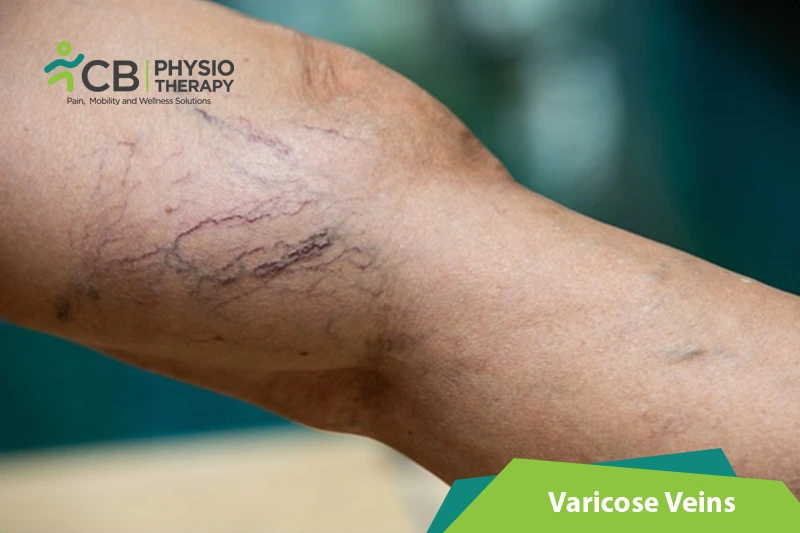
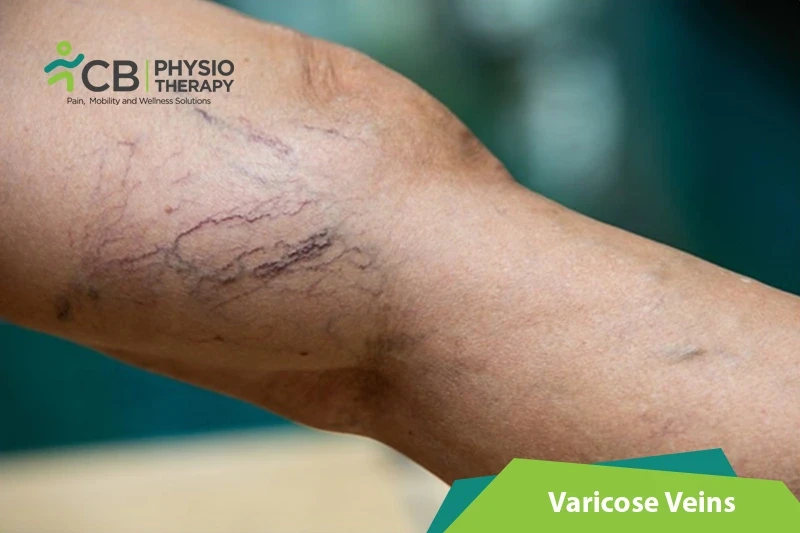
Varicose veins are swollen and twisted blood vessels that bulge under the skin surface. Though any superficial vein may become blue or purple and bulged, but the veins most commonly affected are those in the legs, feet, and ankles. Spider veins, which may surround the varicose veins, are smaller red or purple lines that appear close to the skin’s surface.
Varicose veins aren’t dangerous for most people. Although they can cause discomfort. In severe cases varicose veins can lead to serious health problems, like blood clots.
Varicose veins occur when the walls of the veins become weak. As blood pressure in the vein increases, the vein stretches, the valves that keep blood moving in one direction in the vein can’t work as they should. The blood backs up and pools in the vein, causing the vein to swell, bulge and twist.
This can occur due to several reasons, including:
- Aging process,
- Family history,
- Women are more likely to develop the condition due to hormonal changes
- Pregnant women,
- Standing or sitting for long periods
- Tight clothing like pants with tight waistbands,
- Health conditions, like severe constipation, certain tumors,
- Excess weight,
- Tobacco users.
Varicose veins most often develop on the lower half of the body, usually on the calves, ankles, and feet. They can also develop in the pelvic area mostly in people who have had children. Symptoms of varicose veins include:
- Dark purple or blue in color twisted and bulging like cords just below the surface of the skin on the legs, ankles, and feet. They can develop in clusters. Tiny red or blue lines known as spider veins may appear nearby,
- It may be painful, achy, or sore, mostly behind the knees,
- Legs, ankles, and feet may swell,
- The patient feels tired, heavy, or sluggish, especially after physical activity
- Burning, throbbing, muscle cramps and swelling in the lower legs,
- Pain worsens after sitting or standing for a long time,
- Itching around one or more of the veins,
- Skin discoloration around a varicose vein if left untreated,
- In severe cases, varicose veins can cause venous ulcers (sores) on the skin,
- They can also develop in the pelvic area, especially in people who have had children.
- These veins in the testicles can lead to infertility.
Pathology:
Arteries carry blood from the heart to the other parts of the body, and veins return the blood from the rest of the body to the heart. To bring back blood to the heart, the veins in the legs have to work against gravity. This blood flow is controlled by valves. These valves in the veins open as blood flow towards the heart then close to stop blood from flowing backward, this happens when muscle contractions act as pumps, elastic vein walls help blood return to the heart. If the valves become weak or damaged as in the case of varicose veins, blood can flow backward and pool in the vein, causing the veins to stretch or twist.
Physical examination:
During the physical examination, the veins are examined and also observed during sitting and standing positions.
Trendelenburg Test:
This test is performed during physical examination. The patient is made to lie in the supine position with the legs flexed. Then the legs are raised above the heart level. The examiner squeezes the veins that will empty the vein and also gravity helps to empty the vein completely.
Then a tourniquet is put to occlude the deeper veins and the patient is asked to put the leg down or stand up. In normal conditions, the veins usually fill within 30-35 seconds. If the superficial veins fill quicker with the tourniquet in place, it is a sign that there is valvular incompetence in the deep veins below the tourniquet level.
The tourniquet is released after 20 seconds if there is no rapid filling in the nerves and there is a sudden filling, then it is a sign that the superficial veins are not working properly but the deep veins are competent
The test can be repeated if required by placing the tourniquet at different levels to check the levels at which the valves are incompetent.
Schwartz Test:
Schwartz test is another test performed during physical examination. In this test, the lower limb is exposed and a tap is placed on the lower part of the leg where the long saphenous vein is present. The examiner then checks if an impulse can be felt at the saphenous opening. If the impulse is felt, then it is a sign that the valves are incompetent and the superficial venous system is not functioning properly.
Duplex Ultrasound:
Ultrasound is a safe, painless, and non-invasive technique that allows checking the blood flow. It uses sound waves to produce images of the tissues inside the body. It can show blood clots and how the valves are working.
Venogram:
A venogram is done to check the functioning of the veins. It involves injecting contrast material into the veins to show how blood flows through the veins. This allows determining the condition of the veins
Note: Medication should not be taken without the doctor’s prescription.
There are many different treatments available for varicose veins based upon the presence of different symptoms, size, and location of the varicose veins, cases which accompany skin changes like swelling, dermatitis or ulceration, etc, and those which do not respond to conservative treatment, generally demand further treatment. These treatments include:
Injection therapy or sclerotherapy:
In this therapy, the patient is injected with a liquid solution into the vein to form a clot and help permanently destroy the vessel. This causes the walls of the vein to stick together and eventually, the veins turn into scar tissue and fade away.
Surgery:
Surgery includes removal of varicose veins, including “phlebectomy” or vein stripping. Also known as ligation and stripping, is a process in which the surgeon ties off the affected vein to stop blood from pooling. The surgeon may remove the vein to prevent varicose veins from reappearing.
Elevation
The patient is asked to raise the feet above the waist which helps blood flow to the heart. It increases blood circulation and decreases pressure in the veins. Leg elevation can also be done while sitting or sleeping.
Compression bandaging:
Wearing compression stockings, elastic stockings, and socks or bandaging compresses the part that can help to ease the pain and discomfort caused by varicose veins and may also prevent them from getting worse. Support socks and pantyhose compress the veins and help blood circulate, which can prevent varicose veins from getting worst. It also stops the veins from stretching and helps blood flow.
Exercises:
Exercises are done to improve circulation, move frequently, and avoid sitting still for prolonged periods. Exercise can increase the body’s ability to pump blood up the leg back towards the heart. And thus decreases the chances of getting varicose veins.
Walking or Running:
Low-impact exercises for varicose veins include walking, swimming, and biking, etc. Walking for 30 minutes a day, 5 days a week can give good benefits.
Leg Lifts:
For doing leg lifts the patient sits or lies on the back while sticking the feet straight out. Then the patient lifts one leg at a time up, holding it in the air. Slowly lower it down and repeat the same exercise with the other leg.
Bicycling or Bicycle Legs:
Riding a bike or stationary bike is also found to be beneficial. It can be done by doing bicycle leg exercise even without having an actual bike. The patient lies on the back, puts the legs in the air, bends them at the knee. Pedaling is done slowly while bicycling.
Lunges:
Lunges are done by moving the legs apart in a standing position, then the patient is asked to step forward to slowly bend the knees, keeping it directly above the ankle. This position is held and then slowly the leg is straightened and then return back to the original position.
Rocking the Feet:
The rocking of the feet can be done by sitting or standing, the patient does rocking back and forth from heel to toe.
Laser therapy is a minimally invasive procedure, in which a catheter a long, thin tube, is used and laser to close off a damaged vein. Also known as endovenous thermal ablation is a process of destruction of abnormal veins with techniques using laser, radiofrequency, etc.
The patient is advised to live an active, healthy lifestyle and has a healthy weight to prevent the chances of developing varicose veins. the patient is also advised to avoid long periods of standing to encourage blood flow, take regular breaks to stretch, and walk around, especially if the patient has a job that requires being on feet.
Don't let Varicose Veins decide your day.
Get assessed today — find the cause, get a plan, and know when you'll feel better.