Verified
Dr. Asif Alam
Physiotherapist · BPT
See clinics, physiotherapists and prices for your city.
Whether it's a dull ache, a sharp catch, or pain that keeps coming back — we find the root cause of your Mallet Finger and fix it, at a clinic near you or at home.
Precision Care, Proven RecoveryWe'll call you within 10 minutes to confirm your home visit.We'll call you within 10 minutes to confirm your slot.
Chat with us on WhatsAppCommon triggers include muscle strain, joint stiffness, poor posture and long desk hours. If two or more of these fit, a physiotherapy assessment can identify exactly what's driving it.
Most mallet finger improves without surgery or long-term medication — the key is finding the cause first.
Mallet Finger rarely signals something serious, but see a doctor immediately if it comes with:
Our physios screen for these red flags at every first assessment and refer you to the right doctor if needed.
We start with an AI-based assessment to find the root cause — then follow a clear, four-phase plan.
Hands-on therapy and advanced modalities to calm pain and inflammation fast.
Mobility work and posture correction so everyday movement feels normal again.
Targeted strengthening that protects you — in-clinic or in our physio gym.
Back to work, sport and life — with a home program that prevents relapse.
One patient record, stage by stage: your physiotherapist pinpoints the diagnosis, finds the root cause and builds your in-clinic plan — while Fizo IQ™, our AI decision-support engine, tracks every milestone until your goals are met and you leave with an exercise plan to stay active.
Make these exercises yours — a CB physio personalizes, doses and tracks your plan week by week.
Get my personalized planGeneral guidance only — stop if an exercise increases your pain, and check with your physio before starting a new routine.
Every CB physio is a qualified BPT/MPT clinician. You don't need to choose one — our lead physiotherapist reviews your case and assigns the specialist best suited to treat it.
Verified
Physiotherapist · BPT
Verified
Physiotherapist · BPT
Verified
Physiotherapist · BPT
Verified
Physiotherapist · BPT
Verified
Physiotherapist · MPT (Orthopaedics)
Rated 5.0 / 5 across 20 verified patient reviews in Ghaziabad.
“मुझे फिजियोथेरेपी करवानी है होम सर्विस आपके पास अवेलेबल है”
“VERY Best physiotherapist and good experience”
“I recently had the pleasure of receiving physiotherapy treatment from Dr. Asif, and I cannot praise his skills and dedication enough. As a physiotherapist, he possesses a unique blend of expertise, compassion, and professionalism that sets him apart from others in his field.”
“I recently had the privilege of being treated by Dr. Asif Alam, and I cannot speak highly enough of his exceptional care and expertise as a physiotherapist. His ability to diagnose and explain the root causes of my issues was truly impressive. He provided me with a clear understanding of my condition His hands-on techniques were precise and effective, providing me with immediate relief and tangible results. He continuously monitored my progress and adjusted the treatment plan accordingly, ensuring that I was on track to a full recovery.”
“I have no words to express how good Dr. Asif was for post-knee rehabilitation. Every session I had was excellent. Day by day, I'm improving. I can walk without support. Thanks so much! All praise for you!🙏”
“Thank you, Dr. shally for your outstanding service!👍🏼”
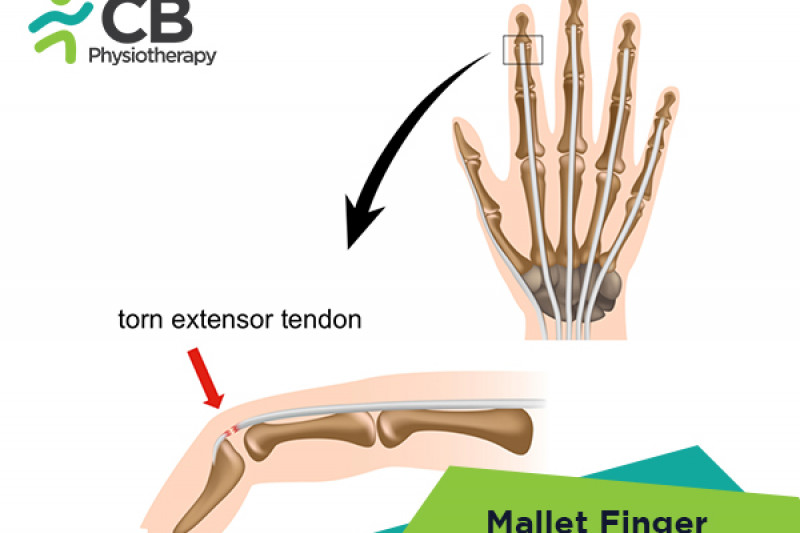
Mallet finger injury also known as “baseball finger,” is a partial or complete tear of the extensor tendon that straightens the end joint i.e. distal interphalangeal (DIP) joint of the finger. The tendon might pull off a small fragment of bone attached at the dorsal base of the distal phalanx with resultant flexed deformity of the distal interphalangeal (DIP) joint.
The mallet finger is usually associated with sports injury or sudden force in the finger:
The patient is not able to completely straighten the finger, other symptoms of mallet finger are given below:
Pathology
Mallet finger or baseball finger is the rupture of the extensor tendon of the finger at the distal interphalangeal (DIP) joint. The rupture of the finger extensor tendon may sometimes occur in combination with fracture of the distal phalange. The patient is not able to completely straighten the finger.
X-ray
X-ray is used to evaluate if there is an avulsion fracture of the distal phalanx.
In case of an uncomplicated mallet finger injury, splinting of the distal interphalangeal joint (DIP) is done in hyperextension for 8 weeks. Whereas severe mallet finger injuries sometimes require surgical treatment and the splint is worn for additional 6-8 weeks at night or while engaging with sports activities. The splint may be made of plastic or metal, applied to either the dorsal or volar part of the finger. The joint must be kept in hyperextension all the time during the 8 weeks, even when the splint is removed for cleaning.
Medication: Non-steroid, non-inflammatory ibuprofen, naproxen, or acetaminophen.
NOTE: Medication should be taken under the doctor's prescription.
Immobilization
The splint is applied to keep the finger in a straight static position and worn continuously for 6 to 8 weeks. The end joint should not bend during the splint age period. The middle finger joint is kept below the splint to support below the joint being exercised by bending the middle joint of the finger and then straightening it. To wash the finger, lay the hand palm down on a flat surface and slip the splint off to remove it, hold the finger straight on a flat surface without bending. Wash the finger with the hand flat on the table, then slide the splint back on.
Physiotherapy after operative treatment focuses mainly on keeping the other joints mobile and thus preventing stiffness.
Cryotherapy can be useful to relieve pain in the early stages, it can be used 10 -15 minutes 2 to 3 times a day.
Ultrasound can be used to hasten the recovery process.
Joint mobilization
The proximal joints are mobilized to gradually decrease the stiffness and increase the movement in the tip of the finger and after removing the splint the active and passive range of movements are started.
Passive range of motion
Passively bend the injured joint gently to maintain the joint range of motion then straighten back the joint. Each position is held for 5 secs with 10 repetitions 3 to 4 times a day.
Passive finger flexion
Using the other hand to stretch the stiff finger at the tip and middle joints, roll it into a full fist. Repeat for all fingers individually. This exercise can also be done by stretching all 4 fingers at the same time. Hold this position for 5 secs and repeat 10 times.
Stretching exercises
Palms flat on the able hold the finger one at a time and lift each finger at a time, hold this position for 5 secs and repeat 10 times.
Active finger flexor tendon glides
Begin with the wrist and fingers straight. Bend at the first knuckles then touch the fingertips to the base of the palm, making a flat fist. Bring the fingers back into a claw position, maintaining the tension in the fingers, roll them into a full, tight fist. Hold this position for 5 secs and repeat 10 times.
Object pick-up
Practice picking up small objects like pins, buttons, coins, etc.
Grip strengthening exercises
Strengthening exercises can also be useful to restore normal hand and finger strength.
Strengthening exercises like holding a squeeze ball, rubber ball or a therapeutic putty can be very helpful to regain mobility and strength. Hold this position for 5 secs and repeat 10 times.

The splint is worn for up to 4 weeks at night, during this phase do not try to examine how much of the finger has healed by bending it, as it might cause further damage. The patient is educated, how to modify activities to avoid recurrent finger injury.
Get assessed today — find the cause, get a plan, and know when you'll feel better.