Verified
Dr. Noureen Begum
Physiotherapist · BPT
See clinics, physiotherapists and prices for your city.
Whether it's a dull ache, a sharp catch, or pain that keeps coming back — we find the root cause of your Erb’s Palsy and fix it, at a clinic near you or at home.
Precision Care, Proven RecoveryWe'll call you within 10 minutes to confirm your home visit.We'll call you within 10 minutes to confirm your slot.
Chat with us on WhatsAppCommon triggers include muscle strain, joint stiffness, poor posture and long desk hours. If two or more of these fit, a physiotherapy assessment can identify exactly what's driving it.
Most erb’s palsy improves without surgery or long-term medication — the key is finding the cause first.
Erb’s Palsy rarely signals something serious, but see a doctor immediately if it comes with:
Our physios screen for these red flags at every first assessment and refer you to the right doctor if needed.
We start with an AI-based assessment to find the root cause — then follow a clear, four-phase plan.
Hands-on therapy and advanced modalities to calm pain and inflammation fast.
Mobility work and posture correction so everyday movement feels normal again.
Targeted strengthening that protects you — in-clinic or in our physio gym.
Back to work, sport and life — with a home program that prevents relapse.
One patient record, stage by stage: your physiotherapist pinpoints the diagnosis, finds the root cause and builds your in-clinic plan — while Fizo IQ™, our AI decision-support engine, tracks every milestone until your goals are met and you leave with an exercise plan to stay active.
Make these exercises yours — a CB physio personalizes, doses and tracks your plan week by week.
Get my personalized planGeneral guidance only — stop if an exercise increases your pain, and check with your physio before starting a new routine.
Every CB physio is a qualified BPT/MPT clinician. You don't need to choose one — our lead physiotherapist reviews your case and assigns the specialist best suited to treat it.
Verified
Physiotherapist · BPT
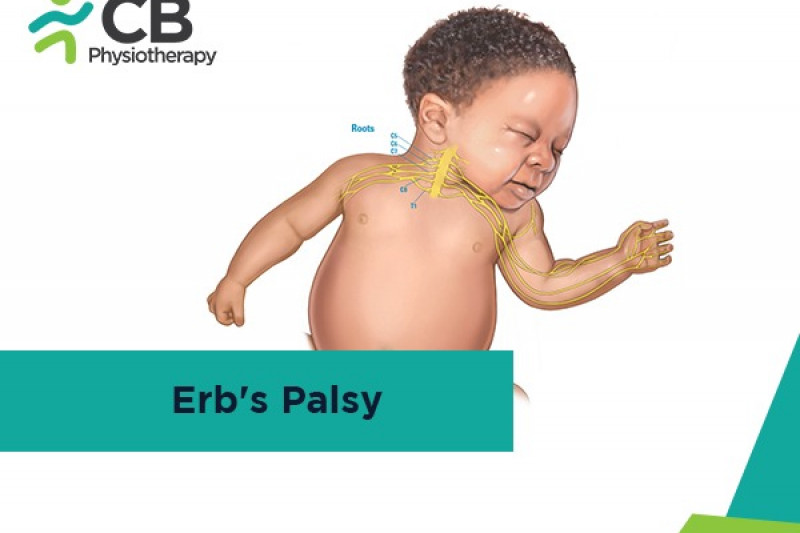
Erb's palsy also known as Erb-Duchenne paralysis is a condition that involves the loss of movement and weakness of the arm. It can occur in both infants and adults. Most commonly it occurs as a result of birth injury due to traction between the child's head and shoulder. The lesion is usually at the junction of the C5 and C6 roots (Erb's point).
Erb's palsy occurs due to the paralysis of the deltoid, supraspinatus, infraspinatus, biceps, teres minor, supinators, and brachialis muscles. And in few cases, there is the involvement of extensor carpi radialis longus and brevis also.
The involvement of these muscle groups results in a typical posture of "waiters or policeman's tip" position. The arm hangs by the side with the shoulder in internal rotation, the elbow in extension, and the forearm pronated.
The upper nerves can get damaged when the shoulder is forced down while the neck stretches up and away from the injured shoulder. And the lower nerves are injured when the arm is forced above the head. The causes for such injury might be:
· Trauma like falls, motor vehicle accidents, bullet wounds.
· Sports injury like football etc.
· Tumors
· Breech delivery
· Improperly used tools during birth
· Large infant size
Injury to the 5th cervical root alone results in weakness or the loss of shoulder: abduction and external rotation, Elbow flexion and, Forearm supination. And the involvement of the 6th cervical root results in the loss of wrist extension.
· Complete lack of movement of one arm
· Partial or total paralysis of one arm
· Weakness in one arm
· Numbness in one arm
· The arm hangs by the side
· Shoulder in internal rotation,
· Elbow in extension and the
· Forearm pronated with the Palm facing backward.
Pathology
Erb's palsy involves the compression of the brachial plexus causing stretch and tear of C5, C6 nerves. The head is deviated away from the shoulder due to excessive traction or stretch.
Electromyography (EMG):
This test can confirm the presence of nerve damage and determine its severity. EMG measures the electrical activity of a muscle in response to stimulation.
Imaging scans:
Magnetic resonance imaging (MRI) or computerized tomography (CT) may be needed on occasion to rule out other possible sources of pressure on the nerve.
Ultrasound and x-ray:
These imaging techniques can be used to find out if there is any damage to the bones and joints of the neck and shoulder.
Nerve conduction test:
Nerve conduction tests help to find how well the nerves can send an electrical signal from the spinal cord to the muscles.
Physical and Neurological examination:
History is taken to know the mechanism of injury followed by a physical and neurological examination to check the movement, sensation, and reflexes of the affected arm.
Medications
Analgesic or pain relief medicines, anti-inflammatory (medications should not be taken without the doctor's permission)
Techniques used by the Physiotherapy
Thermotherapy:
Thermotherapy can be used before the exercises to decrease the stiffness.
NMES:
Electrical stimulation can be used as an adjunct with the exercises to re-educate the muscles and nerves.
Splinting
Aero plane splint or abduction splint can be used to avoid a soft tissue contracture.
Massage
Mild and gentle massage is given to the affected arm to increase circulation, sensory stimulation, and decrease tightness.
PROM exercises:
Passive range of motion exercises are used to prevent the formation of contractures. The exercises help to maintain the range of movement in the joints to prevent stiffness and pain. Involved muscle groups can be exercised and re-educated.
PNF technique:
The involved muscles are activated by assisted active movements by using sensory stimulus. Bilateral symmetrical PNF patterns may be included to achieve irradiation from the normal contralateral limb or the surviving strong muscles of the affected limb.
Strengthening exercises:
Strengthening exercises with weights and resistance can be used for muscle strengthening.
Hydrotherapy exercises:
These exercises help to build up the joint movement and strength by assisting in the motion and also using water resistance for strengthening.
Other activities:
Crawling, climbing, swimming, and throwing activities can be included in the treatment session.

The parent of the child or the patient(adult) is advised to handle the affected arm with care. The arm should be positioned in a comfortable position to prevent the formation of contractures. Exercise should be done on regular basis to maintain the range of motion.
Get assessed today — find the cause, get a plan, and know when you'll feel better.