Platelet-rich Plasma (prp) Injections — How It Works & What It Treats
Also known as Autologous Conditioned Plasma. What Platelet-rich Plasma (prp) Injections is, how it works and what it treats — explained by CB Physiotherapy's clinical team.
How Platelet-rich Plasma (prp) Injections works
Platelet-rich Plasma (prp) Injections (also called Autologous Conditioned Plasma) is one of the treatment approaches our physiotherapists draw on — always as part of an assessment-led plan, never as a standalone fix.
What makes any therapy work is the decision-making around it: whether it fits your diagnosis, at what dose, and combined with what. At CB Physiotherapy, Platelet-rich Plasma (prp) Injections is prescribed after a movement assessment and paired with active rehabilitation, because passive treatment alone rarely produces lasting change.
Platelet-rich Plasma (prp) Injections — techniques & equipment
What the treatment actually involves — your plan combines the pieces your assessment calls for.
Assessment before application
Your physiotherapist first confirms Platelet-rich Plasma (prp) Injections suits your diagnosis — and screens for anything that rules it out.
Targeted application
The treatment is applied to the specific structures your assessment identified, at a dose set for your case.
Paired with active rehab
Exercise and movement retraining run alongside, so the gains each session makes are kept.
Reviewed and progressed
Your response is checked every session; the plan is adjusted rather than repeated on autopilot.
Conditions Platelet-rich Plasma (prp) Injections treats
Where it fits best — your assessment confirms whether it belongs in your plan.
- ✓ Frozen Shoulder →
- ✓ Achilles Tendon Rupture →
- ✓ Tennis Elbow →
- ✓ Osteoarthritis →
- ✓ Plantar Fasciitis →
- ✓ Degenerative Disc Disease →
- ✓ Pain or stiffness that has not settled with rest
- ✓ As part of a wider, assessment-led recovery plan
- ✓ When your assessment identifies the specific problem Platelet-rich Plasma (prp) Injections addresses
What a Platelet-rich Plasma (prp) Injections session looks like
Step by step — from screening to treatment to what comes next.
Screening and consent
A quick reassessment and safety screen — you will know what the session involves and why before it starts.
The treatment itself
Platelet-rich Plasma (prp) Injections applied to the targeted area — most patients find sessions comfortable, and you can speak up at any point.
Active follow-through
Exercise or movement work right after, while the treatment effect is fresh.
Response check
What changed and for how long — the answer shapes your next session and the plan.
Benefits of Platelet-rich Plasma (prp) Injections
- ✓ Delivered by certified physiotherapists, never unsupervised
- ✓ Dosed to your case after a proper assessment
- ✓ Always combined with active rehab, for results that last
- ✓ Available at CB clinics near you — and at home where equipment allows
- ✓ Drug-free support for pain relief and recovery
Safety & contraindications
How CB Physiotherapy delivers Platelet-rich Plasma (prp) Injections
You will not walk into CB Physiotherapy and simply receive Platelet-rich Plasma (prp) Injections — you will receive an assessment, and Platelet-rich Plasma (prp) Injections if your case calls for it. That order matters: it is how we make sure every session moves you towards a goal rather than just filling a slot.
Your plan runs on Fizo IQ™ — diagnosis, root cause, milestones, goals — and Platelet-rich Plasma (prp) Injections is combined with hands-on care and exercise as indicated, at a clinic near you or at home where the equipment allows.
Real published prices from our physiotherapists for Platelet-rich Plasma (prp) Injections in India — your exact quote is confirmed after assessment, before you commit. Packages save 10%.
Get Platelet-rich Plasma (prp) Injections near you
Certified physiotherapists at a clinic near you or at home — same-day slots, assessment-led care.
Request received!
We'll call you within 10 minutes to confirm your home visit.We'll call you within 10 minutes to confirm your slot.
Chat with us on WhatsAppPlatelet-rich Plasma (prp) Injections, answered
Platelet-Rich Plasma (PRP) therapy is a regenerative treatment that involves concentrating platelets from your own blood and injecting them into the injured or degenerative area. Platelets contain growth factors that help:
- Stimulate tissue repair
- Enhance collagen production
- Improve blood supply to damaged tissues
- Reduce inflammatory processes
Unlike treatments that only suppress symptoms, PRP aims to support biological healing at the source of injury.
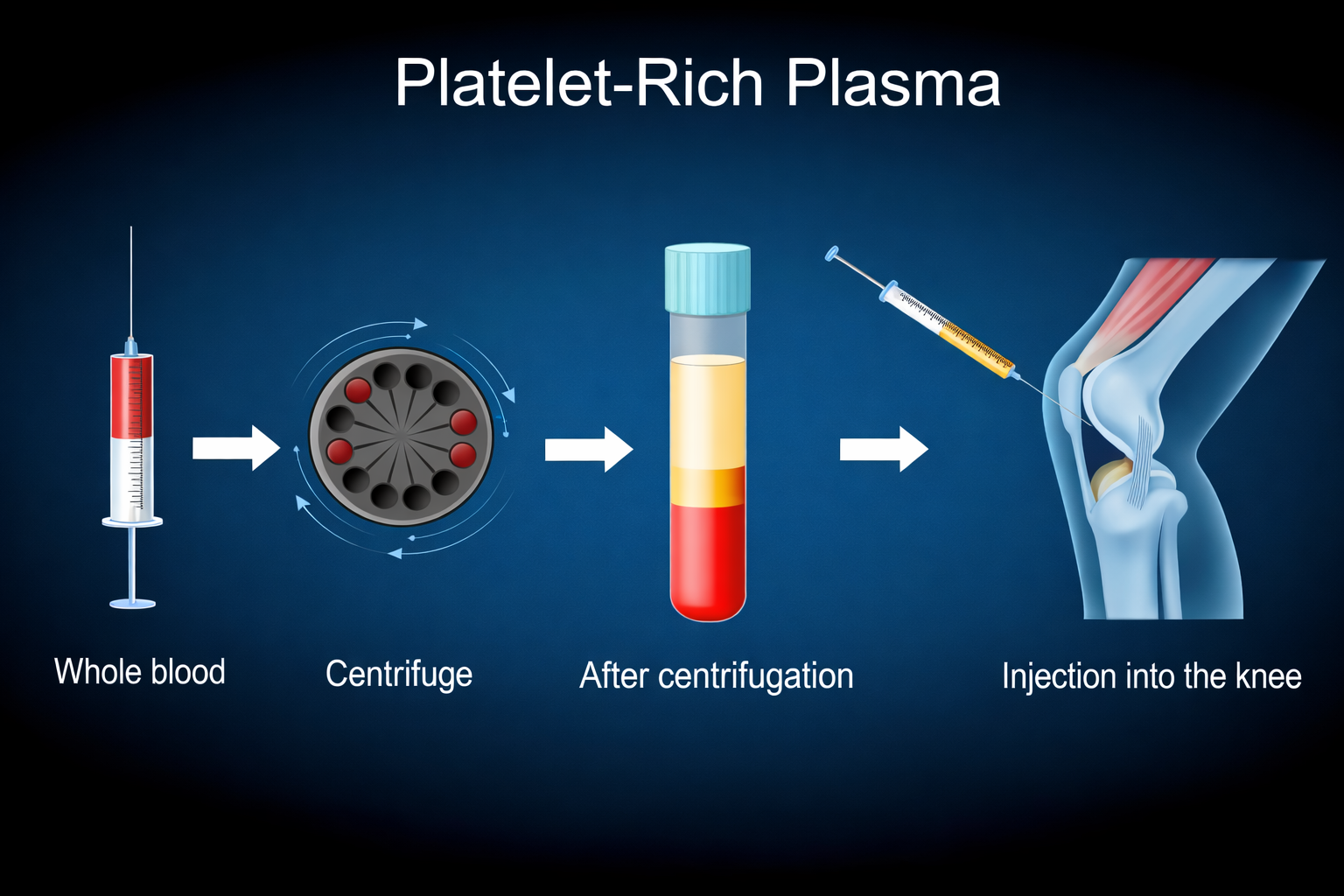
The process involves:
-
Drawing a small sample of your blood
-
Processing it in a centrifuge to separate platelet-rich plasma
-
Injecting the concentrated PRP into the targeted area under image guidance
Once injected, PRP releases growth factors that initiate and accelerate tissue healing.
This makes PRP particularly useful in chronic tendon injuries and early joint degeneration.
PRP injections are frequently used for:
Joint Conditions-
Early degenerative joint changes
-
Tennis elbow (lateral epicondylitis)
-
Rotator cuff tendinopathy
-
Plantar fasciitis (heel pain)
-
Ligament sprains
-
Chronic tendonitis
PRP is often considered when pain persists despite physiotherapy and medication.
PRP provides a regenerative approach to musculoskeletal pain management.
-
Uses your own blood components
-
Minimally invasive procedure
-
Low risk of allergic reaction
-
Targets tissue repair, not just pain relief
-
May slow the progression of early degenerative changes
-
Can be combined with physiotherapy for optimal outcomes
-
Performed as a day-care procedure
Because PRP is prepared from your own blood, the risk of rejection or allergic reaction is minimal.
Temporary effects may include:
-
Mild soreness at injection site
-
Local swelling
-
Temporary stiffness
Proper patient selection and image-guided injection improve safety and precision.
The number of sessions depends on:
-
Severity of tissue damage
-
Chronicity of condition
-
Individual healing response
Typically:
-
1 to 3 sessions may be recommended
-
Sessions are spaced several weeks apart
Your treatment plan is individualized based on clinical evaluation.
PRP may be suitable if:
-
You have chronic tendon or joint pain
-
Early arthritis is present
-
Conservative therapy has not provided adequate improvement
-
You prefer a non-surgical regenerative option
A proper assessment is essential to determine whether PRP is appropriate for your condition.
PRP enhances tissue healing.
Physiotherapy restores strength and movement.
When integrated properly:
-
Healing tissue adapts better to loading
-
Muscle strength improves
-
Joint stability increases
-
Long-term outcomes improve
-
Risk of recurrence decreases
This combined approach supports both biological repair and functional recovery.
Ready to start your recovery?
Get assessed today — find the cause, get a plan, and know when you'll feel better.