Verified
Dr. Anup Brahmbhatt
Physiotherapist · BPT
See clinics, physiotherapists and prices for your city.
Whether it's a dull ache, a sharp catch, or pain that keeps coming back — we find the root cause of your Shoulder Dislocation and fix it, at a clinic near you or at home.
Precision Care, Proven RecoveryWe'll call you within 10 minutes to confirm your home visit.We'll call you within 10 minutes to confirm your slot.
Chat with us on WhatsAppCommon triggers include muscle strain, joint stiffness, poor posture and long desk hours. If two or more of these fit, a physiotherapy assessment can identify exactly what's driving it.
Most shoulder dislocation improves without surgery or long-term medication — the key is finding the cause first.
Shoulder Dislocation rarely signals something serious, but see a doctor immediately if it comes with:
Our physios screen for these red flags at every first assessment and refer you to the right doctor if needed.
We start with an AI-based assessment to find the root cause — then follow a clear, four-phase plan.
Hands-on therapy and advanced modalities to calm pain and inflammation fast.
Mobility work and posture correction so everyday movement feels normal again.
Targeted strengthening that protects you — in-clinic or in our physio gym.
Back to work, sport and life — with a home program that prevents relapse.
One patient record, stage by stage: your physiotherapist pinpoints the diagnosis, finds the root cause and builds your in-clinic plan — while Fizo IQ™, our AI decision-support engine, tracks every milestone until your goals are met and you leave with an exercise plan to stay active.
Top 5 Exercises For Shoulder Dislocation
Steps & precautions →
Top 5 Exercises For Frozen Shoulder
Steps & precautions →
Make these exercises yours — a CB physio personalizes, doses and tracks your plan week by week.
Get my personalized planGeneral guidance only — stop if an exercise increases your pain, and check with your physio before starting a new routine.
Every CB physio is a qualified BPT/MPT clinician. You don't need to choose one — our lead physiotherapist reviews your case and assigns the specialist best suited to treat it.
Verified
Physiotherapist · BPT
Verified
Physiotherapist
Verified
Physiotherapist · BPT
Verified
Physiotherapist · BPT
Verified
Physiotherapist
Rated 4.9 / 5 across 13 verified patient reviews in Bangalore.
“For sure you all should come to his physiotherapy center. Everyone out here are so polite and helpful....all of my Chiro sessions by Dr. Anup were so helpful to cure my rounded shoulder. I was treated by Dr. Nadia. She was so kind and of course so well skilled. You should try this physiotherapy center for sure...”
“Thanks so much, Dr. Bella, for your services. I'm so pleased with every session I got from you for my cervical pain. My cervical pain is almost gone, and I can move my neck freely after treatment. recommended for all.”
“Thanks so much Dr.anup for the treatment. My back issue is resolved to some extent after couple of sessions. I had good experience at cb physiotherapy clinic.👍👍”
“Dr Bela and team has healing hand. She is Best physio and Chiro I ever met thank you. Amazing results in just 1 week of treatment for 10 year old condition.”
“For sure you all should come to this physiotherapy center. Everyone out here are so polite and helpful....all of my Chiro sessions by Dr. Anup were so helpful to cure my rounded shoulder. He was so kind and ofcourse so well skilled.”
“Dr. Madhusudan is a excellent Physio.He listen, understands the problems of the patient very carefully. He suggests genuine therapy for the patients. I highly recommend this doctor.”
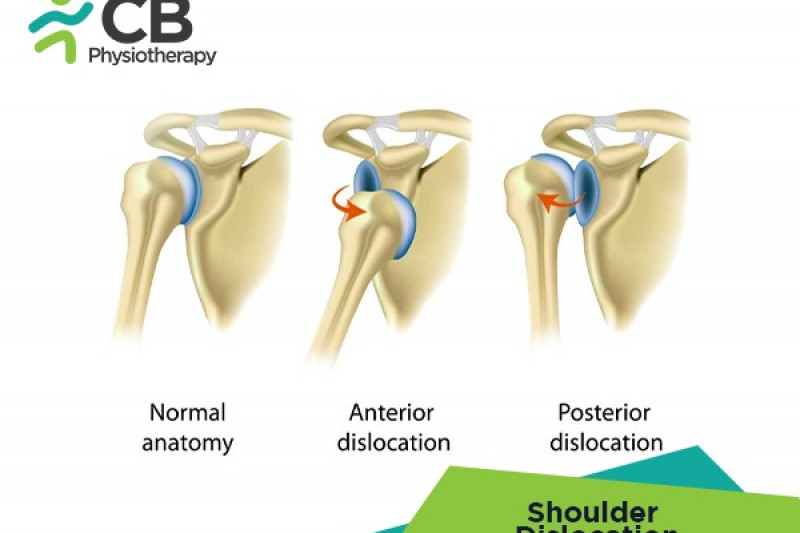
Shoulder dislocation is an injury in which the upper part of the arm bone (humerus) comes out of the cup-shaped socket (glenoid). The shoulder joint is a ball and socket joint, with humerus bone fitted in a groove in the shoulder blade. It is the most mobile joint in the body and can move in several directions. Even though it is supported by muscles, tendons, and ligaments. Even though it is supported by muscles, tendons and ligaments yet mobility can leave the shoulder unstable. The shoulder is the most likely to become dislocated among the joints in the body. Patients regain full shoulder function within a few weeks. If the joint is dislocated, it may become unstable and prone to repeated dislocations.
Types of shoulder dislocations
· Partial dislocation or subluxation
Partial dislocation means the head of the upper arm bone is partially out of the socket, causing pain and instability in the shoulder.
· Complete dislocation
Complete dislocation means the head of the upper arm bone is completely out of the socket. Both partial and complete dislocations causing shoulder pain and instability.
Sometimes a dislocated shoulder may also tear the shoulder ligaments or tendons or even damage nerves. Symptoms of a dislocated shoulder include:
A shoulder dislocation is usually caused due to a fall or blows to the shoulder. This can happen during sports activities.
Pathology
Among shoulder dislocations, anterior dislocation is most common. It can occur due to a blow resulting in an abducted, externally rotated, and extended extremity. It may also occur due to a fall on an outstretched arm.
X-rays:
X-ray shows the image of the dislocation or other damage to the shoulder joint. It also shows the broken bones or other damage to the shoulder joint.
Magnetic resonance imaging (MRI):
MRI helps to evaluate Joint abnormalities caused by traumatic or repetitive injuries.
Computerized tomography (CT) scans:
CT scan of the shoulder joint is a method to check the amount of bone loss on the head of the humerus or the glenoid side.
Medication
Ibuprofen, naproxen or acetaminophen, muscle relaxers.
NOTE: Do not take the medication without the doctor’s prescription.
Once the shoulder joint is dislocated, the joint is more susceptible to future shoulder dislocations. To avoid recurrence, a physiotherapy regime for strengthening and stability exercises should be followed. If shoulder dislocation becomes a recurrent problem, a brace can be helpful. If physiotherapy therapy and bracing fail, surgery may be needed to repair or tighten the torn or stretched ligaments that help to hold the joint in place.
Techniques used by physiotherapist
Place the shoulder in the sling or splint the shoulder joint in its proper position. Plenty of early rest is needed Don't try to move the shoulder or force it back into place, it can cause damage to the shoulder joint and the surrounding ligaments, muscles, blood vessels, or nerves.
The physiotherapist applies ice to the shoulder to reduce pain and swelling by controlling bleeding and fluids retention in and around the shoulder joint.
· Thermotherapy
Thermotherapy is used for relaxation of the muscles before performing the exercise program.
· TENS
Transcutaneous electrical nerve stimulation provides pain relief, which may be caused after performing stretching exercises.
Ultrasound is very effective in breaking adhesions.
· Range of motion and strengthening exercises
Range of motion and strengthening exercises for muscles, prevent the dislocation of the shoulder again in the future. Physiotherapy begins with gentle muscle toning exercises. Later, exercises with weights can be added.
Post-surgery physiotherapy
Physiotherapy after shoulder surgery is essential to restore the shoulder’s function.
After shoulder stabilization surgery, the arm is placed in a sling, usually for 4 to 6 weeks.
To control pain and swelling, icing, and proper positioning are done. This phase lasts for the first few weeks after your surgery, when your shoulder is at the after immobilization gentle range-of-motion and strengthening exercises using only the weight of the arm is started. After immobilization gentle range-of-motion and strengthening exercises
Cryotherapy, TENS, Ultrasound therapy, and Gentle massage are given to help decrease pain, swelling, and stiffness.
After almost 1 month following surgery, the use of your sling is reduced, and range-of-motion and strengthening exercises will progressively become more challenging. Extra resistance for strengthening exercises is slowly increased.
Strengthening of the core muscles of the shoulder and trunk muscles is started which provides additional support and stability to the shoulder. Joint mobilization techniques are used to help restore the shoulder's range of motion. Also light cardiovascular activities, such as exercising on a stationary bike or walking on a treadmill.
This phase begins after 3 months of surgery. The therapist now focuses on restoring strength and use of the arm for daily activities, except for activities such as sports or any other physically strenuous work-related tasks. Modified weight-lifting or gym-based programs are in cooperated to increase the difficulty of exercises.
This phase begins about 4 months after surgery, the therapist helps to return to work, sports, and other higher-level activities. The therapist trains the patient in activity-specific exercises to meet the needs. The exercises include lifting heavy objects, for certain athletes, the task may include catching and throwing. A shoulder brace might be recommended to allow gradual and safe return to regular activity level without re-injury.

Get assessed today — find the cause, get a plan, and know when you'll feel better.