
Pes Anserine Bursitis — Symptoms, Causes & Treatment
Also known as Pes Anserine Bursitis. Causes, symptoms and how physiotherapy treats Pes Anserine Bursitis — without surgery or medicines.
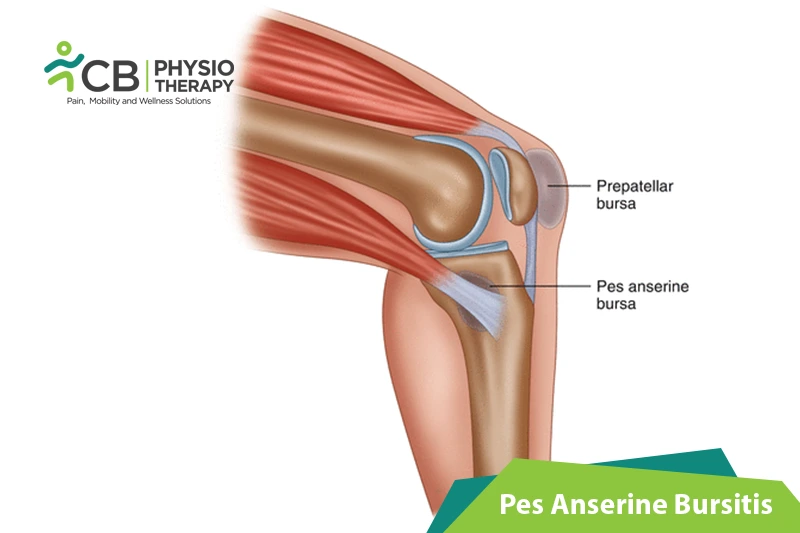
Understanding Pes Anserine Bursitis
Pes Anserine Bursitis is one of the conditions our physiotherapists treat most often — and one of the most treatable when the actual driver is found. Two people with Pes Anserine Bursitis rarely share the same underlying cause, which is why one-size-fits-all treatment so often disappoints.
What matters clinically is the pattern: how it started, what makes it better or worse, and how it behaves through the day. That pattern — mapped in a structured assessment — tells us which structures are involved and which treatment will actually move the needle.
Causes & risk factors of Pes Anserine Bursitis
What commonly drives it — your assessment pins down which of these apply to you.
Old injuries and compensations
A previous injury that never fully rehabilitated often leaves a movement pattern that overloads something else.
Sudden spikes in activity
A new sport, a new gym program, a long trek — tissue adapts to gradual change and protests when change is sudden.
Muscle strain and overload
A sudden lift, an awkward movement or simply more load than the tissues were prepared for — the most common trigger.
Posture and long static hours
Desks, driving and screens keep the same structures loaded for hours at a stretch — comfortable at first, aching later.
Joint stiffness and age-related change
Joints that move less start to hurt more; age-related wear is normal, but painful stiffness is not something to simply accept.
When physiotherapy is the right call
If any of these sound like you, an assessment is the right first step.
- ✓ Movement feels restricted, weak or guarded compared to before
- ✓ You want to return to sport or work with a plan, not by trial and error
- ✓ Pes Anserine Bursitis that keeps returning or hasn't settled within two weeks
- ✓ Pain or stiffness that limits work, sleep or daily activities
- ✓ You want to avoid long-term painkillers — or surgery has been mentioned
Your treatment journey
Step by step — from your first assessment to a tracked recovery plan.
A detailed first assessment
History, movement testing and strength checks — a focused session to find what is actually driving your Pes Anserine Bursitis.
A diagnosis you understand
Your physiotherapist explains the findings in plain language — what is affected, why it happened and what that means for you.
Active, tracked treatment
Hands-on therapy, the right modalities and graded exercise — progressed session by session and tracked on Fizo IQ™.
Prevention, built in
The final phase rebuilds strength and habits so the same problem does not come back — with a home plan you keep.
What recovery looks like
- ✓ A clear diagnosis and a timeline you can plan around
- ✓ Strength and movement rebuilt, not just pain reduced
- ✓ Lower chance of recurrence, with a prevention plan
- ✓ Care without long-term medicines — at a clinic near you or at home
- ✓ Relief that comes from treating the cause, not masking it
When to see a doctor — red flags
How CB Physiotherapy treats Pes Anserine Bursitis
We treat Pes Anserine Bursitis the way we treat everything: assessment first, plan second, treatment third. It sounds obvious, but it is the difference between sessions that fill a slot and sessions that move you towards a goal. Care is delivered by certified physiotherapists at a clinic near you or at home.
Your whole journey is tracked on Fizo IQ™ — the diagnosis, the root cause, the milestones and the goals — so progress is measured, not guessed, and the plan adapts the moment your response calls for it.
Get Pes Anserine Bursitis treatment near you
Certified physiotherapists at a clinic near you or at home — same-day slots, assessment-led care.
Request received!
We'll call you within 10 minutes to confirm your home visit.We'll call you within 10 minutes to confirm your slot.
Chat with us on WhatsAppPes Anserine Bursitis, answered
Pes anserine bursitis is an inflammation of the bursa located between the shinbone and the three tendons of the hamstring muscle at the inner side of the knee. It occurs when the bursa becomes irritated and produces excessive fluid, which causes it to swell and puts pressure on the adjacent parts of the knee. There is inflammation of the pes anserine bursa, causing pain and tenderness on the inside of the knee, approximately 2 to 3 inches below the joint. Pes anserinus means goose's foot and it gets its name from the webbed-foot shape made by the three tendons where they join together forming one tendon and attaching to the shin bone. Underneath this conjoined tendon is the pes anserine bursa, a small sac filled with fluid.
Sartorius: Is the longest muscle in the body that runs across and down the front of the thigh. It helps to bend the knee and hip.
Gracilis: Is a hip adductor (draws the leg inwards).
Semitendinosus: This is one of the 3 hamstring muscles that work together to bend the knee.
Symptoms of bursitis can be seen gradually rather than suddenly. People often complain it hurts more when they exercise or go upstairs, with resisted knee flexion or when they stretch their hamstrings, most common symptoms of pes anserine bursitis are:
- The pain slowly develops on the inside of the knee and/or in the center of the shinbone, approximately 2 to 3 inches below the knee joint,
- Medial knee pain and tenderness on the inner side of the knee approximately 2-3 inches, below the joint.
- Knee swelling,
- Tenderness to touch,
- Pain aggravates with exercise or running, climbing stairs,
- Weakness & Stiffness,
- Sleep Disturbance.
Pathology:
Pes anserine bursitis Is also known as intertendinous bursa, it is an inflammation of the bursa of the conjoined insertion of the M. Sartorius, M. Gracilis, and M. Semitendinosus muscles along the proximal medial aspect of the tibia, the bursa is located approximately two inches below the medial knee joint line between the pes anserine tendons. When there is more pressure in the area of insertion of the pes anserinus it causes an increase in the release of synovial fluid in the lining of the bursa. The bursa then becomes inflamed and painful.
Friction over the area results in inflammation of the pes anserine bursa, which produces excessive fluid and thus swells, placing pressure on the surrounding structures. Several other factors can contribute to the development of pes anserine bursitis, including:
- Commonly found in women, due to a wider pelvis and the angle of the knee joint,
- Repetitive Stress,
- Muscle Weakness/Tightness,
- Overuse, constant friction or stress on the bursa,
- Direct injury,
- Athletes, particularly runners,
- Incorrect training techniques,
- Neglecting to stretch,
- Excessive hill running,
- Tight hamstring muscles,
- Obesity,
- Being duck-footed or having knock knees,
- Medical conditions like osteoarthritis in the knee, Type 2 Diabetes, or Osgood Schlatters are also more likely to develop bursitis.
Physical Examination
The examiner does the physical examination of the knee, for diagnosis.
X-ray:
X-ray is used to rule out the other bony problems.
Magnetic resonance imaging (MRI):
Magnetic resonance imaging (MRI) is done to see the extent of external derangement of the knee.
Bone scan:
The bone scan is done to identify the stress fractures if any in the joint.
Additional test:
Erythrocyte sedimentation rate, blood cell count, and antinuclear anti-body test are recommended.
Medication: Non-steroidal anti-inflammatory medication such as aspirin, ibuprofen, naproxen, anesthetic injections, steroid, etc.
Note: Medication should not be taken without the doctor's prescription.
Surgery:
Patients who do not respond to conservative treatments are recommended surgery like bursectomy.
Rest:
Rest is really important to avoid activities that cause pain. This requires modifying the activities or completely taking rest to allow the swelling to settle down.
Apply ice at regular intervals three or four times a day for 20 minutes at a time, to the inner side of the knee. Ice therapy helps to reduce pain and swelling associated with pes anserine bursitis.
Therapeutic ultrasound helps to reduce the inflammatory process.
Transcutaneous electrical stimulation (TENS):
Transcutaneous electrical stimulation (TENS) can also be given to reduce pain.
Low-level laser therapy:
Low-level laser therapy can be used to have a healing effect on the inflamed bursa.
Massage therapy is used to regain mobility and increase knee range of motion.
Strengthening exercises can be done to decrease tightness, and improve strength and endurance. These exercises include isometric hamstrings, quadriceps, gluteus, and straight leg raises. The exercises are progressed further to single knee dips, squats, leg presses, and lunges resisted leg pulls using elastic tubing are also included.
Stretching exercises:
Stretching exercises are done to increase the range of motion and increase flexibility. These exercises can be stretching of quadriceps, sartorius, and semitendinosus, calf stretches, seated adductor stretch,
Activity modification:
Initial treatment starts with activity modification like modification of activities such as reducing the duration, intensity, and frequency of running. Weight loss is another important factor. Use of pillows between the thighs at night is strongly recommended.
In case of surgery, the patient is advised to slowly return to normal activities and to take care, not to push things too much too quickly. The patient is advised for non-weight bearing exercises such as cycling or swimming initially and then return to short distances alternating between running and walking. But should be advised not to ignore pain while doing an activity, or later during the day allow to take adequate rest.
Don't let Pes Anserine Bursitis decide your day.
Get assessed today — find the cause, get a plan, and know when you'll feel better.