Dr. Nayima Tassaduq
Head Of The Clinic · BPT, MPT
See clinics, physiotherapists and prices for your city.
Whether it's a dull ache, a sharp catch, or pain that keeps coming back — we find the root cause of your Quadriplegia and fix it, at a clinic near you or at home.
Precision Care, Proven RecoveryWe'll call you within 10 minutes to confirm your home visit.We'll call you within 10 minutes to confirm your slot.
Chat with us on WhatsAppCommon triggers include muscle strain, joint stiffness, poor posture and long desk hours. If two or more of these fit, a physiotherapy assessment can identify exactly what's driving it.
Most quadriplegia improves without surgery or long-term medication — the key is finding the cause first.
Quadriplegia rarely signals something serious, but see a doctor immediately if it comes with:
Our physios screen for these red flags at every first assessment and refer you to the right doctor if needed.
We start with an AI-based assessment to find the root cause — then follow a clear, four-phase plan.
Hands-on therapy and advanced modalities to calm pain and inflammation fast.
Mobility work and posture correction so everyday movement feels normal again.
Targeted strengthening that protects you — in-clinic or in our physio gym.
Back to work, sport and life — with a home program that prevents relapse.
One patient record, stage by stage: your physiotherapist pinpoints the diagnosis, finds the root cause and builds your in-clinic plan — while Fizo IQ™, our AI decision-support engine, tracks every milestone until your goals are met and you leave with an exercise plan to stay active.
Make these exercises yours — a CB physio personalizes, doses and tracks your plan week by week.
Get my personalized planGeneral guidance only — stop if an exercise increases your pain, and check with your physio before starting a new routine.
Every CB physio is a qualified BPT/MPT clinician. You don't need to choose one — our lead physiotherapist reviews your case and assigns the specialist best suited to treat it.
Head Of The Clinic · BPT, MPT
Head Of The Clinic · BPTh, MPTh
The same prices you'll see at the clinic — published before you book. Sessions run 30–45 minutes.
Booking a course of sessions? Save 10% when you take a treatment package — and recover with a plan built around your goals.
Ask about packages →Rated 5.0 / 5 across 18 verified patient reviews in Delhi.
“I had a great experience at CB Physiotherapy in Safdarjung, where Dr. Nayima treated my persistent back pain. From the moment I arrived, the clinic had a welcoming atmosphere, and Dr. Nayima’s professionalism stood out. She took the time to thoroughly assess my condition and explained the treatment plan clearly. Over the course of my sessions, I noticed significant improvement in my pain levels and mobility. Dr. Nayima was attentive, skilled, and always ensured I was comfortable during the treatment. I highly recommend CB Physiotherapy for anyone dealing with back pain or other physical issues.”
“Very knowledgeable and gave a great explanation of what was causing me to have such pain in my back. over all treatment was Fantastic.”
“I consulted Dr. Nayima at CB Physiotherapy for spine alignment and fracture pain, and I was quite pleased with the care I received. She developed a tailored treatment plan that included manual therapy and exercises, resulting in great alleviation and improvement. Dr. Nayima possesses expertise, professionalism, and compassion. I strongly suggest her for any spine-related disorders or fractures.”
“I've been going here for just over a month, and dr Nayima has done wonders for my back and neck issue . My only regret is that I did not arrive here sooner. The whole crew is kind and helpful. If you need physical therapy, come here..”
“This place has been fantastic. The staff and therapists are exceptional and extremely informed. I've been to various physical therapy clinics, and this is by far the most useful for my leg and back problems. I would definitely suggest.”
“Recieved treatment from Dr nayima for back and neck problem and i can say that i found relief from pain after couple of sessions. all staff members are very caring.”
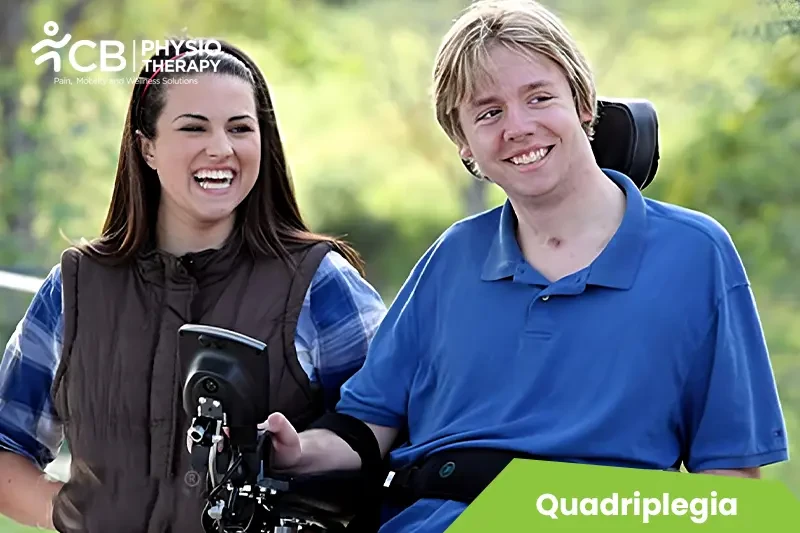
Quadriplegia or Tetraplegia is a condition of paralysis that affects all the limbs and body from the neck to the down. The most common cause of quadriplegia is an injury to the spinal cord at the level of the neck. Quadriplegia is sometimes treatable but in most cases injury results in permanent paralysis.
Quadriplegia is when the person can’t deliberately control or move his muscles and it can affect a person from the neck to down. Depending on how and why it happens, it can affect the ability to move parts of the body, as well as some of the body’s automatic processes that keep the person alive.
Types of Quadriplegia:
Incomplete Quadriplegia: In this type, the quadriplegia blocks some signals from getting through, and thus a person might still have some ability to move, feel sensations, or control automatic body processes like bowel and bladder function.
Complete Quadriplegia: In this type, the quadriplegia blocks all signals from getting through, i.e a person loses muscle control, and the ability to feel sensations, and their brain can’t manage any automatic processes that rely on the signals sent by the brain to work.
Two ways that paralyzed muscles act in Quadriplegia:
Flaccid Quadriplegia:
Flaccid quadriplegia means that muscles don’t work at all and remain flaccid.
Spastic Quadriplegia:
Spastic quadriplegia results in muscles that don’t work by themselves and contract uncontrollably.
Effect of the location of a problem on Quadriplegia?
The spine has several sections. The cervical spine or C-spine is the section in the neck. There are seven vertebrae interlocking bone segments, which make up the C-spine. The C-spine also includes eight spinal nerves, which run in-between vertebrae and lead to different areas of the body.
The effects of a problem with the spinal cord injury can vary widely depending on where exactly it happens. For example, the 6th cervical spinal nerve is known as C6. Quadriplegia can occur when there’s an incomplete or complete spinal cord injury anywhere between C1 and C8. The higher the injury, the more dangerous the effects are. The effects, depending on location:
Get assessed today — find the cause, get a plan, and know when you'll feel better.