Quadriplegia — Symptoms, Causes & Treatment
Also known as Tetraplegia. Causes, symptoms and how physiotherapy treats Quadriplegia — without surgery or medicines.
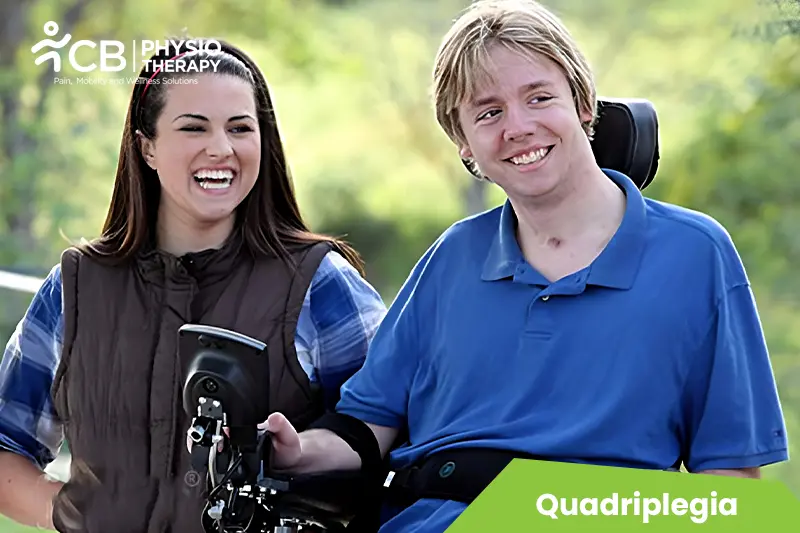
Understanding Quadriplegia
Quadriplegia (also called Tetraplegia) affects people differently, and the right care starts with understanding how it affects you. Its day-to-day impact — on movement, strength, energy and confidence — is where physiotherapy does its work.
Our role in Quadriplegia is practical: protect and rebuild movement and daily function with a plan set after a careful assessment, in coordination with your doctor wherever medical management is involved. No two plans look the same, because no two cases behave the same.
Causes & risk factors of Quadriplegia
What commonly drives it — your assessment pins down which of these apply to you.
More than one possible driver
Quadriplegia can have several contributing factors — a careful history and physical assessment separate them rather than guessing.
Reduced movement and deconditioning
Whatever the trigger, less movement quickly adds weakness and stiffness of its own — usually the most reversible part.
Daily-life load and habits
Work posture, repeated tasks, sleep and stress all shape how a condition behaves day to day.
General health and history
Overall health, previous injuries and existing conditions influence both the picture and the plan — the assessment takes all of it in.
When physiotherapy is the right call
If any of these sound like you, an assessment is the right first step.
- ✓ A new diagnosis of Quadriplegia and you want a clear rehabilitation start point
- ✓ Daily tasks, walking or stairs are getting harder than they used to be
- ✓ Strength, stamina or balance has visibly dropped
- ✓ You want a structured clinic + home program with measurable milestones
- ✓ Family members need guidance to support you safely
Your treatment journey
Step by step — from your first assessment to a tracked recovery plan.
A detailed first assessment
History, movement testing and strength checks — a focused session to find what is actually driving your Quadriplegia.
A diagnosis you understand
Your physiotherapist explains the findings in plain language — what is affected, why it happened and what that means for you.
Active, tracked treatment
Hands-on therapy, the right modalities and graded exercise — progressed session by session and tracked on Fizo IQ™.
Prevention, built in
The final phase rebuilds strength and habits so the same problem does not come back — with a home plan you keep.
What recovery looks like
- ✓ More independence in daily tasks
- ✓ Better strength, balance and stamina
- ✓ Fewer setbacks, with red flags monitored
- ✓ A program your family understands and can support
- ✓ Progress measured milestone by milestone on Fizo IQ™
When to see a doctor — red flags
How CB Physiotherapy treats Quadriplegia
We treat Quadriplegia the way we treat everything: assessment first, plan second, treatment third. It sounds obvious, but it is the difference between sessions that fill a slot and sessions that move you towards a goal. Care is delivered by certified physiotherapists at a clinic near you or at home.
Your whole journey is tracked on Fizo IQ™ — the diagnosis, the root cause, the milestones and the goals — so progress is measured, not guessed, and the plan adapts the moment your response calls for it.
Exercises that help with Quadriplegia
Make these exercises yours — a CB physio personalizes, doses and tracks your plan week by week.
Get my personalized planGeneral guidance only — stop if an exercise increases your pain, and check with your physio before starting a new routine.
Get Quadriplegia treatment near you
Certified physiotherapists at a clinic near you or at home — same-day slots, assessment-led care.
Request received!
We'll call you within 10 minutes to confirm your home visit.We'll call you within 10 minutes to confirm your slot.
Chat with us on WhatsAppQuadriplegia, answered
Quadriplegia or Tetraplegia is a condition of paralysis that affects all the limbs and body from the neck to the down. The most common cause of quadriplegia is an injury to the spinal cord at the level of the neck. Quadriplegia is sometimes treatable but in most cases injury results in permanent paralysis.
Quadriplegia is when the person can’t deliberately control or move his muscles and it can affect a person from the neck to down. Depending on how and why it happens, it can affect the ability to move parts of the body, as well as some of the body’s automatic processes that keep the person alive.
Types of Quadriplegia:
Incomplete Quadriplegia: In this type, the quadriplegia blocks some signals from getting through, and thus a person might still have some ability to move, feel sensations, or control automatic body processes like bowel and bladder function.
Complete Quadriplegia: In this type, the quadriplegia blocks all signals from getting through, i.e a person loses muscle control, and the ability to feel sensations, and their brain can’t manage any automatic processes that rely on the signals sent by the brain to work.
Two ways that paralyzed muscles act in Quadriplegia:
Flaccid Quadriplegia:
Flaccid quadriplegia means that muscles don’t work at all and remain flaccid.
Spastic Quadriplegia:
Spastic quadriplegia results in muscles that don’t work by themselves and contract uncontrollably.
Effect of the location of a problem on Quadriplegia?
The spine has several sections. The cervical spine or C-spine is the section in the neck. There are seven vertebrae interlocking bone segments, which make up the C-spine. The C-spine also includes eight spinal nerves, which run in-between vertebrae and lead to different areas of the body.
The effects of a problem with the spinal cord injury can vary widely depending on where exactly it happens. For example, the 6th cervical spinal nerve is known as C6. Quadriplegia can occur when there’s an incomplete or complete spinal cord injury anywhere between C1 and C8. The higher the injury, the more dangerous the effects are. The effects, depending on location:
- C1 to C2: Injury at this level causes complete paralysis of all four limbs and the muscles that control breathing. These injuries are almost always deadly without immediate care, especially breathing support or ventilation. Injuries at this level can also cut off the brain’s connection to other parts of the autonomic nervous system, which manages automatic functions like blood pressure control, sweating, digestion, and the muscles in the bladder and bowels.
- C3 to C4: Same as above, an injury that is close to C4 may not block the brain’s control of breathing muscles, but breathing problems may occur. Coughing is severely affected and can increase the risk of developing pneumonia.
- C4 to C8: Varying levels of paralysis in the arms and hands. The further down the spinal cord, the less widespread the effects of paralysis.
- Trauma to the spinal cord.
- Motor vehicle accidents
- Injury to the spinal cord.
- Falls.
- Gunshot wounds, blunt impact, stab wounds, etc
- Infection that attacks or compresses the spinal cord.
- Cysts or fluid-filled cavities within the spinal cord (syringomyelia).
- Lack of blood flow due to a ruptured blood vessel or blocked blood vessel rupture.
- Sports-related injuries.
- Spine tumors.
- Cerebral palsy.
- Congenital conditions like Spina Bifida.
- Autoimmune or inflammatory conditions like multiple sclerosis. G B syndrome, etc.
- Numbness in the arms and legs;
- Loss of sensations.
- Paralysis of the arms and legs.
- Urinary retention and bowel dysfunction.
- Difficulty breathing.
- Trouble sitting upright.
- Loss of balance, etc.
Quadriplegia can result from acute cervical spinal cord trauma, compression by tumor, or spinal artery infarction. Injuries at or above C3 to C5 involve the phrenic nerves and can cause partial to complete bilateral Hemi diaphragmatic paralysis.
The therapist carries out the physical examination to check whether there is a loss of limb function, with some symptoms that lead to quadriplegia. It is not easy to diagnose but it can help expand the therapy options and improve the overall prognosis by treating contributing factors early.
MRI Scans:
MRI scans are done to check for the abnormalities such as herniated discs, brain tumors, and cysts in the spinal cord that may block the signals from the brain.
Spinal Taps (Lumbar Punctures):
Spinal punctures are required to draw some cerebrospinal fluid from the spinal column to analyze it and check spinal health.
Blood Tests:
Blood tests are done to check for deficiencies or to check for genetic markers that can indicate a congenital condition that causes inherited paralysis.
Electromyography (EMG) Tests:
An electromyography test is done to help differentiate between muscle and nerve disorders.
Note: Medication should not be taken without the doctor’s prescription.
Surgery: The surgical treatment for quadriplegia can vary widely depending on the cause and where in the spine the problem occurs. Surgery is done to relieve pressure around the spinal cord and to stabilize or fuse vertebrae to keep them from damaging the spinal cord.
Immobilization is recommended as it can help provide pain relief, but active rehabilitation is often better. Immobilization is done by using collars, specialized backboards, or braces to keep the spinal cord stable and prevent anything from pressing into or damaging it.
Thermotherapy:
Thermotherapy or heat therapy helps increases blood circulation and decreases spasticity when given before stretching exercises.
TENS:
Transcutaneous electrical stimulation (TENS) helps to reduce pain after an injury or surgery.
Functional Electrical Stimulation (FES):
Functional electrical stimulations (FES) help the patient to perform functional exercises while he is on stimulations.
Passive Range of Motion:
Passive range of motion exercises helps increase circulation and prevent the formation of pressure sores and contractures.
Active range of motion Exercises:
Active range of motion exercises helps maintain mobility also strengthen the surrounding muscles and improve mobility.
Movement awareness Training:
Movement awareness training helps improve movement and strength. Teaches the importance of posture awareness and reduces the stress on the back while sitting or standing.
Strengthening Exercises:
Strengthening exercises are recommended to strengthen weak areas and strengthen the surrounding muscles and improve mobility.
Stretching Exercises:
Stretching exercises are done to decrease the stiffness of the joints and muscles to increase flexibility and movement.
Balance and Coordination Training:
In quadriplegic patients, balance and coordination training can help to relearn and adjust. Especially for patients who may be more prone to fall injuries after surgery or who are in a recovery stage.
Cardiovascular Exercises:
Cardiovascular exercises help to keep the heart healthy and also help maintain good circulation after an injury to the spine.
Respiratory muscle Strength Training:
Respiratory muscle strength training helps if the patient has a problem in breathing that occurs when there is damage in the cervical and thoracic areas of the spine. The physiotherapist teaches the patient to breathe again and improve respiratory muscle strength.
Mobility Training:
Mobility training improves mobility by teaching the patient to use an assistive device like a wheelchair, walking frame, or crutches, depending on the patient’s condition.
Don't let Quadriplegia decide your day.
Get assessed today — find the cause, get a plan, and know when you'll feel better.