Dr. Rahul Dogra
Head Of The Clinic
See clinics, physiotherapists and prices for your city.
Whether it's a dull ache, a sharp catch, or pain that keeps coming back — we find the root cause of your Tarsal Tunnel Syndrome and fix it, at a clinic near you or at home.
Precision Care, Proven RecoveryWe'll call you within 10 minutes to confirm your home visit.We'll call you within 10 minutes to confirm your slot.
Chat with us on WhatsAppCommon triggers include muscle strain, joint stiffness, poor posture and long desk hours. If two or more of these fit, a physiotherapy assessment can identify exactly what's driving it.
Most tarsal tunnel syndrome improves without surgery or long-term medication — the key is finding the cause first.
Tarsal Tunnel Syndrome rarely signals something serious, but see a doctor immediately if it comes with:
Our physios screen for these red flags at every first assessment and refer you to the right doctor if needed.
We start with an AI-based assessment to find the root cause — then follow a clear, four-phase plan.
Hands-on therapy and advanced modalities to calm pain and inflammation fast.
Mobility work and posture correction so everyday movement feels normal again.
Targeted strengthening that protects you — in-clinic or in our physio gym.
Back to work, sport and life — with a home program that prevents relapse.
One patient record, stage by stage: your physiotherapist pinpoints the diagnosis, finds the root cause and builds your in-clinic plan — while Fizo IQ™, our AI decision-support engine, tracks every milestone until your goals are met and you leave with an exercise plan to stay active.
Every plan combines hands-on care, advanced modalities and guided exercise — matched to your assessment.
Make these exercises yours — a CB physio personalizes, doses and tracks your plan week by week.
Get my personalized planGeneral guidance only — stop if an exercise increases your pain, and check with your physio before starting a new routine.
Every CB physio is a qualified BPT/MPT clinician. You don't need to choose one — our lead physiotherapist reviews your case and assigns the specialist best suited to treat it.
Head Of The Clinic
Head Of The Clinic · BPT, MPT
Verified
Sr. Consultant Physiotherapist · BPT, MPT
Head Of The Clinic · BPTh, MPTh
Sr. Consultant Physiotherapist · BPTh
Head Of The Clinic · BPTh, MPTh
The same prices you'll see at the clinic — published before you book. Sessions run 30–45 minutes.
Booking a course of sessions? Save 10% when you take a treatment package — and recover with a plan built around your goals.
Ask about packages →Rated 5.0 / 5 across 66 verified patient reviews in Delhi.
“I visited CB Physiotherapy because I pulled my hamstring. I consulted Dr. Meghna here who gave me a one week treatment plan and suffice to say I started to see results after the first session itself. I was unable to sit and had a lot of pain while walking. After my first session, I was able to walk better and sit better. By the end of the week, I had no pain. They have good infrastructure here and offer various treatments from cupping therapy to laser treatment. I would definitely recommend Dr. Meghna over any other physiotherapist in Saket if not Delhi.”
“I went for consultation for my knee pain and there I met Dr Rahul He took my consultation and sessions for 9 days and he was supr throughout the sessions and now it's so easy for me to be back in daily routine.”
“I had an amazing experience with Dr. Rahul also he took care of everything regarding my lower back strain also they have all the equipment which can help them to cure from the pain or injury. It was a great overall experience with the clinic staff too”
“Hello, I had 15 sessions with them. Overall all sessions were good. Their staff are very knowledgeable and helpful. A special thanks to Mr. Rahul and Ms. Mehak. Both them really helped with my pain on right shoulder and explained about basic and various exercises which i should do on regular basis. Would definitely recommend others.”
“Dr. Rahul is an amazing physiotherapist! He genuinely cares about his patients and tailors treatments to fit your needs. Thanks to him, I’ve seen great progress and feel so much better. Highly recommend.”
“I came for my wrist pain and Dr Rahul took my entire sessions and he is such a wonderful and skilled therapist. im much relieved now, I must recommend him to all”
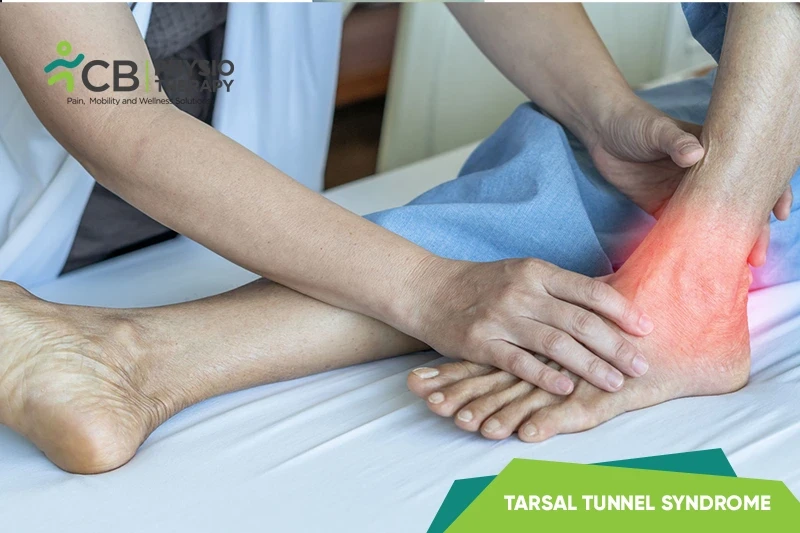
Tarsal Tunnel Syndrome (TTS) or posterior tibial nerve neuralgia is a painful foot condition in which there is repeated pressure resulting in damage to the posterior tibial nerve as it passes through the tarsal tunnel at the ankle. Anything which occupies space in the tarsal canal including cysts and swelling from ankle injuries can compress the tibial nerve. A tarsal tunnel is a narrow space found on the inner side of the ankle. It is a narrow passageway just below the medial malleolus inside the ankle that is bound by bone and soft tissue. Nerves, blood vessels, and tendons pass through this tunnel, including the tibial nerve.
Anything that causes compression of the posterior tibial nerve or takes up space in the tarsal tunnel can squash the tibial nerve. This reduces the blood flow to the nerve which results in tarsal tunnel syndrome. Common causes for tarsal tunnel syndrome are:
Symptoms vary depending on each individual. Some people experience symptoms that progress gradually, others may experience symptoms that begin suddenly. Symptoms of posterior tibial nerve compression are felt on the inner side of the ankle, under the foot, and into the toes. In severe cases, symptoms may also be felt from the calf to the knee. Symptoms usually include:
Pathology:
The tarsal tunnel syndrome is an entrapment neuropathy of the tibial nerve. A tarsal tunnel is formed by the flexor retinaculum, which extends posteriorly and distally to the medial malleolus. The symptoms of compression and tension neuropathies may coexist.
Physical examination:
The examiner checks the progression of the symptoms and checks the medical history like trauma to the area. Examines the foot and ankle, and looks for physical characteristics that could indicate tarsal tunnel syndrome.
Tinel's test:
Tinel's test involves gently tapping the tibial nerve. If the patient experiences a tingling sensation or pain as a result of that pressure, indicates tarsal tunnel syndrome.
Electromyography:
An Electromyography test is done to detect nerve dysfunction.
Magnetic resonance imaging (MRI):
Magnetic resonance imaging (MRI) is done to check whether a mass or bony growth is causing the tarsal tunnel syndrome.
Medication: Non-steroidal anti-inflammatory drugs, Analgesics, etc.
Note: Medication should not be taken without the doctor's prescription
Surgery:
If tarsal tunnel syndrome fails to resolve with conservative treatment, then surgery may be advised, known as Tarsal Tunnel Release or Decompression. Tarsal Tunnel Release may be done arthroscopically, during tarsal tunnel decompression surgery, the flexor retinaculum is first released (cut) and then the area is fully inspected.
Also any abnormal growths e.g. cysts or scar tissue are removed and any fibrous bands that place pressure on the posterior tibial nerve are released.
Rest:
Patients should avoid activities that increase symptoms. Rest helps to reduce pressure on the nerve and allows it to heal.
Regular application of ice to the inner ankle can help to reduce pain and inflammation from tarsal tunnel syndrome and should only be applied for 10 minutes at a time to avoid the risk of further injury.
Compression:
Wearing a compression bandage can help to reduce swelling around the ankle which in turn reduces the pressure on the nerve.
Elevation:
The foot is kept at an elevation that is higher than the level of the heart, which helps to reduce swelling in the ankle and thus reduce the symptoms of tarsal tunnel syndrome.
Orthotics:
Supportive shoes or inserts for the shoes can help to correct foot position by supporting the foot arches. These also help prevent ankle rolling both of which help to reduce the pressure through the tarsal tunnel.
Bracing:
A specially designed ankle brace helps to limit foot and ankle movement and also reduces pressure through the tarsal tunnel.
Kinesio taping is found to be effective, it helps to provide mechanical support for an unstable ankle joint.
Transcutaneous Electrical Stimulation (TENS):
Transcutaneous Electrical Stimulation (TENS) is also found to be effective to decrease swelling, spasms, and pain.
Therapeutic Ultrasound:
The use of Therapeutic ultrasound helps to decrease pain, and inflammation improves function, and helps to enhance the healing process.
Exercises:
Progressive strengthening and stretching exercises help the foot and ankle muscles to support the ankle joint, and mobilization exercises for the tibial nerve improve the integrity of the nerve.

Obese patients are advised to lose weight to reduce symptoms of tarsal tunnel syndrome as pressure goes through the foot. Also, the patient is advised to perform foot and ankle functions with a brace during high-intensity exercises for protection and support.
Get assessed today — find the cause, get a plan, and know when you'll feel better.