Open today · 8 AM–8 PM · Same-day slots
CB Physiotherapy
Same-day appointments

Radial Tunnel Syndrome Treatment Doctors in Ghaziabad

Whether it's a dull ache, a sharp catch, or pain that keeps coming back — we find the root cause of your Radial Tunnel Syndrome and fix it, at a clinic near you or at home.

Precision Care, Proven Recovery
ACCURATE DIAGNOSIS
ROOT CAUSE ASSESSMENT
COMPREHENSIVE RECOVERY PLAN
MILESTONE TRACKING
GOALS ACHIEVED
STAYING ACTIVE
See how it works ↓
Move pain-free Avoid drugs & surgery
5.0 / 5 · 20 Google reviews Verified on Google

Request received!

We'll call you within 10 minutes to confirm your home visit.We'll call you within 10 minutes to confirm your slot.

Chat with us on WhatsApp

Book in 30 seconds

Visit your nearest CB clinic. Tell us your concern and a preferred time — we'll confirm your slot by call within 10 minutes.

Same-day booking by default. We'll confirm your exact slot by call.
+91
No spam · Your number is safe with us
Prefer to talk now? Call +09821966696
Understanding your radial tunnel syndrome

Does this sound like you?

Common triggers include muscle strain, joint stiffness, poor posture and long desk hours. If two or more of these fit, a physiotherapy assessment can identify exactly what's driving it.

  • A dull ache or sharp, burning radial tunnel syndrome that keeps returning
  • Discomfort that worsens with movement, lifting or long sitting hours
  • Morning stiffness that eases as you move
  • Pain that limits work, sport or everyday activities
  • Recurring episodes that keep coming back

Most radial tunnel syndrome improves without surgery or long-term medication — the key is finding the cause first.

⚠ When to seek urgent medical care

Radial Tunnel Syndrome rarely signals something serious, but see a doctor immediately if it comes with:

  • Fever, unexplained weight loss, or a history of cancer
  • Numbness or weakness that keeps getting worse
  • Loss of bladder or bowel control
  • Pain after a major fall or accident

Our physios screen for these red flags at every first assessment and refer you to the right doctor if needed.

Assessment-led treatment

How we treat radial tunnel syndrome

We start with an AI-based assessment to find the root cause — then follow a clear, four-phase plan.

Phase 1

Ease the pain

Hands-on therapy and advanced modalities to calm pain and inflammation fast.

Phase 2

Restore movement

Mobility work and posture correction so everyday movement feels normal again.

Phase 3

Build strength

Targeted strengthening that protects you — in-clinic or in our physio gym.

Phase 4

Return to activity

Back to work, sport and life — with a home program that prevents relapse.

Your physiotherapist, with Fizo IQ™

Every recovery, planned and proven

One patient record, stage by stage: your physiotherapist pinpoints the diagnosis, finds the root cause and builds your in-clinic plan — while Fizo IQ™, our AI decision-support engine, tracks every milestone until your goals are met and you leave with an exercise plan to stay active.

Physio Expert @CB with Fizo IQ™ — recovery engine
TRACKING
ACCURATE DIAGNOSIS
L4–L5 disc bulge · nerve-root irritation, pinpointed at the first movement assessment
ROOT CAUSE ASSESSMENT
Poor sitting posture, weak core–hip chain · quietly loading that disc
COMPREHENSIVE RECOVERY PLAN
24 clinic sessions · manual therapy + spinal decompression · guided exercise therapy, reviewed weekly
MILESTONE TRACKING
Sitting pain-free ✓ · stairs ✓ · next: the morning 5 km walk
GOALS ACHIEVED
Pain 7 → 3 in six weeks · back to daily life, moving freely
STAYING ACTIVE
A personalized exercise plan, yours to keep · so the pain doesn't come back
Example recovery journey · every plan is built around you
Move better

Exercises that help with Radial Tunnel Syndrome

More exercises →

Make these exercises yours

Get my personalized plan

General guidance only — stop if an exercise increases your pain, and check with your physio before starting a new routine.

Meet your care team

Licensed experts who treat hundreds like you every month

Every CB physio is a qualified BPT/MPT clinician. You don't need to choose one — our lead physiotherapist reviews your case and assigns the specialist best suited to treat it.

Dr. Puneet Kumar, physiotherapist in Ghaziabad Verified

Dr. Puneet Kumar

Physiotherapist · MPT (Orthopaedics)

5.0 (1)
Ghaziabad
6 yrs experience
Ortho Spine Sports Physiotherapy Center
Not sure who to see? You don't have to decide. Our lead physiotherapist reviews every case and assigns the physio best suited to it — based on your condition and availability.
Patient stories

Radial Tunnel Syndrome recoveries, verified on Google

Rated 5.0 / 5 across 20 verified patient reviews in Ghaziabad.

Verified

“मुझे फिजियोथेरेपी करवानी है होम सर्विस आपके पास अवेलेबल है”

SK
Sumit Kumar Verified patient · Treated at CB · 5 months ago
Verified

“VERY Best physiotherapist and good experience”

AU
Arun Upadhyay Verified patient · Treated at CB
Verified

“I recently had the pleasure of receiving physiotherapy treatment from Dr. Asif, and I cannot praise his skills and dedication enough. As a physiotherapist, he possesses a unique blend of expertise, compassion, and professionalism that sets him apart from others in his field.”

SK
Shawaiz Khan Verified patient · Treated at CB · 3 months ago
Verified

“I recently had the privilege of being treated by Dr. Asif Alam, and I cannot speak highly enough of his exceptional care and expertise as a physiotherapist. His ability to diagnose and explain the root causes of my issues was truly impressive. He provided me with a clear understanding of my condition His hands-on techniques were precise and effective, providing me with immediate relief and tangible results. He continuously monitored my progress and adjusted the treatment plan accordingly, ensuring that I was on track to a full recovery.”

KN
Krishna N12 Verified patient · Treated at CB · 3 months ago
Verified

“I have no words to express how good Dr. Asif was for post-knee rehabilitation. Every session I had was excellent. Day by day, I'm improving. I can walk without support. Thanks so much! All praise for you!🙏”

RB
Rajiv Bhatia Verified patient · Treated at CB · 3 months ago
Verified

“Thank you, Dr. shally for your outstanding service!👍🏼”

AB
Aakash Bansal Verified patient · Treated at CB · 4 months ago
Good to know

Radial Tunnel Syndrome, answered

Radial tunnel syndrome also known as supinator syndrome occurs when the radial nerve is compressed as it enters the radial tunnel. The radial nerve is one of three nerves of the forearm, traveling from the side of the neck, down the back of the arm, through the forearm, and into the hand. The radial nerve causes movements, like forearm rotation, elbow extension, and wrist and finger movement.

When the radial nerve, or the structures around it, becomes inflamed, it leads to this condition. The causes for radial tunnel syndrome can be:

  • Swelling or fluid in the arm, or surrounding tissues
  • Repetitive activities of forearm and wrist
  • Extending the elbow too much
  • Typing or using a screwdriver
  • Repeated push-and-pull activities
  • Lifting heavyweights
  • Sports activities like throwing a football or baseball
  • Direct blow to the outside of the elbow or forearm
  • Gripping, pinching or bending the wrist
  • Poor strength and flexibility
  • Swelling in the forearm
  • Injury
  • Tumors
  • Diabetes.

The symptoms vary from person to person, some of the symptoms are given below:

  • Deep, aching pain below the elbow in the forearm muscles
  • Pain aggravates by twisting, pushing, or gripping
  • The altered or absent sensation between the thumb and index finger on the back of the hand
  • Weakness of the forearm muscles
  • Decreased wrist strength
  • Difficult to grip or lift certain objects
  • Pain may get worse while sleeping
  • Wrist drop causing loss of ability to lift the hand.

Pathology

Radial Tunnel Syndrome occurs due to the compression of the posterior interosseous nerve which lies in the proximal part of the forearm.

Physical exam

Physical examination is done to look for the painful spot. Pinpointing the source of the pain will be most helpful to check for nerve damage or problems with the bones, muscles, or tendons.

The patient is asked to turn the palm from a palm down position to a palm-up position and apply resistance. If the patient experiences pain in the forearm, then it is a sign of radial tunnel syndrome.

Another test requires, to keep the middle finger straight against resistance. If it is painful then it is a sign of radial tunnel syndrome.

Rule of nine tests:

During this test, when the arm is facing up and the elbow slightly flexed, the physiotherapist separates the elbow into nine equally sized areas, in three rows. Then slight pressure is applied to each spot, if the patient feels pain on the outermost spots of the top two rows, it is a sign of radial tunnel syndrome.

X-Ray:

X-Ray is done to exclude any degenerative elbow changes.

Magnetic Resonance Imaging (MRI):

Though Magnetic Resonance Imaging is not often able to determine the level to which the nerve is irritated or compressed, but can be beneficial in excluding other problems.

Electromyogram (EMG) Tests:

Electromyogram (EMG) tests are recommended to see if the muscles of the forearm are working properly. If the test shows a problem in the muscles, it indicates that it may be caused by a problem in the radial nerve.

Nerve Conduction Velocity (NCV) Test:

Nerve conduction velocity (NCV) test measures the speed of an electrical impulse as it travels along the radial nerve. If the speed is very slow, indicates that the nerve is pinched.

Medication: Non-steroidal anti-inflammatory medications like aspirin, naproxen, ibuprofen, etc.

Note: Medication should not be taken without the doctor's permission.

Surgical treatment is recommended in case rest and non-operative therapy fails. Surgical decompression is done to remove the unwanted pressure from the radial nerve.

Rest:

Rest is recommended to avoid movement that causes pain. A wrist brace or splint is used to reduce movement in the forearm. Wear a wrist or an elbow splint to reduce movement and irritation in the radial nerve.

Ice therapy:

Apply ice for 10-15 minutes every 2 to 3 hours, it helps to decrease the swelling. It causes vasoconstriction of the blood flow, relaxation and makes the muscles more flexible.

Ultrasound massage:

Ultrasound therapy is given to decrease pain and increase circulation.

Manual Therapy:

Manipulation and massage, are given to the soft tissues to prevent the development of adhesions, thus restricting the nerve. Mobility of the nerve reduces nerve entrapment.

Strengthening Exercises:

Strengthening exercises of the muscles help to maintain the balance between agonist and antagonist muscles, closed-kinetic chain activities, proprioceptive neuromuscular facilitation (PNF) diagonal strengthening patterns, and a full range of motions with protective strength, drills, and plyometrics are recommended.

Stretching Exercises:

Wrist Extension Stretch:

Place the affected arm straight in front, with the hand up and fingers facing towards the sky. Use another hand to pull back on the fingers, until a stretch is felt in the forearm.

Wrist Flexion Stretch:

Place the affected arm straight in front, with the hand down and the fingers facing towards the ground. Use the other hand to pull back on the back of the palm until a stretch is felt in the forearm.

Wrist supination:

Place the affected arm by the side at 90-degree, with the forearm and hand facing up. Put the other hand on the wrist and rotate the forearm inward, toward the body, without moving the other parts of the arm.

Self-directed nerve gliding Exercises:

Radial nerve glides:

Stand straight, drop the shoulders slightly and rotate the arms into the body. Flex the wrist on one side and raise the arm up to waist level as the head is tilted to the opposite way. Once the stretch is felt, hold the position for 5 seconds.

These exercises should be done on both sides, even though dealing with radial tunnel syndrome in one arm.

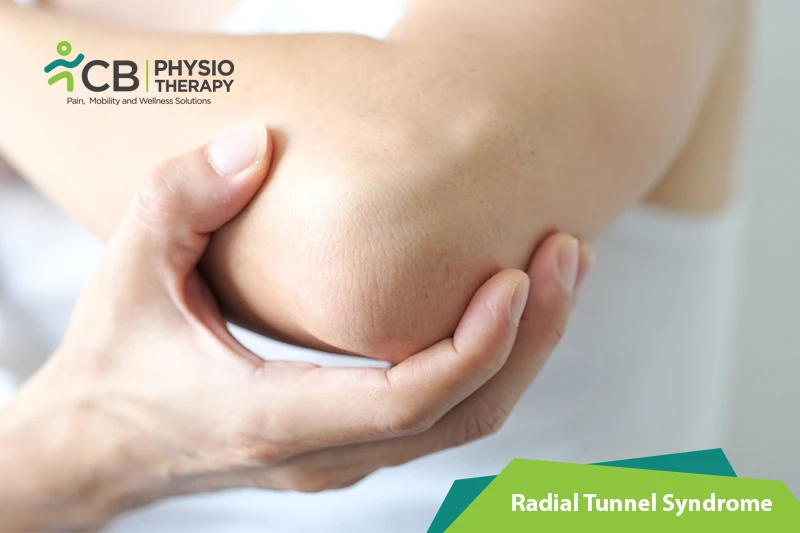
The patient needs to wear a wrist strap during the day and an elbow pad or splint at night to control symptoms. After the recovery, exercises should be continued to maintain the mobility and strength gained. Avoid repetitive motion that causes symptoms, take frequent breaks or modify the work duties. Pain should not be ignored during exercises. If the elbow pain worsens, due to exercising or if the pain does not improve after performing the exercises for 6 to 12 weeks, then the patient is advised to inform his physiotherapist.

Ready when you are

Don't let the pain decide your day.

Get assessed today — find the cause, get a plan, and know when you'll feel better.

📞 Call 💬 WhatsApp Book now