Open today · 8 AM–8 PM · Same-day slots
CB Physiotherapy
Same-day appointments

Plantar Fasciitis Treatment Doctors in Gurgaon

Whether it's a dull ache, a sharp catch, or pain that keeps coming back — we find the root cause of your Plantar Fasciitis and fix it, at a clinic near you or at home.

Precision Care, Proven Recovery
ACCURATE DIAGNOSIS
ROOT CAUSE ASSESSMENT
COMPREHENSIVE RECOVERY PLAN
MILESTONE TRACKING
GOALS ACHIEVED
STAYING ACTIVE
See how it works ↓
Move pain-free Avoid drugs & surgery
5.0 / 5 · 22 Google reviews Verified on Google

Request received!

We'll call you within 10 minutes to confirm your home visit.We'll call you within 10 minutes to confirm your slot.

Chat with us on WhatsApp

Book in 30 seconds

Visit your nearest CB clinic. Tell us your concern and a preferred time — we'll confirm your slot by call within 10 minutes.

Same-day booking by default. We'll confirm your exact slot by call.
+91
No spam · Your number is safe with us
Prefer to talk now? Call +09821966696
Understanding your plantar fasciitis

Does this sound like you?

Common triggers include muscle strain, joint stiffness, poor posture and long desk hours. If two or more of these fit, a physiotherapy assessment can identify exactly what's driving it.

  • A dull ache or sharp, burning plantar fasciitis that keeps returning
  • Discomfort that worsens with movement, lifting or long sitting hours
  • Morning stiffness that eases as you move
  • Pain that limits work, sport or everyday activities
  • Recurring episodes that keep coming back

Most plantar fasciitis improves without surgery or long-term medication — the key is finding the cause first.

⚠ When to seek urgent medical care

Plantar Fasciitis rarely signals something serious, but see a doctor immediately if it comes with:

  • Fever, unexplained weight loss, or a history of cancer
  • Numbness or weakness that keeps getting worse
  • Loss of bladder or bowel control
  • Pain after a major fall or accident

Our physios screen for these red flags at every first assessment and refer you to the right doctor if needed.

Assessment-led treatment

How we treat plantar fasciitis

We start with an AI-based assessment to find the root cause — then follow a clear, four-phase plan.

Phase 1

Ease the pain

Hands-on therapy and advanced modalities to calm pain and inflammation fast.

Phase 2

Restore movement

Mobility work and posture correction so everyday movement feels normal again.

Phase 3

Build strength

Targeted strengthening that protects you — in-clinic or in our physio gym.

Phase 4

Return to activity

Back to work, sport and life — with a home program that prevents relapse.

Your physiotherapist, with Fizo IQ™

Every recovery, planned and proven

One patient record, stage by stage: your physiotherapist pinpoints the diagnosis, finds the root cause and builds your in-clinic plan — while Fizo IQ™, our AI decision-support engine, tracks every milestone until your goals are met and you leave with an exercise plan to stay active.

Physio Expert @CB with Fizo IQ™ — recovery engine
TRACKING
ACCURATE DIAGNOSIS
L4–L5 disc bulge · nerve-root irritation, pinpointed at the first movement assessment
ROOT CAUSE ASSESSMENT
Poor sitting posture, weak core–hip chain · quietly loading that disc
COMPREHENSIVE RECOVERY PLAN
24 clinic sessions · manual therapy + spinal decompression · guided exercise therapy, reviewed weekly
MILESTONE TRACKING
Sitting pain-free ✓ · stairs ✓ · next: the morning 5 km walk
GOALS ACHIEVED
Pain 7 → 3 in six weeks · back to daily life, moving freely
STAYING ACTIVE
A personalized exercise plan, yours to keep · so the pain doesn't come back
Example recovery journey · every plan is built around you
How we treat

The tools we use to fix it

Every plan combines hands-on care, advanced modalities and guided exercise — matched to your assessment.

Feeling something?

Symptoms Plantar Fasciitis addresses

These symptoms respond well to Plantar Fasciitis — tap one to see how we treat it near you.

Move better

Exercises that help with Plantar Fasciitis

More exercises →

Make these exercises yours

Get my personalized plan

General guidance only — stop if an exercise increases your pain, and check with your physio before starting a new routine.

Meet your care team

Licensed experts who treat hundreds like you every month

Every CB physio is a qualified BPT/MPT clinician. You don't need to choose one — our lead physiotherapist reviews your case and assigns the specialist best suited to treat it.

Not sure who to see? You don't have to decide. Our lead physiotherapist reviews every case and assigns the physio best suited to it — based on your condition and availability.
Patient stories

Plantar Fasciitis recoveries, verified on Google

Rated 5.0 / 5 across 22 verified patient reviews in Gurgaon.

Verified

“Best physiotherapist on CB physio platform . Highly educated and very confident regarding knowledge. Thanks CB physio you provide me best Doctor...”

JB
Jatin Verified patient · Treated at CB
Verified

“Received good treatment from Dr .Amit for ankle injury. Now I can walk without any support. My mobility is improved so much..🙏🙏 thank you”

AM
Aman Mehra Verified patient · Treated at CB · 3 months ago
Verified

“Thanks for the treatment, sir, for my back issue; it is quite relaxing now. Pain has been subsidised a lot. I am very satisfied with the treatment I received.”

PS
Prajakta Sharma Verified patient · Treated at CB · 3 months ago
Verified

“i have been to several physical therapy providers over the years, and this one is by far the best. The therapists is caring and really know their stuff. i got treatment for elbow at my home. its so convenient. the treatment was good i can feel much difference..thank you.”

AA
Ashish Arora Verified patient · Treated at CB · 3 months ago
Verified

“I suffered a serious injury that left me with limited mobility and a lot of pain. But thanks to the amazing care I received from Dr. Amit, I was able to regain my strength after 4 sessions and get back to my normal routine. I’m so grateful for his support and expertise..”

GB
Gautam Brar Verified patient · Treated at CB · 3 months ago
Verified

“Dr. Surender is an exceptional home physiotherapy services provider who has a wealth of knowledge and experience in treating various conditions. I recently had the pleasure of receiving treatment from him for a persistent back pain, and I can confidently say that he is one of the best physiotherapists I have ever had.👍🏼🙏”

AS
Amritpal Singh Verified patient · Treated at CB · 4 months ago
Good to know

Plantar Fasciitis, answered

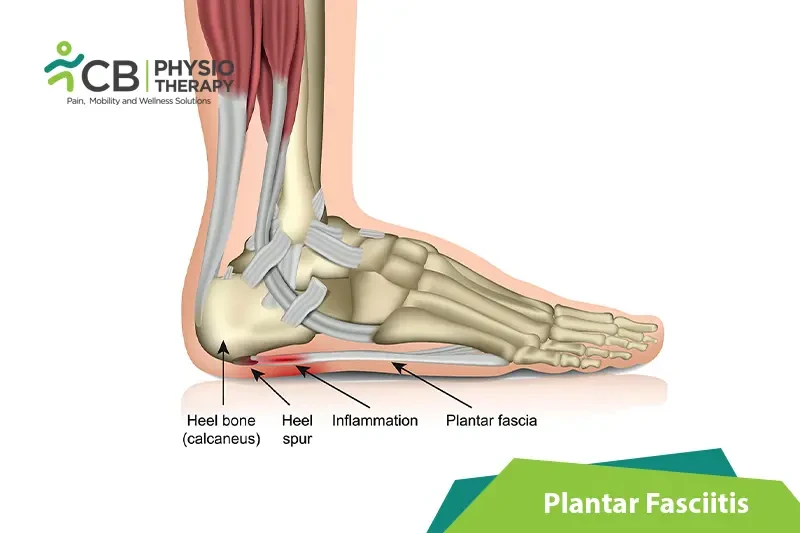
Plantar fasciitis is the inflammation of the ligament (bowstring) or plantar fascia, present underneath the sole attached at the heel, responsible for stretching.

Patients with plantar fasciitis suffer from pain and inflammation. The symptoms of plantar fasciitis include:

  • Pain at the bottom of the heel, or around it.
  • Pain aggravates while standing or sitting for a prolonged period or while and after exercising.
  • Pain after intense activity such as running or jumping.
  • Pain in the medial part of the foot.
  • Pain is worse in the morning.
  • Inflammation and stiffness.
  • Swelling in the heel.
  • Pain while walking barefoot or in shoes with minimal support.

Excessive pressure on the foot can cause a small tear in the tissue and too much pressure can damage the plantar fascia. Other causes may include:

  • Age between 40 to 60 years.
  • Repetitive activities doing exercises like running.
  • Flat feet, high arches.
  • Tight calf muscles.
  • Obesity.
  • Pregnancy.
  • Arthritis.
  • Standing for extended periods.
  • Wearing high-heeled shoes.
  • High longitudinal arches.
  • Weakness of the ankle and foot stabilizers.

Pathology

Plantar fasciitis occurs when the plantar fascia becomes irritated. The plantar fascia supports the foot, providing a tension bridge as well as shock absorption, but it cannot take too much pressure, as a result, excessive tension creates fascia fibers to become inflamed.

Physical examination:

To check the tenderness, redness, swelling, and exact location of the pain in the foot. Examination for reflexes, muscle tone, sense of touch and sight, coordination, and balance are also done.

X-ray:

An X-ray can be used to check any bony lesions of the foot like subcalcaneal spur.

Magnetic resonance imaging (MRI):

Magnetic resonance imaging (MRI) is used for assessing plantar fascia thickening.

Medication: Nonsteroidal anti-inflammatory drugs (NSAIDs), Corticosteroids etc.

Note: Medication should be taken as prescribed by the doctor.

If the conservative treatments do not relieve the symptoms of plantar fasciitis, then the next option is surgery.

Rest:

Rest is first recommended for plantar fasciitis until the inflammation goes away.

Ice:

Ice packs or ice massage can be applied for the treatment of plantar fascia, it is done for 15 to 20 minutes.

Contrast Bath:

A contrast bath is used for the reduction of swelling and inflammation, given for 15 min.

Shock wave therapy:

Shock wave therapy is sound waves bombarded on the heel to stimulate healing within the ligament and relieve symptoms.

Ultrasound:

Ultrasound is given to decrease inflammation, pain and prevent adhesion formation.

Iontophoresis:

Iontophoresis is done in which medication is allowed to pass through the tissue with the help of an electric current.

Posterior-night splints:

Posterior-night splints help maintain ankle dorsiflexion and toe extension, thus providing constant stretch on the plantar fascia.

Foot orthoses:

Foot orthoses provide short-term functional benefits and also a reduction in pain.

Shoe modification:

A soft silicone heel pad can be used to protect the heel. Heel cushions are placed in the back of the shoe, which reduces the effect of the arch support. A viscoelastic heel cup can be placed over the medial calcaneal tubercle to reduce ground reactive forces.

Sole Modification:

A sponge rubber cushion with the center removed may be placed under the heel, or a hole may be drilled into the sole of the shoe at the site of inflammation and covered with sponge rubber.

Taping:

Taping can be done on the gastrocnemius and plantar fascia.

Strengthening exercises:

High-load strength training is an effective treatment for plantar fasciitis. It helps in the reduction of pain and improves function. Towel curls, towel pickup, calf raises (unilateral and bilateral), picking up marbles, and resisted thera-band exercises for the lower leg are examples of strengthening exercises.

Stretching exercises:

Stretching consists of crossing the affected leg over the unaffected leg and using the fingers across the base of the toes to apply pressure onto the toe extension until a stretch is felt along the plantar fascia. Achilles tendon stretching exercises can be performed in a standing position with the affected leg placed behind the unaffected leg with the toes pointed forward. The front knee is bent, keeping the back knee straight and heel on the ground. The stretching can be gentle, prolonged, slow, and static, performed five times by holding each stretch for 15-20 sec.

Manipulations and mobilization:

Manipulations and mobilization help in decreasing pain and stiffness, e.g ankle, subtalar and midfoot joint mobilizations.

Depending on the stage of injury patients should be educated that the symptoms may take a few weeks to improve injury. The patient should follow the advice and activity modification should be done to decrease the distance and duration of walking and instead of doing running or, jumping activities, swimming or cycling should be done to reduce the stress on the foot.

Ready when you are

Don't let the pain decide your day.

Get assessed today — find the cause, get a plan, and know when you'll feel better.

📞 Call 💬 WhatsApp Book now