Open today · 8 AM–8 PM · Same-day slots
CB Physiotherapy
Same-day appointments

Posterior Cruciate Ligament(pcl) Injury Treatment Doctors in Hyderabad

Whether it's a dull ache, a sharp catch, or pain that keeps coming back — we find the root cause of your Posterior Cruciate Ligament(pcl) Injury and fix it, at a clinic near you or at home.

Precision Care, Proven Recovery
ACCURATE DIAGNOSIS
ROOT CAUSE ASSESSMENT
COMPREHENSIVE RECOVERY PLAN
MILESTONE TRACKING
GOALS ACHIEVED
STAYING ACTIVE
See how it works ↓
Move pain-free Avoid drugs & surgery

Request received!

We'll call you within 10 minutes to confirm your home visit.We'll call you within 10 minutes to confirm your slot.

Chat with us on WhatsApp

Book in 30 seconds

Visit your nearest CB clinic. Tell us your concern and a preferred time — we'll confirm your slot by call within 10 minutes.

Same-day booking by default. We'll confirm your exact slot by call.
+91
No spam · Your number is safe with us
Prefer to talk now? Call +04045210121
Understanding your posterior cruciate ligament(pcl) injury

Does this sound like you?

Common triggers include muscle strain, joint stiffness, poor posture and long desk hours. If two or more of these fit, a physiotherapy assessment can identify exactly what's driving it.

  • A dull ache or sharp, burning posterior cruciate ligament(pcl) injury that keeps returning
  • Discomfort that worsens with movement, lifting or long sitting hours
  • Morning stiffness that eases as you move
  • Pain that limits work, sport or everyday activities
  • Recurring episodes that keep coming back

Most posterior cruciate ligament(pcl) injury improves without surgery or long-term medication — the key is finding the cause first.

⚠ When to seek urgent medical care

Posterior Cruciate Ligament(pcl) Injury rarely signals something serious, but see a doctor immediately if it comes with:

  • Fever, unexplained weight loss, or a history of cancer
  • Numbness or weakness that keeps getting worse
  • Loss of bladder or bowel control
  • Pain after a major fall or accident

Our physios screen for these red flags at every first assessment and refer you to the right doctor if needed.

Assessment-led treatment

How we treat posterior cruciate ligament(pcl) injury

We start with an AI-based assessment to find the root cause — then follow a clear, four-phase plan.

Phase 1

Ease the pain

Hands-on therapy and advanced modalities to calm pain and inflammation fast.

Phase 2

Restore movement

Mobility work and posture correction so everyday movement feels normal again.

Phase 3

Build strength

Targeted strengthening that protects you — in-clinic or in our physio gym.

Phase 4

Return to activity

Back to work, sport and life — with a home program that prevents relapse.

Your physiotherapist, with Fizo IQ™

Every recovery, planned and proven

One patient record, stage by stage: your physiotherapist pinpoints the diagnosis, finds the root cause and builds your in-clinic plan — while Fizo IQ™, our AI decision-support engine, tracks every milestone until your goals are met and you leave with an exercise plan to stay active.

Physio Expert @CB with Fizo IQ™ — recovery engine
TRACKING
ACCURATE DIAGNOSIS
L4–L5 disc bulge · nerve-root irritation, pinpointed at the first movement assessment
ROOT CAUSE ASSESSMENT
Poor sitting posture, weak core–hip chain · quietly loading that disc
COMPREHENSIVE RECOVERY PLAN
24 clinic sessions · manual therapy + spinal decompression · guided exercise therapy, reviewed weekly
MILESTONE TRACKING
Sitting pain-free ✓ · stairs ✓ · next: the morning 5 km walk
GOALS ACHIEVED
Pain 7 → 3 in six weeks · back to daily life, moving freely
STAYING ACTIVE
A personalized exercise plan, yours to keep · so the pain doesn't come back
Example recovery journey · every plan is built around you
Feeling something?

Symptoms Posterior Cruciate Ligament(pcl) Injury addresses

These symptoms respond well to Posterior Cruciate Ligament(pcl) Injury — tap one to see how we treat it near you.

Move better

Exercises that help with Posterior Cruciate Ligament(pcl) Injury

More exercises →

Make these exercises yours

Get my personalized plan

General guidance only — stop if an exercise increases your pain, and check with your physio before starting a new routine.

Meet your care team

Licensed experts who treat hundreds like you every month

Every CB physio is a qualified BPT/MPT clinician. You don't need to choose one — our lead physiotherapist reviews your case and assigns the specialist best suited to treat it.

Not sure who to see? You don't have to decide. Our lead physiotherapist reviews every case and assigns the physio best suited to it — based on your condition and availability.
Good to know

Posterior Cruciate Ligament(pcl) Injury, answered

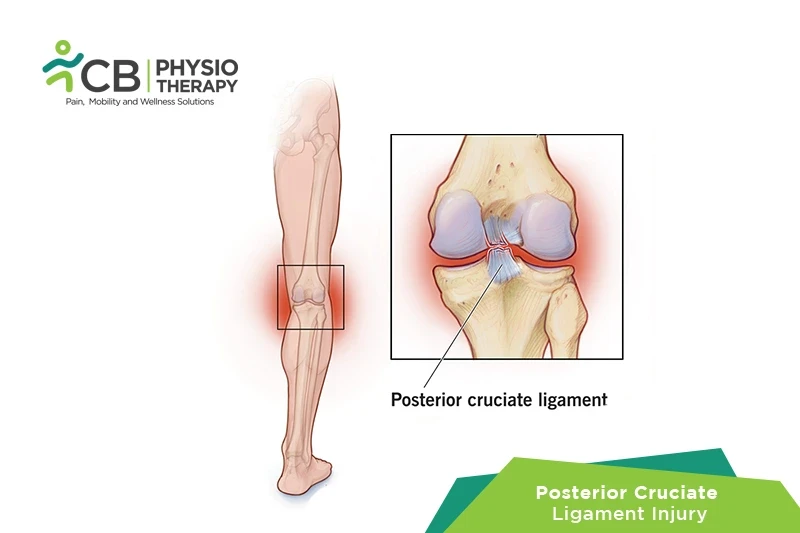
The posterior cruciate ligament (PCL) and the anterior cruciate ligament (ACL) connect the thighbone or femur to the shinbone i.e tibia. The anterior and posterior cruciate ligaments both form an "X" in the center of the knee. If one of these ligaments is torn, then it might cause pain, swelling, and a feeling of instability. Though posterior cruciate ligament (PCL) injury occurs far less often than the anterior cruciate ligament (ACL) if in case it is injured, it causes less pain, disability, and knee instability than an ACL tear, but still takes several weeks or months to recover.

PCL injuries are graded according to severity:

Grade 1: There is limited damage as a result of overstretching. Knee stability and function are not affected.

Grade 2: In this grade, the ligament is partially torn and the patient feels instability.

Grade 3: The patient has a complete ligament tear or rupture. This type of injury is usually accompanied by a sprain of the ACL or/ and collateral ligaments.

If only the posterior cruciate ligament is injured then the symptoms will be so mild they are not noticed, but after some time, the pain might worsen and the knee might feel more unstable. But if other parts of the knee have also been injured, then signs and symptoms are more severe. The patient feels:

  • Mild to moderate pain in the knee,
  • Slight limp or difficulty in walking,
  • Rapid swelling in the knee occurs within hours of the injury,
  • Instability,
  • Pop like a sound heard while playing immediately after the injury,
  • Feeling of giving way.

The posterior cruciate ligament can be torn alone, or along with the other ligament. This can be due to:

  • Shinbone hit hard just below the knee,
  • Bad landings from a jump, simple misstep or fast direction change,
  • Fall on a bent knee,
  • Motor vehicle accidents, dashboard injury,
  • Hyper-extension and rotational stress,
  • Contact sports like football and soccer,
  • Athletes, with hyper-flexion movement.

Physical examination:

Physical examination is done by palpating, the looseness or fluid in the joint. The patient is asked to move the knee, leg, or foot in different directions also asked to stand and walk. The injured leg is compared with the healthy leg to look for sagging or abnormal movement in the knee or shinbone.

X-ray:

An X-ray cannot detect ligament damage but can show bone fractures. Posterior cruciate ligament injuries sometimes have breaks in which a small chunk of bone, is pulled away from the main bone. It can be done in different positions, like standing and weight-bearing with 45° knee flexion.

Magnetic resonance imaging (MRI) scan:

Magnetic resonance imaging (MRI) scan is a painless procedure that uses radio waves and a strong magnetic field to produce images of the soft tissues of the body. MRI scan can show a posterior cruciate ligament tear and also determines whether the other knee ligaments or cartilage are injured. It may appear normal in grade I and II injures.

Medications: Anti-inflammatory medications, analgesics, pain killers, etc.

Note: Medication should not be taken without the doctor's prescription.

Surgery

Treatment depends on the posterior cruciate ligament (PCL) injury on the extent of the injury, in most cases, surgery isn't required.

In severe cases, if the injury is combined with other torn knee ligaments, cartilage damage, or a broken bone, then surgery to reconstruct the ligament might be required. Surgery might also be considered if there are continuous episodes of knee instability despite appropriate rehabilitation.

Arthroscopy: It is a surgical technique, to look inside the knee joint. A tiny video camera is inserted into the knee joint through a small incision, to view the images of the inside of the joint on a computer monitor or TV screen.

Reconstruction: Posterior Cruciate Ligament reconstruction is done to restore normal knee mechanics and dynamic knee stability, and thus correct posterior tibial laxity.

Rest:

Stay off the injured knee, to protect it from further damage. For mobility, crutches are used.

Ice:

Ice packs are applied to the knee for 20 to 30 minutes after every 3 to 4 hours for 2 to 3 days.

Compression:

For compression, an elastic bandage is wrapped around the knee.

Elevation:

To elevate lie down and place a pillow under the knee to help reduce swelling.

Ultrasound therapy:

Ultrasound therapy is used to reduce pain and increase the range of motion.

Transcutaneous electrical stimulation (TENS):

Transcutaneous electrical stimulations are used to decrease pain and swelling.

Range of motion exercises:

Range of motion exercises is used to help decrease swelling and restore the range of motion of the knee.

Stretching exercises:

Stretching exercises are held for 30-seconds, followed by relaxation and repeated 5 times, these stretches can be given to hamstrings, iliotibial tract, gastrocsoleus, etc.

Strengthening Exercises:

Strengthening exercises include isometrics, isotonic and isokinetic exercises. Quad sets, hams sets, hamstring curls, straight leg raises, heel raises, heel dig bridging, shallow standing knee bends are examples of strengthening exercises.

Progressive resistive exercises (PRE):

Progressive resistive exercises are self-resistive exercises that are progressed gradually to self-generated tension and resistance exercise with weight belts.

Balance exercises:

Balance exercises are used to enhance balance and equilibrium by using a bobath ball or a wobble board.

Plyometrics:

Plyometric exercises like high-intensity exercises are used to meet the high demands of strenuous and sports activities. These high-intensity exercises include squat jumps, clapping pushups, reverse lunge knee-ups, jumping, running, etc.

The patient is asked to avoid twisting or pivoting movement of the knee. Strengthening and stretching exercises should be continued to prevent reinjury. The patient should be careful while doing strenuous activities.

Ready when you are

Don't let the pain decide your day.

Get assessed today — find the cause, get a plan, and know when you'll feel better.

📞 Call 💬 WhatsApp Book now