
Meralgia Paresthetica — Symptoms, Causes & Treatment
Also known as Meralgia Paresthetica. Causes, symptoms and how physiotherapy treats Meralgia Paresthetica — without surgery or medicines.
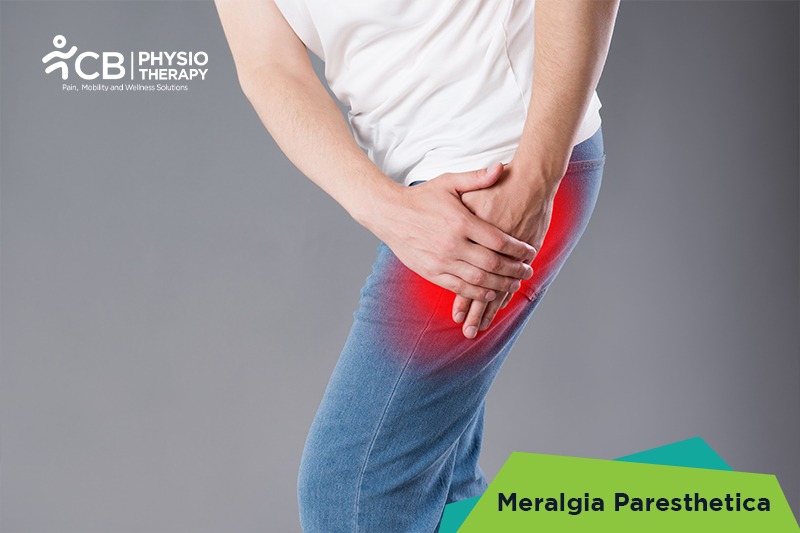
Understanding Meralgia Paresthetica
Meralgia Paresthetica affects people differently, and the right care starts with understanding how it affects you. Its day-to-day impact — on movement, strength, energy and confidence — is where physiotherapy does its work.
Our role in Meralgia Paresthetica is practical: protect and rebuild movement and daily function with a plan set after a careful assessment, in coordination with your doctor wherever medical management is involved. No two plans look the same, because no two cases behave the same.
Causes & risk factors of Meralgia Paresthetica
What commonly drives it — your assessment pins down which of these apply to you.
More than one possible driver
Meralgia Paresthetica can have several contributing factors — a careful history and physical assessment separate them rather than guessing.
Reduced movement and deconditioning
Whatever the trigger, less movement quickly adds weakness and stiffness of its own — usually the most reversible part.
Daily-life load and habits
Work posture, repeated tasks, sleep and stress all shape how a condition behaves day to day.
General health and history
Overall health, previous injuries and existing conditions influence both the picture and the plan — the assessment takes all of it in.
When physiotherapy is the right call
If any of these sound like you, an assessment is the right first step.
- ✓ A new diagnosis of Meralgia Paresthetica and you want a clear rehabilitation start point
- ✓ Daily tasks, walking or stairs are getting harder than they used to be
- ✓ Strength, stamina or balance has visibly dropped
- ✓ You want a structured clinic + home program with measurable milestones
- ✓ Family members need guidance to support you safely
Your treatment journey
Step by step — from your first assessment to a tracked recovery plan.
A detailed first assessment
History, movement testing and strength checks — a focused session to find what is actually driving your Meralgia Paresthetica.
A diagnosis you understand
Your physiotherapist explains the findings in plain language — what is affected, why it happened and what that means for you.
Active, tracked treatment
Hands-on therapy, the right modalities and graded exercise — progressed session by session and tracked on Fizo IQ™.
Prevention, built in
The final phase rebuilds strength and habits so the same problem does not come back — with a home plan you keep.
What recovery looks like
- ✓ More independence in daily tasks
- ✓ Better strength, balance and stamina
- ✓ Fewer setbacks, with red flags monitored
- ✓ A program your family understands and can support
- ✓ Progress measured milestone by milestone on Fizo IQ™
When to see a doctor — red flags
How CB Physiotherapy treats Meralgia Paresthetica
At CB Physiotherapy, treatment for Meralgia Paresthetica starts with finding its cause: a structured, physiotherapist-led assessment before anything is prescribed. Your plan then combines hands-on therapy, targeted exercise and the right modalities — delivered at a clinic near you or at home, and coordinated with your doctor where medical care is involved.
Every case runs on Fizo IQ™, our recovery engine: diagnosis, root cause, plan, milestones and goals, tracked session by session. You always know where you are in your recovery — and what comes next.
Exercises that help with Meralgia Paresthetica
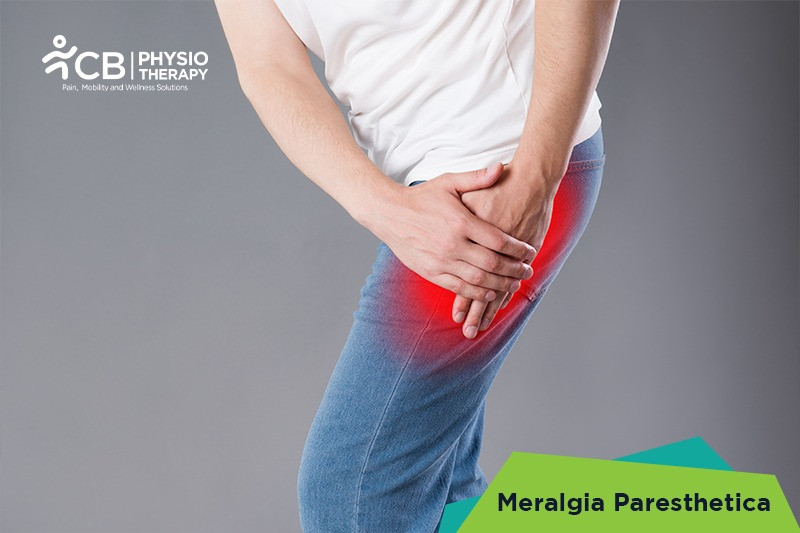
Make these exercises yours — a CB physio personalizes, doses and tracks your plan week by week.
Get my personalized planGeneral guidance only — stop if an exercise increases your pain, and check with your physio before starting a new routine.
Get Meralgia Paresthetica treatment near you
Certified physiotherapists at a clinic near you or at home — same-day slots, assessment-led care.
Request received!
We'll call you within 10 minutes to confirm your home visit.We'll call you within 10 minutes to confirm your slot.
Chat with us on WhatsAppMeralgia Paresthetica, answered
Meralgia Paresthetica is a condition that occurs due to the compression of the lateral femoral cutaneous nerve (LFCN). This nerve supplies sensation to the front and side of the thigh. Meralgia Paresthetica causes burning pain and numbness in the thigh area.
- Overweight,
- Extremely tight clothes for a long time that includes stockings, belts, pants, etc, that cause tension on the skin,
- Injuries during car accidents due to seat belts,
- Heavy objects on the waists, like guns and other tools,
- Diabetes,
- Pregnancy,
- Recovering from recent surgery,
- Different lengths of legs.
- Pain on the outer thigh, extending down to the outer side of the knee,
- Burning, tingling, stabbing pain,
- Numbness in the thigh,
- Pain aggravates when the thigh is touched lightly,
- Pain worsens after walking or standing for long periods,
- Aching pain in the groin area that radiates to the buttocks,
- Feeling pressure on the foot is accompanied by the feeling of extensive pain after walking or even standing still for some time.
PATHOLOGY:
Meralgia Paresthetica is the entrapment neuropathy of the lateral femoral cutaneous nerve that causes pain, inflammation, and numbness in the outer thigh.
Physical Examination is done for some movements of the leg to check for neurological abnormalities. Also, medical history is considered to make the proper diagnosis.
X-rays:
X-rays are done to rule out any bony problems.
Magnetic resonance imaging and CT scan:
Magnetic resonance imaging and CT scan are done to look inside the hip region of the pelvic area which helps to know the root cause of the disease.
Electromyography:
Electromyography is done to check the electrical activity of the muscles in the leg region. A thin needle electrode is used for the same.
Nerve Conduction Test:
A nerve conduction test is done to check the nerve function by applying electrodes to the patient's skin.
Nerve Blockade:
For nerve blockage, the patient is injected with anesthesia into the thigh, at a point where the lateral femoral cutaneous nerve (LFCN) is supposed to be compressed.
Blood Tests:
The blood test is done to rule out the other conditions.
Note: Medication should not be taken without the doctor's prescription.
Surgery:
Nerve decompression and neurectomy surgery are done rarely to correct any compression of the lateral femoral cutaneous nerve. Surgery is usually recommended if the symptoms are not relieved by other treatments.
Cryotherapy is found to be effective to decrease swelling and pain.
Thermotherapy increases blood circulation and relieves pain and inflammation.
Phonophoresis:
Phonophoresis helps the body to absorb pain medications that are applied.
Transcutaneous electrical stimulations (TENS):
Transcutaneous electrical nerve stimulation (TENS) is an effective treatment for painful peripheral neuropathy. It provides symptom relief by using an electric current to stimulate the nerve and activates central mechanisms and causes an analgesic effect.
Low-level laser therapy (LLLT)
Low laser therapy is found to be effective for LCN, as it has an analgesic effect for neuropathic pain.
Kinesio-Taping increases vascular and lymphatic flow, decreases pain, enhances normal muscle function, proprioception, and also helps to correct any malalignments.
Acupuncture techniques like needling and cupping can be done as it has shown effective results.
Manual therapy like myofascial therapy for iliopsoas, rectus femoris, Active Release Techniques (ART), mobilization or manipulation for the pelvis, and transverse friction massage of the inguinal ligament is recommended.
Exercises:
30 – 40 minutes of exercises a day for 3 or 4 days a week is done to relieve chronic pain, these exercises include joint stability exercises, flexibility exercises, muscle strengthening, and endurance exercises.
Strengthening and Stretching Exercises:
Strengthening and Stretching Exercises for the hip, pelvis, and abdominal core exercises are recommended. Strengthening exercises like isometric exercises with resistance, use of weights, etc can be done. Nerve stretching exercises can be done to relieve pain and reduce the tightness in the nerves and also help relieve pain that is associated with tight nerves.
Balance Exercises:
Balance training exercises are given to enhance postural control and functional ability.
Weight loss therapy for obese patients:
Physiotherapists help to decrease weight, by designing a weight loss program and increasing patients' physical activities.
Aerobic exercises like stationary biking, brisk walking, swimming, and water aerobic exercises can be done.
The patient is advised to lose weight, not to wear tight clothes, and avoid wearing tool belts and girdles. The patients are advised to take timely treatment from the doctors, to prevent any damage in the nervous system in the infected part.
Don't let Meralgia Paresthetica decide your day.
Get assessed today — find the cause, get a plan, and know when you'll feel better.