
Spondylolisthesis — Symptoms, Causes & Treatment
Also known as Spondylolisthesis. Causes, symptoms and how physiotherapy treats Spondylolisthesis — without surgery or medicines.
Understanding Spondylolisthesis
Spondylolisthesis can arrive suddenly or build over months, and how much it hurts is a poor guide to how serious it is — minor strains can hurt intensely, while slow-building problems stay quiet until they start limiting you.
Physiotherapy approaches Spondylolisthesis by treating the cause rather than chasing the symptom: a detailed movement assessment first, then a plan combining hands-on treatment, targeted exercise and the habit changes that stop it returning.
Causes & risk factors of Spondylolisthesis
What commonly drives it — your assessment pins down which of these apply to you.
Old injuries and compensations
A previous injury that never fully rehabilitated often leaves a movement pattern that overloads something else.
Sudden spikes in activity
A new sport, a new gym program, a long trek — tissue adapts to gradual change and protests when change is sudden.
Muscle strain and overload
A sudden lift, an awkward movement or simply more load than the tissues were prepared for — the most common trigger.
Posture and long static hours
Desks, driving and screens keep the same structures loaded for hours at a stretch — comfortable at first, aching later.
Joint stiffness and age-related change
Joints that move less start to hurt more; age-related wear is normal, but painful stiffness is not something to simply accept.
When physiotherapy is the right call
If any of these sound like you, an assessment is the right first step.
- ✓ You want to return to sport or work with a plan, not by trial and error
- ✓ Spondylolisthesis that keeps returning or hasn't settled within two weeks
- ✓ Pain or stiffness that limits work, sleep or daily activities
- ✓ You want to avoid long-term painkillers — or surgery has been mentioned
- ✓ You've been diagnosed with Spondylolisthesis and told to "rest and see"
Your treatment journey
Step by step — from your first assessment to a tracked recovery plan.
A detailed first assessment
History, movement testing and strength checks — a focused session to find what is actually driving your Spondylolisthesis.
A diagnosis you understand
Your physiotherapist explains the findings in plain language — what is affected, why it happened and what that means for you.
Active, tracked treatment
Hands-on therapy, the right modalities and graded exercise — progressed session by session and tracked on Fizo IQ™.
Prevention, built in
The final phase rebuilds strength and habits so the same problem does not come back — with a home plan you keep.
What recovery looks like
- ✓ A clear diagnosis and a timeline you can plan around
- ✓ Strength and movement rebuilt, not just pain reduced
- ✓ Lower chance of recurrence, with a prevention plan
- ✓ Care without long-term medicines — at a clinic near you or at home
- ✓ Relief that comes from treating the cause, not masking it
When to see a doctor — red flags
How CB Physiotherapy treats Spondylolisthesis
We treat Spondylolisthesis the way we treat everything: assessment first, plan second, treatment third. It sounds obvious, but it is the difference between sessions that fill a slot and sessions that move you towards a goal. Care is delivered by certified physiotherapists at a clinic near you or at home.
Your whole journey is tracked on Fizo IQ™ — the diagnosis, the root cause, the milestones and the goals — so progress is measured, not guessed, and the plan adapts the moment your response calls for it.
Exercises that help with Spondylolisthesis
 Top 5 Exercises For Spondylolisthesis
Steps & precautions →
Top 5 Exercises For Spondylolisthesis
Steps & precautions →
 Top 5 Exercises For Back Pain
Steps & precautions →
Top 5 Exercises For Back Pain
Steps & precautions →
Make these exercises yours — a CB physio personalizes, doses and tracks your plan week by week.
Get my personalized planGeneral guidance only — stop if an exercise increases your pain, and check with your physio before starting a new routine.
Get Spondylolisthesis treatment near you
Certified physiotherapists at a clinic near you or at home — same-day slots, assessment-led care.
Request received!
We'll call you within 10 minutes to confirm your home visit.We'll call you within 10 minutes to confirm your slot.
Chat with us on WhatsAppSpondylolisthesis, answered
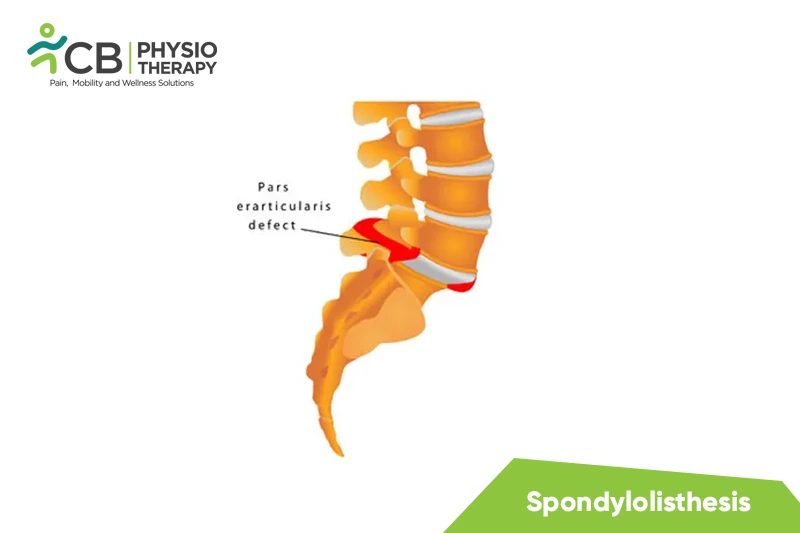
Spondylolisthesis is a spinal condition that affects the lower vertebrae of the spinal column. This disease causes one of the lower vertebrae to slip forward onto the bone present beneath it. It’s a painful condition but treatable in most cases, both by therapeutic as well as surgical methods.
The symptoms of spondylolisthesis vary. People suffering from mild symptoms may not have any symptoms, but those with severe cases may be unable to perform daily activities. Few most common symptoms are:
- Persistent pain in the lower back.
- Stiffness in the back and legs.
- Tenderness in the lower back.
- Pain in the thigh.
- Tightness in hamstring and buttock muscles
- Difficulty walking.
Spondylolisthesis has many causes, some of them are:
- Above 50 yrs of age,
- Heredity.
- Birth defect
- Sudden injury or trauma to the spine.
- Repetitive trauma to the spine.
- Rapid growth during adolescence.
- Strain or overstretch and stress on the lower back.
- Sports such as football, weightlifting, gymnastics, track, and field.
- Spondylolysis.
Pathology:
Pathology of spondylolisthesis involves a fractured pars interarticularis of the lumbar vertebrae, also called the isthmus. This affects the supporting integrity of the vertebrae, which could lead to slippage of the corpus of the vertebrae, called spondylolisthesis. This, in turn, leads to lumbar instability. This slippage can occur in 2 directions: anterior translation, called anterolisthesis, or backward translation, called retrolisthesis. Ligamentous structures, including the iliolumbar ligament, between L5 and the sacrum, are stronger than those between L4 and L5, because of which the vertebral slip commonly develops in L4.
Physical examination:
Physical examination is the first step in diagnosing this condition. In the case of spondylolisthesis, the patient may have difficulty raising the leg straight outward during simple exercises.
X-rays:
X-rays of the lower spine are used to determine whether a vertebra is out of place. The examiner may also look for any possible bone fractures on the X-ray images.
CT-scan:
CT scan shows a more detailed image of the misplaced bone pressing on the nerves.
Magnetic resonance imaging (MRI):
Magnetic resonance imaging (MRI) scans help locate pinched nerves.
Medication: Anti-inflammatory drugs such as ibuprofen, epidural steroid injections, etc.
Note: Medication should not be taken without the doctor’s prescription.
Surgery:
The treatment for spondylolisthesis depends on the severity of pain and vertebra slippage Adults suffering from severe cases of spondylolisthesis may need to have spinal fusion surgery. Surgical correction of the misplaced vertebra is required when the bone has slipped so far down that the spine doesn’t respond to nonsurgical therapies. Surgery is also required if the bones of the spine are pressing on the nerves.
Thermotherapy provides relief by increasing circulation and decreasing pain.
Cryotherapy is used to provide relief for sore muscles.
Ultrasound therapy works by passing the sound waves causing tissues to oscillate at a frequency that increases blood flow.
Transcutaneous electrical stimulations (TENS):
This electrical modality stimulates the muscles through variable intensities of electrical current. TENS helps reduce muscle spasms and increases the body’s production of endorphins (natural painkillers).
IFT helps to increase blood circulation, stimulates the spinal nerve, and reduces pain and inflammation.
Brace:
A brace can be used temporarily used for relief. Though, wearing a brace for a long time can make the muscles weaker.
Massage uses the application of appropriate pressure, to reduce pain, increase blood flow, reduce swelling, promote tissue growth, and provide relief from muscle spasms.
Manual therapy reduces pain, and thus improves function by increasing the range of motion, e.g., manipulation, mobilization, etc.
Exercises:
Exercises include a simple range of motion like flexion, extension, side flexion, and rotation movements. Stretching exercises are done to decrease stiffness and pain. And also increase the flexibility of the lumbar spine. Strengthening exercises are recommended to regain the lost strength of the back muscles. These exercises include isometric exercises, isotonic exercises, and many more.
The patient is advised to maintain the alignment of the spine during sitting and standing activities, not to remain in the same position for a longer period, and therefore take breaks in between. Medical intervention is crucial for relieving symptoms of spondylolisthesis. Early treatment measures are advised to alleviate most symptoms of this condition, as it can cause pain and permanent damage if left untreated.
Don't let Spondylolisthesis decide your day.
Get assessed today — find the cause, get a plan, and know when you'll feel better.