
Whiplash — Symptoms, Causes & Treatment
Also known as Whiplash. Causes, symptoms and how physiotherapy treats Whiplash — without surgery or medicines.
Understanding Whiplash
Living with Whiplash usually means negotiating with it daily — adjusting how you sit, move, sleep and work around it. It is common; that never makes it something you simply have to live with.
In most cases the problem behaves mechanically: particular movements or positions load the affected structures more than they can currently tolerate. A physiotherapy assessment identifies that mechanism, and treatment targets it directly — most mechanical cases respond well to conservative care, without medicines or surgery.
Causes & risk factors of Whiplash
What commonly drives it — your assessment pins down which of these apply to you.
Joint stiffness and age-related change
Joints that move less start to hurt more; age-related wear is normal, but painful stiffness is not something to simply accept.
Weakness and deconditioning
When supporting muscles lose strength, load shifts to structures that were never meant to carry it.
Old injuries and compensations
A previous injury that never fully rehabilitated often leaves a movement pattern that overloads something else.
Sudden spikes in activity
A new sport, a new gym program, a long trek — tissue adapts to gradual change and protests when change is sudden.
Muscle strain and overload
A sudden lift, an awkward movement or simply more load than the tissues were prepared for — the most common trigger.
When physiotherapy is the right call
If any of these sound like you, an assessment is the right first step.
- ✓ You want to return to sport or work with a plan, not by trial and error
- ✓ Whiplash that keeps returning or hasn't settled within two weeks
- ✓ Pain or stiffness that limits work, sleep or daily activities
- ✓ You want to avoid long-term painkillers — or surgery has been mentioned
- ✓ You've been diagnosed with Whiplash and told to "rest and see"
Your treatment journey
Step by step — from your first assessment to a tracked recovery plan.
A detailed first assessment
History, movement testing and strength checks — a focused session to find what is actually driving your Whiplash.
A diagnosis you understand
Your physiotherapist explains the findings in plain language — what is affected, why it happened and what that means for you.
Active, tracked treatment
Hands-on therapy, the right modalities and graded exercise — progressed session by session and tracked on Fizo IQ™.
Prevention, built in
The final phase rebuilds strength and habits so the same problem does not come back — with a home plan you keep.
What recovery looks like
- ✓ Strength and movement rebuilt, not just pain reduced
- ✓ Lower chance of recurrence, with a prevention plan
- ✓ Care without long-term medicines — at a clinic near you or at home
- ✓ Relief that comes from treating the cause, not masking it
- ✓ A clear diagnosis and a timeline you can plan around
When to see a doctor — red flags
How CB Physiotherapy treats Whiplash
We treat Whiplash the way we treat everything: assessment first, plan second, treatment third. It sounds obvious, but it is the difference between sessions that fill a slot and sessions that move you towards a goal. Care is delivered by certified physiotherapists at a clinic near you or at home.
Your whole journey is tracked on Fizo IQ™ — the diagnosis, the root cause, the milestones and the goals — so progress is measured, not guessed, and the plan adapts the moment your response calls for it.
Exercises that help with Whiplash
Make these exercises yours — a CB physio personalizes, doses and tracks your plan week by week.
Get my personalized planGeneral guidance only — stop if an exercise increases your pain, and check with your physio before starting a new routine.
Get Whiplash treatment near you
Certified physiotherapists at a clinic near you or at home — same-day slots, assessment-led care.
Request received!
We'll call you within 10 minutes to confirm your home visit.We'll call you within 10 minutes to confirm your slot.
Chat with us on WhatsAppWhiplash, answered
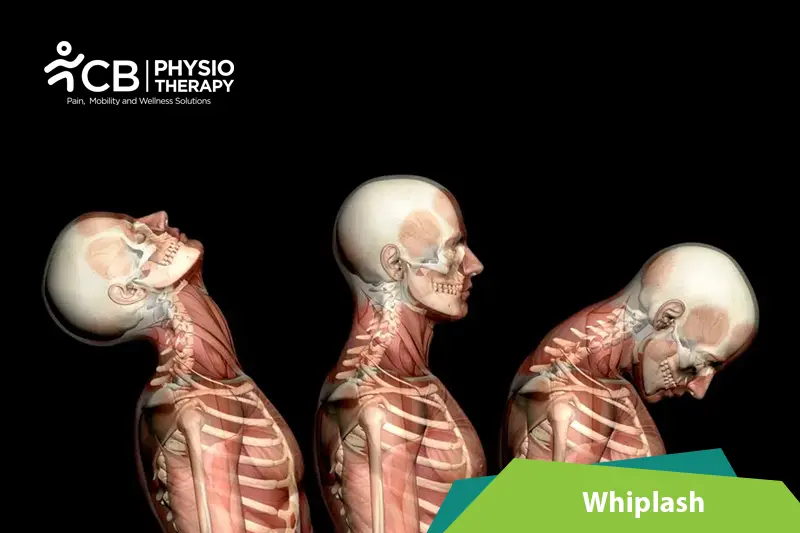
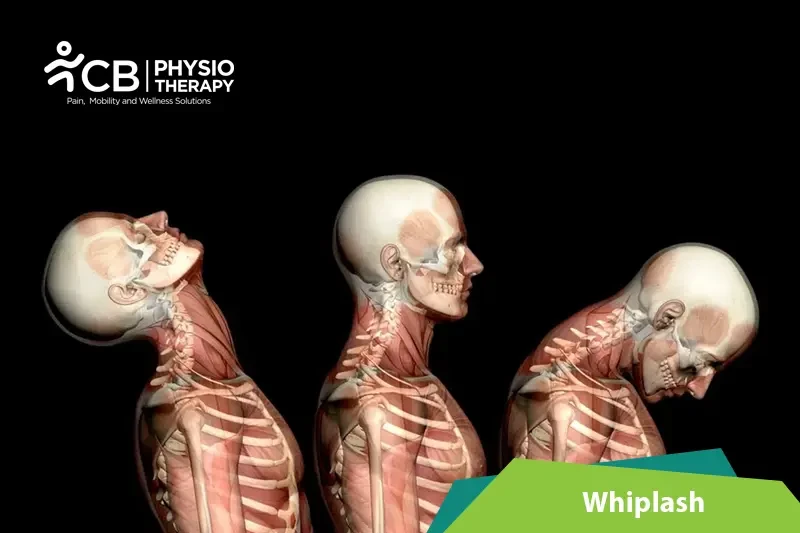
The term "whiplash" injury is used for accelerating-decelerating injuries that occur to the neck region or the cervical spine, modified to a term known as whiplash-associated disorders (WAD), these describe a collection of neck-related symptoms after a motor vehicle accident (MVA). Whiplash and whiplash-associated disorders (WAD) affect many structures of the cervical spine, depending on the force, the direction of impact, and many other factors.
The whiplash-associated disorder has a variety of motor, sensorimotor, sensory, and psychological symptoms some of them include:
- Headache,
- Dizziness,
- Neck stiffness,
- Numbness and tingling in arms and hands,
- Tinnitus,
- Malaise,
- Constant or motion-induced neck pain,
- Restricted cervical range of motion,
- Disturbed motor control of the neck,
- Cervical spine instability,
- Vision and hearing problems,
- Loss of balance,
- Psychological distress,
- Post-traumatic stress,
- Concentration and memory problems,
- Sleep disturbances,
- Anxiety,
- Depression.
Whiplash-associated disorders can occur due to no, of causes some of them are mentioned below:
- Older people tend to have decreased muscle flexibility and strength, thus can cause more damage than a younger person when it is forcibly moved back and forth,
- Sudden motion to the muscles, tendons, nerves, and discs of the neck,
- MVA or car crash-related mechanism,
- High impact sports injuries, like gymnastics, football, boxing, or skiing,
- Rides, such as roller coaster,
- Physical assault like punching or shaking,
- A fall.
Assessment of the patient with WAD should follow the normal cervical examination.
Physical examination:
Physical examination including inspection, palpation, ROM testing, and neurological examination is done to identify signs and symptoms of whiplash.
X-ray:
X-ray is recommended after the injury, a fracture, or damage to the spine. X-rays may also be used in patients whose symptoms don't improve after several weeks of injury.
Magnetic resonance imaging (MRI):
Magnetic resonance imaging, or MRI, is used to check the injury to the spinal cord or discs.
CT scan:
Computerized tomography, or CT scan, can show images of the bones and muscles.
Medication: Analgesics, nonsteroidal anti-inflammatory, muscle relaxants.
Note: Medication should not be taken without the doctor's prescription.
Therapeutic Ultrasound:
Therapeutic Ultrasound is recommended to promote healing and reduce pain, stiffness, muscle spasms and cramps.
Transcutaneous electrical nerve stimulation TENS:
Transcutaneous electrical nerve stimulation (TENS) may be used for the patient by applying a mild electric current to the skin. It helps to ease neck pain and improve muscle strength.
Ice therapy decreases the blood circulation in the injured part, which helps to reduce pain, inflammation, and muscle spasms.
Heat therapy increases blood circulation thus increasing the oxygen to the injured part. The blood removes the toxic substances which creates muscle spasms.
Rest:
Immobilize the neck for only a suitable time as prolonged immobilization may decrease muscle strength.
Soft foam:
Cervical collars can be used for whiplash injury to hold the neck and head still.
Range of motion exercises:
Early mobilization and range of motion exercises are most effective. Exercises like chin tuck help to retrain the deep muscles in the neck. After the car accident, the longus capitis and longus colli muscles of the neck have often decreased activity. Other exercises may include rotating the neck in both directions, tilting the head side to side bending the neck toward the chest, rolling the shoulders etc.
Strengthening exercises:
Strengthening the muscles, improves posture, and restores normal movement. Strengthening exercises like the serratus wall slide is a light strengthening exercise, it is a good re-training exercise for the serratus anterior muscle.
Stretching exercises:
Stretching exercises are done to increase range of motion, exercises like Levator release with a ball can be used to reduce muscle tightness where the shoulder and the neck meet.
The patient should be educated about motor vehicle accidents and advised to adhere to safe driving practices, like not driving while distracted, using seatbelts properly, and adjusting the headrest to the correct height.
Don't let Whiplash decide your day.
Get assessed today — find the cause, get a plan, and know when you'll feel better.