Verified
Dr. Surender Singh
Physiotherapist · BPT
See clinics, physiotherapists and prices for your city.
Whether it's a dull ache, a sharp catch, or pain that keeps coming back — we find the root cause of your Hand Fractures and fix it, at a clinic near you or at home.
Precision Care, Proven RecoveryWe'll call you within 10 minutes to confirm your home visit.We'll call you within 10 minutes to confirm your slot.
Chat with us on WhatsAppCommon triggers include muscle strain, joint stiffness, poor posture and long desk hours. If two or more of these fit, a physiotherapy assessment can identify exactly what's driving it.
Most hand fractures improves without surgery or long-term medication — the key is finding the cause first.
Hand Fractures rarely signals something serious, but see a doctor immediately if it comes with:
Our physios screen for these red flags at every first assessment and refer you to the right doctor if needed.
We start with an AI-based assessment to find the root cause — then follow a clear, four-phase plan.
Hands-on therapy and advanced modalities to calm pain and inflammation fast.
Mobility work and posture correction so everyday movement feels normal again.
Targeted strengthening that protects you — in-clinic or in our physio gym.
Back to work, sport and life — with a home program that prevents relapse.
One patient record, stage by stage: your physiotherapist pinpoints the diagnosis, finds the root cause and builds your in-clinic plan — while Fizo IQ™, our AI decision-support engine, tracks every milestone until your goals are met and you leave with an exercise plan to stay active.
These symptoms respond well to Hand Fractures — tap one to see how we treat it near you.
Make these exercises yours — a CB physio personalizes, doses and tracks your plan week by week.
Get my personalized planGeneral guidance only — stop if an exercise increases your pain, and check with your physio before starting a new routine.
Every CB physio is a qualified BPT/MPT clinician. You don't need to choose one — our lead physiotherapist reviews your case and assigns the specialist best suited to treat it.
Verified
Physiotherapist · BPT
Verified
Physiotherapist · MPT
Verified
Physiotherapist · BPT
Verified
Physiotherapist · BPT
Verified
Physiotherapist · BPT
Verified
Physiotherapist · BPT
Verified
Physiotherapist
Rated 5.0 / 5 across 22 verified patient reviews in Gurgaon.
“Best physiotherapist on CB physio platform . Highly educated and very confident regarding knowledge. Thanks CB physio you provide me best Doctor...”
“Received good treatment from Dr .Amit for ankle injury. Now I can walk without any support. My mobility is improved so much..🙏🙏 thank you”
“Thanks for the treatment, sir, for my back issue; it is quite relaxing now. Pain has been subsidised a lot. I am very satisfied with the treatment I received.”
“i have been to several physical therapy providers over the years, and this one is by far the best. The therapists is caring and really know their stuff. i got treatment for elbow at my home. its so convenient. the treatment was good i can feel much difference..thank you.”
“I suffered a serious injury that left me with limited mobility and a lot of pain. But thanks to the amazing care I received from Dr. Amit, I was able to regain my strength after 4 sessions and get back to my normal routine. I’m so grateful for his support and expertise..”
“Dr. Surender is an exceptional home physiotherapy services provider who has a wealth of knowledge and experience in treating various conditions. I recently had the pleasure of receiving treatment from him for a persistent back pain, and I can confidently say that he is one of the best physiotherapists I have ever had.👍🏼🙏”
The hand is an amazing work of intricate design and function, consisting of 27 bones including 8 bones of the wrist. When the other underlying structures of the hand like joint cartilage, ligaments, tendons, muscles, nerves, arteries, veins, and fingernails are injured, it can make a person handicap.
TYPES OF HAND FRACTURES
Hand fractures can occur due to many reasons few of them are:
The symptoms of hand fractures depend on the type of injury, mechanism, and severity of the injury:
PATHOLOGY
Depending upon the age of the individual, strength, frequency, and the type of forces produced by the injury, the bone fracture can occur. Usually, repetitive movements or high-velocity forces can lead to mechanical failure.
Medical evaluation may include a medical history and physical examination.
X-rays:
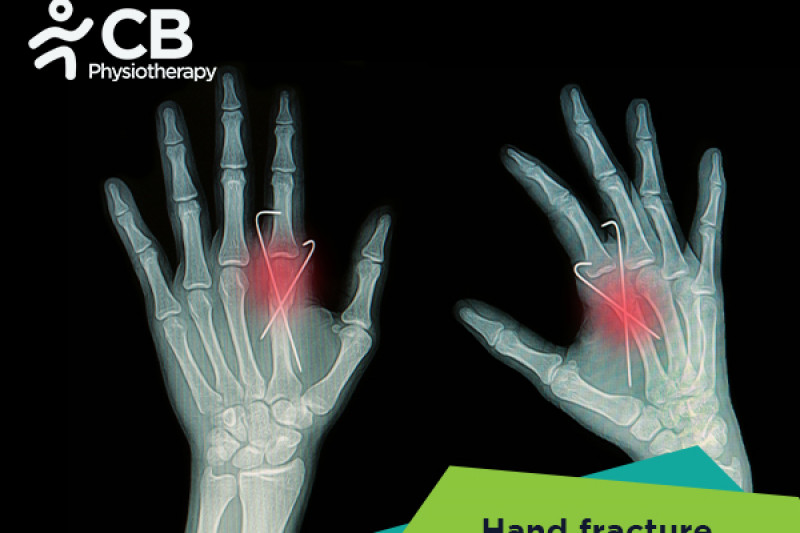
X-rays will require X-rays to identify any bony problem, fracture, or dislocation or rule out foreign bodies.
Computed tomography scan (CT scan):
Computed tomography scan (CT scan) provides detailed information about the bone.
Magnetic resonance imaging (MRI):
Magnetic resonance imaging (MRI) creates very detailed images using magnetic fields, it shows the image of the damaged bone and soft tissues.
Bone scan:
A bone scan helps to find fractures that are not shown by an X-ray.
Depending on the fracture type, location of the fracture, and stability, operative or non-operative intervention is used. Non-displaced fractures and fractures that are stable are treated with closed reduction or non-operative intervention by closed reduction by using a splint or a cast for immobilization. Displaced or unstable fractures are treated by open reduction or operative interventions like internal or external fixators e.g. screws, pins, screws, plates, Kirschner wires, etc.
Medication: Pain reliever, such as acetaminophen, ibuprofen, etc.
Note: Medication should not be taken without the doctor's prescription.
Immobilization
During the acute healing phase immobilization is commonly required to maintain stability. Splinting and casting during the acute phase of injury limits inflammation and protects injured tissues and bones. Immobilization can be done by using static splints, serial splints, dynamic splints, or static progressive splints. Splinting should be continued as long as patients show improvement, which might take several weeks to months. After the result is obtained splinting should be discontinued.
Thermotherapy is used to treat pain and stiffness. The application of heat, also known as thermotherapy, helps in early edema control and restoration of movement. Thermotherapy can be applied by heating pads, moist heat, water or paraffin baths, heating lamps etc.
Cryotherapy or ice is used to decrease pain and soft tissue swelling. The application includes ice packs, cold-water baths, cooling units, and gel wraps. Cryotherapy may also reduce edema and muscle spasticity.
Ultrasound delivers heat to deeper layers of tissues by altering cell membrane permeability.
Transcutaneous electrical nerve stimulation (TENS)
Transcutaneous electrical nerve stimulation is also used frequently to decrease pain and increase neuromuscular response.
Laser therapy helps to treat hand fractures by decreasing pain and increasing functionality.
Scar massage
Scar massage decreases edema and breaks tissue adhesions. Scar massage also desensitizes the incision.
Range of motion exercises
Range of motion exercises following early operative fixation, the restoration of active and passive range of motion may begin to minimize pain and control swelling and inflammation. Early range of motion is most effective after initial immobilization. The exercises include active, active-assisted, passive, and resisted movements. Resisted motion is incorporated into the sessions to enhance the strength and endurance of the injured hand.
Strengthening
Strengthening exercises are incorporated into the sessions once the range of motion is achieved. Strengthening exercises can be done by using putty, finger exerciser, and modalities like NMES. Neuromuscular electrical stimulation (NMES) may also be used for motor strengthening, especially after disuse atrophy prolonged immobilization. Grip and pinch strengthening exercises are also done. After stability and soft tissue healing, patients are advanced to the strengthening and endurance sessions.
Functional activities
Training in functional activities prepares the patient for return to work and hobby with exercises. Useful measures are taken for hand functional recovery, to return to work and recreational activities. The addition of vigorous exercises to the rehabilitative process maximizes the functional outcome while promoting a safe and effective return to work.
The home program is given with easily understood illustrations and complete instructions to the patient.

Get assessed today — find the cause, get a plan, and know when you'll feel better.