Verified
Dr. Anup Brahmbhatt
Physiotherapist · BPT
See clinics, physiotherapists and prices for your city.
Whether it's a dull ache, a sharp catch, or pain that keeps coming back — we find the root cause of your De Quervain's Tenosynovitis and fix it, at a clinic near you or at home.
Precision Care, Proven RecoveryWe'll call you within 10 minutes to confirm your home visit.We'll call you within 10 minutes to confirm your slot.
Chat with us on WhatsAppCommon triggers include muscle strain, joint stiffness, poor posture and long desk hours. If two or more of these fit, a physiotherapy assessment can identify exactly what's driving it.
Most de quervain's tenosynovitis improves without surgery or long-term medication — the key is finding the cause first.
De Quervain's Tenosynovitis rarely signals something serious, but see a doctor immediately if it comes with:
Our physios screen for these red flags at every first assessment and refer you to the right doctor if needed.
We start with an AI-based assessment to find the root cause — then follow a clear, four-phase plan.
Hands-on therapy and advanced modalities to calm pain and inflammation fast.
Mobility work and posture correction so everyday movement feels normal again.
Targeted strengthening that protects you — in-clinic or in our physio gym.
Back to work, sport and life — with a home program that prevents relapse.
One patient record, stage by stage: your physiotherapist pinpoints the diagnosis, finds the root cause and builds your in-clinic plan — while Fizo IQ™, our AI decision-support engine, tracks every milestone until your goals are met and you leave with an exercise plan to stay active.
Make these exercises yours — a CB physio personalizes, doses and tracks your plan week by week.
Get my personalized planGeneral guidance only — stop if an exercise increases your pain, and check with your physio before starting a new routine.
Every CB physio is a qualified BPT/MPT clinician. You don't need to choose one — our lead physiotherapist reviews your case and assigns the specialist best suited to treat it.
Verified
Physiotherapist · BPT
Verified
Physiotherapist
Verified
Physiotherapist · BPT
Verified
Physiotherapist · BPT
Verified
Physiotherapist
Rated 4.9 / 5 across 13 verified patient reviews in Bangalore.
“For sure you all should come to his physiotherapy center. Everyone out here are so polite and helpful....all of my Chiro sessions by Dr. Anup were so helpful to cure my rounded shoulder. I was treated by Dr. Nadia. She was so kind and of course so well skilled. You should try this physiotherapy center for sure...”
“Thanks so much, Dr. Bella, for your services. I'm so pleased with every session I got from you for my cervical pain. My cervical pain is almost gone, and I can move my neck freely after treatment. recommended for all.”
“Thanks so much Dr.anup for the treatment. My back issue is resolved to some extent after couple of sessions. I had good experience at cb physiotherapy clinic.👍👍”
“Dr Bela and team has healing hand. She is Best physio and Chiro I ever met thank you. Amazing results in just 1 week of treatment for 10 year old condition.”
“For sure you all should come to this physiotherapy center. Everyone out here are so polite and helpful....all of my Chiro sessions by Dr. Anup were so helpful to cure my rounded shoulder. He was so kind and ofcourse so well skilled.”
“Dr. Madhusudan is a excellent Physio.He listen, understands the problems of the patient very carefully. He suggests genuine therapy for the patients. I highly recommend this doctor.”
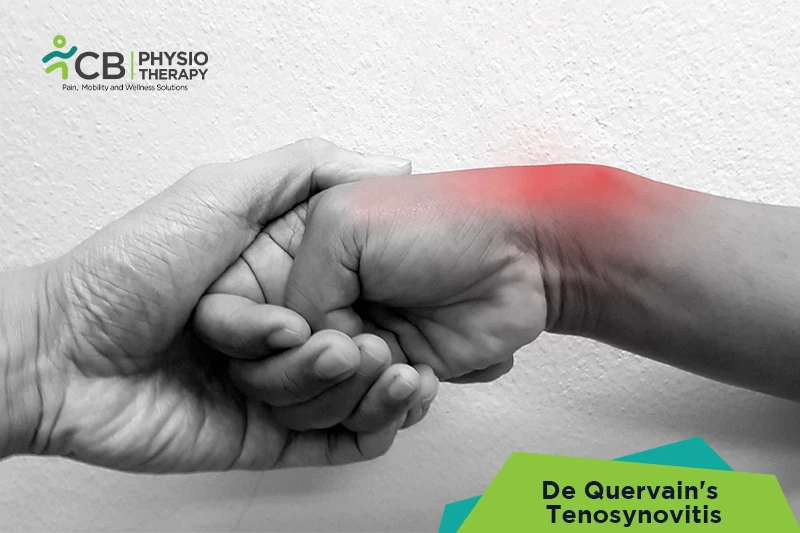
De Quervain's tenosynovitis or washerwoman's sprain or mummy thumb or radial styloid tenosynovitis is a painful condition affecting the tendons on the thumb side of the wrist. It causes painful swelling or inflammation of the tendon of the thumb. It is a tendinosis of the tendon sheath that covers the two tendons of the thumb, the extensor pollicis longus, and the abductor pollicis brevis. The pain may extend from the forearm to the thumb base. De Quervain's tenosynovitis hurts while turning the wrist, grasping, or making a fist.
Symptoms of de Quervain's tenosynovitis can radiate to the forearm, also other symptoms include:
De Quervain's tendinitis can be caused by several factors, including:
Pathology
De Quervain's tendinitis is the inflammation of the tendons which control the movement of the thumb and the tendon sheaths. The repetitive movements result in pain at the outer side of the wrist. Pain and discomfort increase while gripping or rotating the wrist.
De Quervain's tenosynovitis does not require any investigation it is easily diagnosed by the Finkelstein test.
The patient is asked to make a fist with the fingers wrapped over the thumb. Keeping the hand in a fist position, the wrist is moved up and down, the motion of shaking someone's hand. The swollen tendons are pulled through the narrowed sheath and result in pain, thus diagnosed as de Quervain's tenosynovitis.
Medication: Anti-inflammatory medication, such as naproxen or ibuprofen, steroid injection.
NOTE: Medication should not be taken without the doctor's prescription.
Non-surgical treatments
Splints:
Splints or braces are recommended for rest. These are used to immobilize the wrist and thumb at the meta-carpo-phalangeal joint but also allow the thumb end joint and other fingers to move.
Surgical treatments
Surgery may be recommended if non-surgical treatments do not help relieve pain and swelling. A tiny cut is made in the sheath to pass the tendon. The sheath is cut which allows more room for the tendons to slide. Surgery is done to alleviate pain and swelling and restore range of motion. After recovery, physiotherapy is done to strengthen the muscles.
Apply ice to the thumb and wrist to decrease the inflammation, swelling, and amount of pain. Avoid activities that are causing pain and swelling.
Heat therapy or thermotherapy can help relax and loosen tight musculature.
Transcutaneous electrical stimulation (TENS) can be used to relieve pain.
Ultrasound therapy helps to accelerate the healing process of the soft tissues such as tendons and synovial sheath.
Laser therapy is found to be the most used and effective in reducing pain and increasing functionality in patients with De Quervain tenosynovitis.
The taping technique can also be used to decrease pain and thus improve function.
Massage
Massage at the thenar muscles can help relax tight musculature that causes pain. It decreases fascia restriction, stretches the connective tissue, and promotes a better healing environment.
Myofascial release is a soft tissue technique used to relax the muscles thus reducing the tension in the tendon or muscles.
Range of motion exercises
Active hand movements and range-of-motion exercises are recommended.
The strengthening exercises are progressed from isometric, eccentric, concentric, and then glides. These exercises help to strengthen and stabilize the muscles and joints of the hand and thumb. Shoulder and elbow strengthening exercises are also recommended to place less load at the wrist.
Stretching exercises
Stretching exercises or gliding techniques are recommended to allow the thumb tendons to glide easily within the tunnel.
Mobilization
Mobilization decreases the pain and improves the range of motion. A radial glide of the proximal row of carpals is given then the patient is asked to move the thumb into radial abduction-adduction.

The patient is advised to make changes if required while doing activities or exercises e.g. changing the inappropriate biomechanics used while a task is done, e.g. ergonomics for the usage of the phone, writing or using a keyboard, etc .
Get assessed today — find the cause, get a plan, and know when you'll feel better.