Cauda Equina Syndrome — Symptoms, Causes & Treatment
Also known as CAUDA EQUINA SYNDROME. Causes, symptoms and how physiotherapy treats Cauda Equina Syndrome — without surgery or medicines.
Understanding Cauda Equina Syndrome
Cauda Equina Syndrome affects people differently, and the right care starts with understanding how it affects you. Its day-to-day impact — on movement, strength, energy and confidence — is where physiotherapy does its work.
Our role in Cauda Equina Syndrome is practical: protect and rebuild movement and daily function with a plan set after a careful assessment, in coordination with your doctor wherever medical management is involved. No two plans look the same, because no two cases behave the same.
Causes & risk factors of Cauda Equina Syndrome
What commonly drives it — your assessment pins down which of these apply to you.
More than one possible driver
Cauda Equina Syndrome can have several contributing factors — a careful history and physical assessment separate them rather than guessing.
Reduced movement and deconditioning
Whatever the trigger, less movement quickly adds weakness and stiffness of its own — usually the most reversible part.
Daily-life load and habits
Work posture, repeated tasks, sleep and stress all shape how a condition behaves day to day.
General health and history
Overall health, previous injuries and existing conditions influence both the picture and the plan — the assessment takes all of it in.
When physiotherapy is the right call
If any of these sound like you, an assessment is the right first step.
- ✓ A new diagnosis of Cauda Equina Syndrome and you want a clear rehabilitation start point
- ✓ Daily tasks, walking or stairs are getting harder than they used to be
- ✓ Strength, stamina or balance has visibly dropped
- ✓ You want a structured clinic + home program with measurable milestones
- ✓ Family members need guidance to support you safely
Your treatment journey
Step by step — from your first assessment to a tracked recovery plan.
A detailed first assessment
History, movement testing and strength checks — a focused session to find what is actually driving your Cauda Equina Syndrome.
A diagnosis you understand
Your physiotherapist explains the findings in plain language — what is affected, why it happened and what that means for you.
Active, tracked treatment
Hands-on therapy, the right modalities and graded exercise — progressed session by session and tracked on Fizo IQ™.
Prevention, built in
The final phase rebuilds strength and habits so the same problem does not come back — with a home plan you keep.
What recovery looks like
- ✓ More independence in daily tasks
- ✓ Better strength, balance and stamina
- ✓ Fewer setbacks, with red flags monitored
- ✓ A program your family understands and can support
- ✓ Progress measured milestone by milestone on Fizo IQ™
When to see a doctor — red flags
How CB Physiotherapy treats Cauda Equina Syndrome
We treat Cauda Equina Syndrome the way we treat everything: assessment first, plan second, treatment third. It sounds obvious, but it is the difference between sessions that fill a slot and sessions that move you towards a goal. Care is delivered by certified physiotherapists at a clinic near you or at home.
Your whole journey is tracked on Fizo IQ™ — the diagnosis, the root cause, the milestones and the goals — so progress is measured, not guessed, and the plan adapts the moment your response calls for it.
Get Cauda Equina Syndrome treatment near you
Certified physiotherapists at a clinic near you or at home — same-day slots, assessment-led care.
Request received!
We'll call you within 10 minutes to confirm your home visit.We'll call you within 10 minutes to confirm your slot.
Chat with us on WhatsAppCauda Equina Syndrome, answered
1: Herniated Disc.
2: Spinal Tumors.
3: Spinal Stenosis.
4: Trauma or Injury.
5: Infections and Abscesses.
6: Lumbar Disc Prolapse.
7: Spinal Hematoma.
8: Inflammatory Conditions.
9: Postoperative Complications.
1: Lower back pain.
2: Leg weakness.
3: Saddle anesthesia.
4: Leg Pain (Sciatica).
5: Numbness or Weakness.
6: Bladder Dysfunction.
7: Bowel Dysfunction.
8: Sexual Dysfunction.
9: Loss of Reflexes:
PATHOLOGY
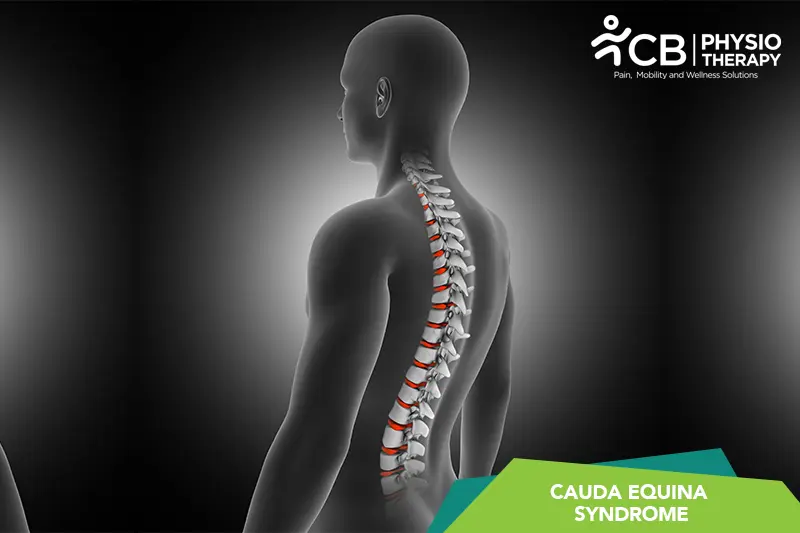
Pathologically, CES results from pressure on the cauda equina nerves, leading to neurological deficits. Immediate medical attention is crucial for diagnosis and intervention to prevent permanent damage.
Additionally, clinical assessments, neurological examinations, and evaluation of symptoms such as bowel/bladder dysfunction are vital for diagnosis. A thorough neurological examination is essential to assess motor and sensory function, reflexes, and other neurological signs.
MRI (Magnetic Resonance Imaging):
An MRI scan of the spine is often used to visualize the spinal cord and nerve roots. It can help identify the cause of compression and the extent of damage.
CT (Computed Tomography) Myelogram:
This test involves injecting a contrast dye into the spinal canal to enhance imaging during a CT scan. It provides detailed images of the spinal cord and nerve roots.
Urodynamic Studies:
These tests evaluate bladder function and can help determine the extent of neurological involvement.
Blood Tests:
Blood tests may be conducted to rule out other potential causes of symptoms.
(Note: Medication should not be taken without the doctor’s prescription.)
Treatment for Cauda Equina Syndrome (CES) often involves emergency surgical intervention to relieve pressure on the affected nerves. The surgery aims to decompress the spinal cord and nerves, addressing the underlying cause, such as a herniated disc or tumor. Timeliness is crucial to prevent permanent neurological damage. Post-surgery, rehabilitation, and physical therapy may be necessary to aid recovery.
Cold therapy can help alleviate pain by reducing nerve conduction and slowing down the transmission of pain signals. It may be particularly useful for managing acute pain or inflammation. It may also help in reducing muscle spasms, which can be common in conditions involving nerve compression. By numbing the affected area, it can contribute to muscle relaxation.
Thermotherapy (Heat Therapy):
Heat therapy can help relax muscles and improve flexibility. This can be particularly useful for individuals with CES who may experience muscle tightness or spasms. Heat promotes vasodilation, leading to increased blood flow to the targeted area. Improved blood circulation can aid in the delivery of oxygen and nutrients to tissues, supporting the healing process. Heat therapy can be effective in relieving chronic pain, stiffness, and discomfort. Applying heat before stretching or range of motion exercises can enhance the effectiveness of these activities. It can make tissues more pliable and reduce the risk of injury during exercises.
Transcutaneous Electrical Nerve Stimulation (TENS):
TENS involves the use of a small, battery-operated device that delivers low-voltage electrical stimulation to the skin. It may help in managing pain by interfering with the transmission of pain signals.
Neuromuscular Electrical Stimulation (NMES):
NMES is used to stimulate muscle contractions by delivering electrical impulses to nerves. It can be employed to prevent muscle atrophy and improve muscle strength in individuals with weakness or paralysis.
Electrical Stimulation for Pelvic Floor Muscles:
CES may affect pelvic floor function, leading to bladder and bowel dysfunction. Electrical stimulation can be used to target and strengthen pelvic floor muscles, helping in the management of incontinence.
Biofeedback:
Biofeedback involves using electronic monitoring to provide visual or auditory feedback about physiological processes such as muscle activity or bladder function. It can be utilized to help individuals regain control over certain functions, including those affected by cauda equina syndrome.
Functional Electrical Stimulation (FES):
FES uses electrical stimulation to activate specific muscles or muscle groups. It may be applied to assist with activities such as walking, especially in cases where there is weakness or paralysis in the lower extremities.
Range of Motion Exercises:
Controlled and progressive range of motion exercises help maintain joint flexibility and prevent stiffness. These exercises are tailored to the individual's condition and may include movements of the spine and extremities.
Strengthening Exercises:
Targeted exercises aim to strengthen muscles weakened due to nerve compression. The focus may be on the muscles of the lower back, hips, and legs. The intensity and type of exercises will depend on the individual's specific condition and functional goals.
Balance and Coordination Training:
CES can affect balance and coordination, especially if there is weakness or paralysis in the lower extremities. Physiotherapists work on exercises that enhance balance and coordination to improve mobility and reduce the risk of falls.
Pelvic Floor Rehabilitation:
CES can lead to bladder and bowel dysfunction. Pelvic floor exercises and biofeedback may be employed to address incontinence issues and improve pelvic floor muscle function.
Don't let Cauda Equina Syndrome decide your day.
Get assessed today — find the cause, get a plan, and know when you'll feel better.