Open today · 8 AM–8 PM · Same-day slots
CB Physiotherapy
Same-day appointments

De Quervain's Tenosynovitis Treatment Doctors in Noida

Whether it's a dull ache, a sharp catch, or pain that keeps coming back — we find the root cause of your De Quervain's Tenosynovitis and fix it, at a clinic near you or at home.

Precision Care, Proven Recovery
ACCURATE DIAGNOSIS
ROOT CAUSE ASSESSMENT
COMPREHENSIVE RECOVERY PLAN
MILESTONE TRACKING
GOALS ACHIEVED
STAYING ACTIVE
See how it works ↓
Move pain-free Avoid drugs & surgery
5.0 / 5 · 31 Google reviews Verified on Google

Request received!

We'll call you within 10 minutes to confirm your home visit.We'll call you within 10 minutes to confirm your slot.

Chat with us on WhatsApp

Book in 30 seconds

Visit your nearest CB clinic. Tell us your concern and a preferred time — we'll confirm your slot by call within 10 minutes.

Same-day booking by default. We'll confirm your exact slot by call.
+91
No spam · Your number is safe with us
Prefer to talk now? Call +09821966696
Understanding your de quervain's tenosynovitis

Does this sound like you?

Common triggers include muscle strain, joint stiffness, poor posture and long desk hours. If two or more of these fit, a physiotherapy assessment can identify exactly what's driving it.

  • A dull ache or sharp, burning de quervain's tenosynovitis that keeps returning
  • Discomfort that worsens with movement, lifting or long sitting hours
  • Morning stiffness that eases as you move
  • Pain that limits work, sport or everyday activities
  • Recurring episodes that keep coming back

Most de quervain's tenosynovitis improves without surgery or long-term medication — the key is finding the cause first.

⚠ When to seek urgent medical care

De Quervain's Tenosynovitis rarely signals something serious, but see a doctor immediately if it comes with:

  • Fever, unexplained weight loss, or a history of cancer
  • Numbness or weakness that keeps getting worse
  • Loss of bladder or bowel control
  • Pain after a major fall or accident

Our physios screen for these red flags at every first assessment and refer you to the right doctor if needed.

Assessment-led treatment

How we treat de quervain's tenosynovitis

We start with an AI-based assessment to find the root cause — then follow a clear, four-phase plan.

Phase 1

Ease the pain

Hands-on therapy and advanced modalities to calm pain and inflammation fast.

Phase 2

Restore movement

Mobility work and posture correction so everyday movement feels normal again.

Phase 3

Build strength

Targeted strengthening that protects you — in-clinic or in our physio gym.

Phase 4

Return to activity

Back to work, sport and life — with a home program that prevents relapse.

Your physiotherapist, with Fizo IQ™

Every recovery, planned and proven

One patient record, stage by stage: your physiotherapist pinpoints the diagnosis, finds the root cause and builds your in-clinic plan — while Fizo IQ™, our AI decision-support engine, tracks every milestone until your goals are met and you leave with an exercise plan to stay active.

Physio Expert @CB with Fizo IQ™ — recovery engine
TRACKING
ACCURATE DIAGNOSIS
L4–L5 disc bulge · nerve-root irritation, pinpointed at the first movement assessment
ROOT CAUSE ASSESSMENT
Poor sitting posture, weak core–hip chain · quietly loading that disc
COMPREHENSIVE RECOVERY PLAN
24 clinic sessions · manual therapy + spinal decompression · guided exercise therapy, reviewed weekly
MILESTONE TRACKING
Sitting pain-free ✓ · stairs ✓ · next: the morning 5 km walk
GOALS ACHIEVED
Pain 7 → 3 in six weeks · back to daily life, moving freely
STAYING ACTIVE
A personalized exercise plan, yours to keep · so the pain doesn't come back
Example recovery journey · every plan is built around you
Move better

Exercises that help with De Quervain's Tenosynovitis

More exercises →

Make these exercises yours

Get my personalized plan

General guidance only — stop if an exercise increases your pain, and check with your physio before starting a new routine.

Meet your care team

Licensed experts who treat hundreds like you every month

Every CB physio is a qualified BPT/MPT clinician. You don't need to choose one — our lead physiotherapist reviews your case and assigns the specialist best suited to treat it.

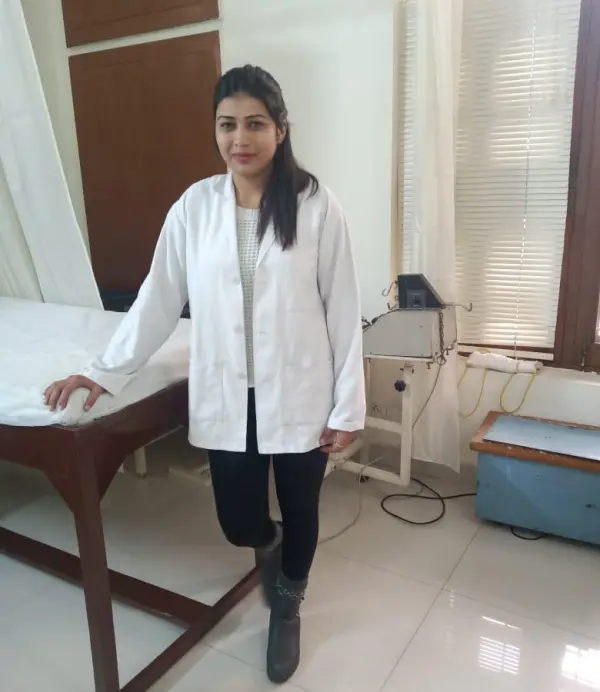
Dr. Vidhi, physiotherapist in Noida Extention Verified

Dr. Vidhi

Physiotherapist · BPT

5.0 (9)
Noida Extention
5 yrs experience
Ortho Spine Sports Physiotherapy Center
Dr. Deepika, physiotherapist in Greater Noida Verified

Dr. Deepika

Physiotherapist

5.0 (1)
Greater Noida
4 yrs experience
Ortho Spine Sports Physiotherapy Center
Not sure who to see? You don't have to decide. Our lead physiotherapist reviews every case and assigns the physio best suited to it — based on your condition and availability.
Patient stories

De Quervain's Tenosynovitis recoveries, verified on Google

Rated 5.0 / 5 across 31 verified patient reviews in Noida.

Verified

“Dr kasim listened well to my situation, was very quick to diagnose me and gave very clear guidelines on how I should manage my condition”

AB
Aahil Verified patient · Treated at CB · 3 weeks ago
Verified

“I recently had the opportunity to experience physiotherapy at home, and I must say it was an outstanding and convenient experience. One of the biggest advantages of receiving physiotherapy at home was the convenience it offered. Instead of traveling to a clinic or hospital, the physiotherapists came to my doorstep, saving me time and energy. This personalized approach allowed me to receive treatment in the comfort of my own home, which greatly contributed to my overall well-being and recovery. Thanks Dr. kasim for the services.”

RG
Rakhi Gupta Verified patient · Treated at CB · 3 months ago
Verified

“I wholeheartedly recommend Dr. Kasim to anyone seeking treatment for a shoulder issue. His outstanding care, expertise, and compassionate approach make him an exceptional physiotherapist. Under his guidance, I experienced remarkable progress and successful recovery. Thank you, Dr. Kasim, for your exceptional care and dedication to helping your patients regain their shoulder health.”

AH
Anwer Hussain Verified patient · Treated at CB · 3 months ago
Verified

“Dr. Vidhi's approach is highly professional and patient-centered. She took the time to thoroughly assess my condition, asking detailed questions and actively listening to my concerns. She ensured that I fully understood my diagnosis, the treatment plan, and the expected outcomes. . Her dedication to providing evidence-based care was evident. thanks for treated me so well..god bless.”

RK
Rakulpreet Kaur Verified patient · Treated at CB · 3 months ago
Verified

“Thank you sir for providing home physiotherapy treatment. its wonderful to have session with you. 🙏🙏”

SL
Sham Lal Verified patient · Treated at CB · 3 months ago
Verified

“Hats off to you, ma'am. I am very satisfied with the treatment I had for body posture. Every session was great; it made me feel comfortable.👍👍”

AV
Anjali Verma Verified patient · Treated at CB · 3 months ago
Good to know

De Quervain's Tenosynovitis, answered

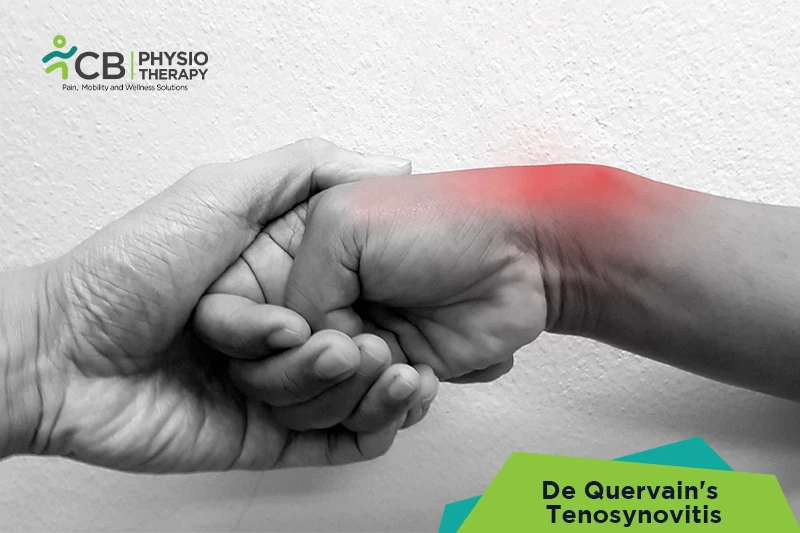
De Quervain's tenosynovitis or washerwoman's sprain or mummy thumb or radial styloid tenosynovitis is a painful condition affecting the tendons on the thumb side of the wrist. It causes painful swelling or inflammation of the tendon of the thumb. It is a tendinosis of the tendon sheath that covers the two tendons of the thumb, the extensor pollicis longus, and the abductor pollicis brevis. The pain may extend from the forearm to the thumb base. De Quervain's tenosynovitis hurts while turning the wrist, grasping, or making a fist.

Symptoms of de Quervain's tenosynovitis can radiate to the forearm, also other symptoms include:

  • Pain along the side of the wrist on the side of the thumb.
  • Pain aggravated by pinching, grasping, thumb and wrist flexion, and other movements of the thumb and wrist.
  • Swelling near the thumb.
  • Tenderness at APB/EPL at wrist crease.
  • Snapping or popping sensation in the wrist when moving the thumb.

De Quervain's tendinitis can be caused by several factors, including:

  • Overuse.
  • Direct blow to the thumb
  • Repetitive grasping
  • Inflammatory conditions like rheumatoid arthritis.
  • Wear and tear
  • Repetitive strain injury
  • Lifting the newborn baby
  • Opening a can or bottle
  • Gardening
  • Playing golf or racket sport
  • Racquet sports (tennis, racquetball)
  • Skiing
  • Using a hammer.

Pathology

De Quervain's tendinitis is the inflammation of the tendons which control the movement of the thumb and the tendon sheaths. The repetitive movements result in pain at the outer side of the wrist. Pain and discomfort increase while gripping or rotating the wrist.

De Quervain's tenosynovitis does not require any investigation it is easily diagnosed by the Finkelstein test.

The patient is asked to make a fist with the fingers wrapped over the thumb. Keeping the hand in a fist position, the wrist is moved up and down, the motion of shaking someone's hand. The swollen tendons are pulled through the narrowed sheath and result in pain, thus diagnosed as de Quervain's tenosynovitis.

Medication: Anti-inflammatory medication, such as naproxen or ibuprofen, steroid injection.

NOTE: Medication should not be taken without the doctor's prescription.

Non-surgical treatments

Splints:

Splints or braces are recommended for rest. These are used to immobilize the wrist and thumb at the meta-carpo-phalangeal joint but also allow the thumb end joint and other fingers to move.

Surgical treatments

Surgery may be recommended if non-surgical treatments do not help relieve pain and swelling. A tiny cut is made in the sheath to pass the tendon. The sheath is cut which allows more room for the tendons to slide. Surgery is done to alleviate pain and swelling and restore range of motion. After recovery, physiotherapy is done to strengthen the muscles.

Cryotherapy:

Apply ice to the thumb and wrist to decrease the inflammation, swelling, and amount of pain. Avoid activities that are causing pain and swelling.

Heat Packs

Heat therapy or thermotherapy can help relax and loosen tight musculature.

TENS

Transcutaneous electrical stimulation (TENS) can be used to relieve pain.

Ultrasound therapy

Ultrasound therapy helps to accelerate the healing process of the soft tissues such as tendons and synovial sheath.

Laser therapy

Laser therapy is found to be the most used and effective in reducing pain and increasing functionality in patients with De Quervain tenosynovitis.

Taping

The taping technique can also be used to decrease pain and thus improve function.

Massage

Massage at the thenar muscles can help relax tight musculature that causes pain. It decreases fascia restriction, stretches the connective tissue, and promotes a better healing environment.

Myofascial release

Myofascial release is a soft tissue technique used to relax the muscles thus reducing the tension in the tendon or muscles.

Range of motion exercises

Active hand movements and range-of-motion exercises are recommended.

Strengthening exercises

The strengthening exercises are progressed from isometric, eccentric, concentric, and then glides. These exercises help to strengthen and stabilize the muscles and joints of the hand and thumb. Shoulder and elbow strengthening exercises are also recommended to place less load at the wrist.

Stretching exercises

Stretching exercises or gliding techniques are recommended to allow the thumb tendons to glide easily within the tunnel.

Mobilization

Mobilization decreases the pain and improves the range of motion. A radial glide of the proximal row of carpals is given then the patient is asked to move the thumb into radial abduction-adduction.
The patient is advised to make changes if required while doing activities or exercises e.g. changing the inappropriate biomechanics used while a task is done, e.g. ergonomics for the usage of the phone, writing or using a keyboard, etc .

Ready when you are

Don't let the pain decide your day.

Get assessed today — find the cause, get a plan, and know when you'll feel better.

📞 Call 💬 WhatsApp Book now