Verified
Dr. Deepanshu Khatri
Physiotherapist
See clinics, physiotherapists and prices for your city.
Whether it's a dull ache, a sharp catch, or pain that keeps coming back — we find the root cause of your Anterior Cruciate Ligament Tear(acl) and fix it, at a clinic near you or at home.
Precision Care, Proven RecoveryWe'll call you within 10 minutes to confirm your home visit.We'll call you within 10 minutes to confirm your slot.
Chat with us on WhatsAppCommon triggers include muscle strain, joint stiffness, poor posture and long desk hours. If two or more of these fit, a physiotherapy assessment can identify exactly what's driving it.
Most anterior cruciate ligament tear(acl) improves without surgery or long-term medication — the key is finding the cause first.
Anterior Cruciate Ligament Tear(acl) rarely signals something serious, but see a doctor immediately if it comes with:
Our physios screen for these red flags at every first assessment and refer you to the right doctor if needed.
We start with an AI-based assessment to find the root cause — then follow a clear, four-phase plan.
Hands-on therapy and advanced modalities to calm pain and inflammation fast.
Mobility work and posture correction so everyday movement feels normal again.
Targeted strengthening that protects you — in-clinic or in our physio gym.
Back to work, sport and life — with a home program that prevents relapse.
One patient record, stage by stage: your physiotherapist pinpoints the diagnosis, finds the root cause and builds your in-clinic plan — while Fizo IQ™, our AI decision-support engine, tracks every milestone until your goals are met and you leave with an exercise plan to stay active.
Every plan combines hands-on care, advanced modalities and guided exercise — matched to your assessment.
Offered by our physiotherapists near you — see how Interferential Therapy (ift) fits your recovery plan.
Offered by our physiotherapists near you — see how Ultrasound Therapy fits your recovery plan.
Offered by our physiotherapists near you — see how Cryotherapy(cold Therapy) fits your recovery plan.
Offered by our physiotherapists near you — see how Dynamic Compression Therapy fits your recovery plan.
These symptoms respond well to Anterior Cruciate Ligament Tear(acl) — tap one to see how we treat it near you.
Make these exercises yours — a CB physio personalizes, doses and tracks your plan week by week.
Get my personalized planGeneral guidance only — stop if an exercise increases your pain, and check with your physio before starting a new routine.
Every CB physio is a qualified BPT/MPT clinician. You don't need to choose one — our lead physiotherapist reviews your case and assigns the specialist best suited to treat it.
Verified
Physiotherapist
Head Of The Clinic
Head Of The Clinic · BPT, MPT
Verified
Sr. Consultant Physiotherapist · BPT, MPT
Head Of The Clinic · BPTh, MPTh
Sr. Consultant Physiotherapist · BPTh
Head Of The Clinic · BPTh, MPTh
The same prices you'll see at the clinic — published before you book. Sessions run 30–45 minutes.
Booking a course of sessions? Save 10% when you take a treatment package — and recover with a plan built around your goals.
Ask about packages →Rated 5.0 / 5 across 102 verified patient reviews in Delhi.
“I visited CB Physiotherapy because I pulled my hamstring. I consulted Dr. Meghna here who gave me a one week treatment plan and suffice to say I started to see results after the first session itself. I was unable to sit and had a lot of pain while walking. After my first session, I was able to walk better and sit better. By the end of the week, I had no pain. They have good infrastructure here and offer various treatments from cupping therapy to laser treatment. I would definitely recommend Dr. Meghna over any other physiotherapist in Saket if not Delhi.”
“I went for consultation for my knee pain and there I met Dr Rahul He took my consultation and sessions for 9 days and he was supr throughout the sessions and now it's so easy for me to be back in daily routine.”
“I had an amazing experience with Dr. Rahul also he took care of everything regarding my lower back strain also they have all the equipment which can help them to cure from the pain or injury. It was a great overall experience with the clinic staff too”
“Hello, I had 15 sessions with them. Overall all sessions were good. Their staff are very knowledgeable and helpful. A special thanks to Mr. Rahul and Ms. Mehak. Both them really helped with my pain on right shoulder and explained about basic and various exercises which i should do on regular basis. Would definitely recommend others.”
“Dr. Deepanshu is an exceptional physiotherapist! His personalized treatment plan and hands-on techniques helped me recover from chronic back pain effectively. He’s patient, knowledgeable, and takes the time to explain everything clearly. His positive attitude and encouragement made the entire process motivating and stress-free. I highly recommend him to anyone seeking top-notch physiotherapy care!”
“Dr. Rahul is an amazing physiotherapist! He genuinely cares about his patients and tailors treatments to fit your needs. Thanks to him, I’ve seen great progress and feel so much better. Highly recommend.”
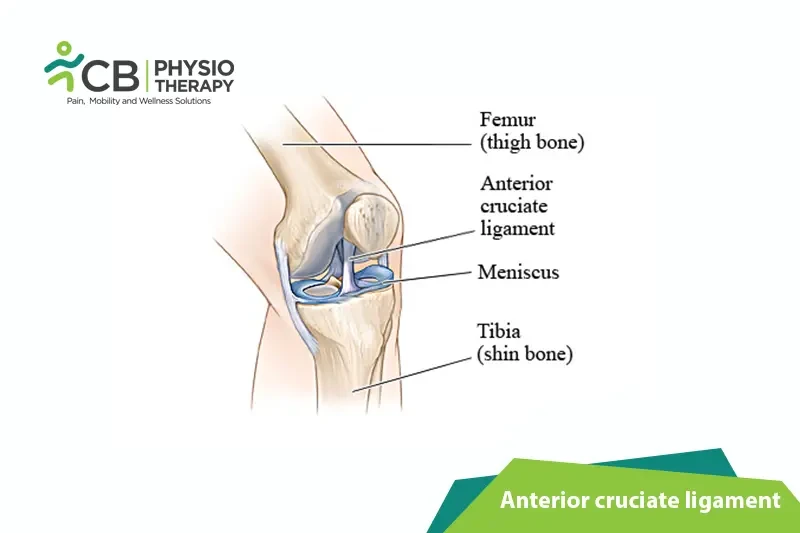
The anterior cruciate ligament (ACL) is one of the two cruciate ligaments which help in the stabilization of the knee joint. It is a strong band made of connective tissue and collagenous fibers that originate from the anteromedial part of the intercondylar region of the tibial plateau and extends posteromedially to get attached to the lateral femoral condyle. During flexion and extension, both the anterior cruciate ligament (ACL) and posterior cruciate ligament (PCL) prevent excessive forward or backward motion of the tibia in relation to the femur.
Signs and symptoms of anterior cruciate ligament tear vary from patient to patient depending on the intensity of the tear. A few of the common symptoms are mentioned below:
Pathology:
ACL tears occur in the middle portion of the ligament and appear as discontinuity of the ligament or abnormal contour. The injury also leads to alteration in the mechanics of the knee. This mechanical deficit can lead to an increase in meniscal injury.
An ACL tear is usually sudden and can be seen in both contact and non-contact sports. It can also occur:
Physical examination:
During the physical examination, the examiners check the knee for swelling and tenderness and compare the injured knee to the uninjured knee. The knee is also moved into a variety of positions to assess the range of motion and overall function of the joint.
Lachman test:
The patient is asked to lie in a supine position on the bed. The patient's knee is placed in about 20-30 degrees flexion. The leg should be in slight external rotation. The examiner places one hand behind the tibia and the other on the patient's thigh but the thumb should be on the tibial tuberosity while pulling the tibia anteriorly, usually ACL should prevent forward translational movement of the tibia on the femur. But if the test is positive then the anterior translation of the tibia is associated with a soft or a mushy end feel.
Anterior drawer test:
The patient is asked to lie supine on a plinth with hips flexed to 45 degrees, knees flexed to 90 degrees, and feet flat on the plinth. The examiner sits on the toes of the tested extremity to stabilize it. The examiner grasps the proximal lower leg, just below the tibial plateau or tibiofemoral joint line, and tries to translate the lower leg anteriorly. The test is positive if there is a lack of end feel or excessive anterior translation as compared to the contralateral side.
X-rays:
X-rays are done to rule out a bone fracture. Though it doesn't show soft tissues, such as ligaments and tendons.
Magnetic resonance imaging (MRI):
Magnetic resonance imaging (MRI) uses radio waves and a strong magnetic field and creates images of both hard and soft tissues in the body. Magnetic resonance imaging shows the extent of an injury and signs of damage to other tissues in the knee, including the cartilage.
Ultrasound:
Ultrasound uses sound waves to visualize internal structures. It is also used to check for injuries in the ligaments, tendons, and muscles of the knee.
Medications: Anti-inflammatory drugs, a steroid medication, etc.
Note: Medication should not be taken without the doctor's prescription.
Surgery:
Surgery is required if the ACL is torn badly, if the knee gives way while walking, or if the person is an athlete. During the surgery, the damaged ACL is removed and replaced with tissue to help a new ligament grow in its place.
Rest :
Rest and staying off the feet for a while is recommended to enhance the process of healing by decreasing the movement of the knee joint.
Knee brace:
A knee brace provides extra support for the patients having damaged ACL while running or playing sports.
Compression:
Bandaging can be done to decrease the swelling in or around the knee joint by wrapping an ace bandage around the knee.
Elevation:
Elevation of the affected limb also decreases swelling and edema. The patient is made to lie down with the knee propped up on pillows.
Ice packs may be used to decrease swelling. Ice is applied on the knee at least every two hours for 20 minutes at a time.
Transcutaneous electrical stimulations (TENS):
Transcutaneous electrical stimulations (TENS) help to decrease knee pain and knee swelling.
NMES:
NMES is given to improve the strength of quadriceps muscles and to regain normal quadriceps control.
This therapy uses red and infrared light for the relief of pain, accelerates the process of healing, and decreases inflammation. The light source is placed against the skin, then the photons penetrate several centimeters and get absorbed by the mitochondria, which is the energy-producing part of the cell.
Shockwave therapy is highly effective in ACL tear, it enhances the process of healing and results in early recovery.
.
Gait training:
Gait training is given with help of assistive devices like crutches, and progressed from walking with crutches to walking normally with no assistive device. Crutches can help to keep weight off the knee.
Pain and swelling in the knee can limit the knee's range of motion. Simple range of motion exercises can be done to help improve and normalize knee mobility like prone hang.
Strengthening exercises:
Strengthening exercises are used to strengthen the quadriceps, hamstrings, and hip muscles e.g like isometric, isotonic, and isokinetic exercises can be done to strengthen the muscles.
Balance exercises:
After an ACL tear, the patient has difficulty maintaining appropriate balance on the injured leg. For balance training wobble board or a BAPS board may be used to regain normal proprioception, or body awareness, after the injury.
Plyometrics:
Plyometrics helps to return to high-level sports. Plyometric training helps to learn to properly jump and land and regain the confidence needed to return to athletics.
The patient is educated to learn how to prevent re-injury of the ACL. The patient is advised to continue the physiotherapy strengthening exercises even after recovery to gain maximum strength.
Get assessed today — find the cause, get a plan, and know when you'll feel better.