Open today · 8 AM–8 PM · Same-day slots
CB Physiotherapy
Same-day appointments

Tendinitis Treatment Doctors in Gurgaon

Whether it's a dull ache, a sharp catch, or pain that keeps coming back — we find the root cause of your Tendinitis and fix it, at a clinic near you or at home.

Precision Care, Proven Recovery
ACCURATE DIAGNOSIS
ROOT CAUSE ASSESSMENT
COMPREHENSIVE RECOVERY PLAN
MILESTONE TRACKING
GOALS ACHIEVED
STAYING ACTIVE
See how it works ↓
Move pain-free Avoid drugs & surgery
5.0 / 5 · 22 Google reviews Verified on Google

Request received!

We'll call you within 10 minutes to confirm your home visit.We'll call you within 10 minutes to confirm your slot.

Chat with us on WhatsApp

Book in 30 seconds

Visit your nearest CB clinic. Tell us your concern and a preferred time — we'll confirm your slot by call within 10 minutes.

Same-day booking by default. We'll confirm your exact slot by call.
+91
No spam · Your number is safe with us
Prefer to talk now? Call +09821966696
Understanding your tendinitis

Does this sound like you?

Common triggers include muscle strain, joint stiffness, poor posture and long desk hours. If two or more of these fit, a physiotherapy assessment can identify exactly what's driving it.

  • A dull ache or sharp, burning tendinitis that keeps returning
  • Discomfort that worsens with movement, lifting or long sitting hours
  • Morning stiffness that eases as you move
  • Pain that limits work, sport or everyday activities
  • Recurring episodes that keep coming back

Most tendinitis improves without surgery or long-term medication — the key is finding the cause first.

⚠ When to seek urgent medical care

Tendinitis rarely signals something serious, but see a doctor immediately if it comes with:

  • Fever, unexplained weight loss, or a history of cancer
  • Numbness or weakness that keeps getting worse
  • Loss of bladder or bowel control
  • Pain after a major fall or accident

Our physios screen for these red flags at every first assessment and refer you to the right doctor if needed.

Assessment-led treatment

How we treat tendinitis

We start with an AI-based assessment to find the root cause — then follow a clear, four-phase plan.

Phase 1

Ease the pain

Hands-on therapy and advanced modalities to calm pain and inflammation fast.

Phase 2

Restore movement

Mobility work and posture correction so everyday movement feels normal again.

Phase 3

Build strength

Targeted strengthening that protects you — in-clinic or in our physio gym.

Phase 4

Return to activity

Back to work, sport and life — with a home program that prevents relapse.

Your physiotherapist, with Fizo IQ™

Every recovery, planned and proven

One patient record, stage by stage: your physiotherapist pinpoints the diagnosis, finds the root cause and builds your in-clinic plan — while Fizo IQ™, our AI decision-support engine, tracks every milestone until your goals are met and you leave with an exercise plan to stay active.

Physio Expert @CB with Fizo IQ™ — recovery engine
TRACKING
ACCURATE DIAGNOSIS
L4–L5 disc bulge · nerve-root irritation, pinpointed at the first movement assessment
ROOT CAUSE ASSESSMENT
Poor sitting posture, weak core–hip chain · quietly loading that disc
COMPREHENSIVE RECOVERY PLAN
24 clinic sessions · manual therapy + spinal decompression · guided exercise therapy, reviewed weekly
MILESTONE TRACKING
Sitting pain-free ✓ · stairs ✓ · next: the morning 5 km walk
GOALS ACHIEVED
Pain 7 → 3 in six weeks · back to daily life, moving freely
STAYING ACTIVE
A personalized exercise plan, yours to keep · so the pain doesn't come back
Example recovery journey · every plan is built around you
Feeling something?

Symptoms Tendinitis addresses

These symptoms respond well to Tendinitis — tap one to see how we treat it near you.

Move better

Exercises that help with Tendinitis

More exercises →

Make these exercises yours

Get my personalized plan

General guidance only — stop if an exercise increases your pain, and check with your physio before starting a new routine.

Meet your care team

Licensed experts who treat hundreds like you every month

Every CB physio is a qualified BPT/MPT clinician. You don't need to choose one — our lead physiotherapist reviews your case and assigns the specialist best suited to treat it.

Not sure who to see? You don't have to decide. Our lead physiotherapist reviews every case and assigns the physio best suited to it — based on your condition and availability.
Patient stories

Tendinitis recoveries, verified on Google

Rated 5.0 / 5 across 22 verified patient reviews in Gurgaon.

Verified

“Best physiotherapist on CB physio platform . Highly educated and very confident regarding knowledge. Thanks CB physio you provide me best Doctor...”

JB
Jatin Verified patient · Treated at CB
Verified

“Received good treatment from Dr .Amit for ankle injury. Now I can walk without any support. My mobility is improved so much..🙏🙏 thank you”

AM
Aman Mehra Verified patient · Treated at CB · 3 months ago
Verified

“Thanks for the treatment, sir, for my back issue; it is quite relaxing now. Pain has been subsidised a lot. I am very satisfied with the treatment I received.”

PS
Prajakta Sharma Verified patient · Treated at CB · 3 months ago
Verified

“i have been to several physical therapy providers over the years, and this one is by far the best. The therapists is caring and really know their stuff. i got treatment for elbow at my home. its so convenient. the treatment was good i can feel much difference..thank you.”

AA
Ashish Arora Verified patient · Treated at CB · 3 months ago
Verified

“I suffered a serious injury that left me with limited mobility and a lot of pain. But thanks to the amazing care I received from Dr. Amit, I was able to regain my strength after 4 sessions and get back to my normal routine. I’m so grateful for his support and expertise..”

GB
Gautam Brar Verified patient · Treated at CB · 3 months ago
Verified

“Dr. Surender is an exceptional home physiotherapy services provider who has a wealth of knowledge and experience in treating various conditions. I recently had the pleasure of receiving treatment from him for a persistent back pain, and I can confidently say that he is one of the best physiotherapists I have ever had.👍🏼🙏”

AS
Amritpal Singh Verified patient · Treated at CB · 4 months ago
Good to know

Tendinitis, answered

Tendinitis or tendonitis is the inflammation of a tendon, which is a fibrous band of tissue that connects the bones to muscles. Tendonitis is a condition in which the tendon becomes inflamed or suffers a tear, causing acute pain, tenderness, and inflammation making it difficult to move the affected joint. The most commonly affected parts of the body are the elbow, wrist, finger, thigh, and ankle, etc. Tendinitis can occur more commonly among adults who play a lot of sports and occurs in any age group. Though older people are more susceptible because the tendons tend to become weaker with age. Some of the common Tendinitis that commonly occur in our body are:


Achilles tendinitis: Achilles tendon lies between the heel and the calf muscle. Occurs most commonly in sports players. Usually caused due to improper footwear. It is mostly seen among patients with rheumatoid arthritis.


Peroneal Tendonitis: Peroneal tendonitis affects the two tendons, one tendon attaches to the little toe, while the other runs along the sole and attaches to the inner side of the arch. If they can rub against the bone and overuse and load, symptoms are caused like pain and instability.

Posterior Tibial Tendonitis: Posterior Tibial Tendonitis affects the tendon that attaches the back of the shinbone to the foot. When it becomes inflamed, over time, this can result in flatfoot.

Supraspinatus tendinitis: Tendon around the shoulder joint becomes inflamed, causing supraspinatus tendinitis, which causes pain, especially during upward movement and becomes more painful while lying on the affected shoulder at night.

Tennis or golfer’s elbow: Lateral epicondylitis also known as tennis elbow, the patient feels pain on the outer side of the elbow radiating down towards the wrist. Whereas in Golfer’s elbow or medial epicondylitis pain is on the inner side of the elbow, commonly occurring among Golfers. Pain is more acute when the patient tries to lift against a force, radiating down to the wrist.

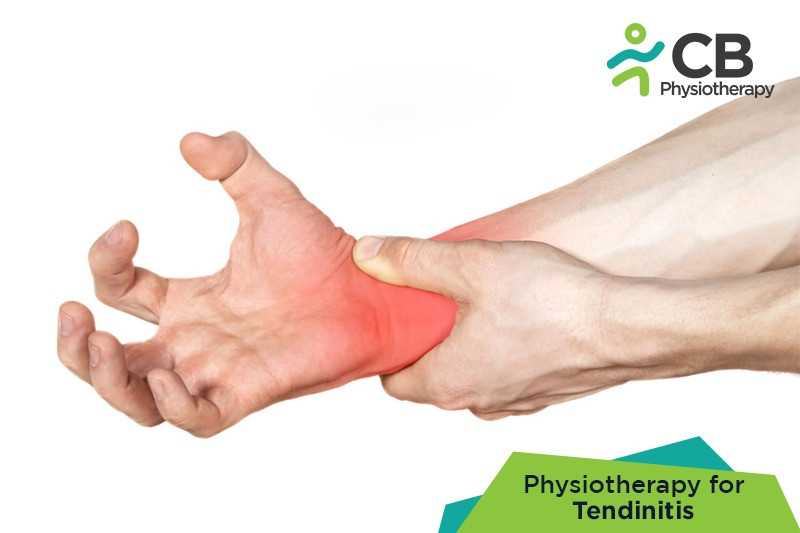
De Quervain’s tenosynovitis: It is the inflammation of the sheath that surrounds the thumb and lies between the thumb and wrist. It becomes painful to move the thumb due to the thickening of the sheath and swelling in the area.

Trigger finger or thumb: The tendon sheath in the palm is thickened and inflamed thus becomes fixed in a bent position and does not allow the tendon to move smoothly. Even sometimes a nodule forms along the tendon. The finger or thumb clicks when straightened.

Tendinitis of the wrist: Occurs most commonly in players like badminton players, tennis players, and workers, due to repeated use of the wrist.

Jumper's knee: It is a form of knee tendonitis, involving either the quadriceps tendon at the upper edge of the kneecap or the patellar tendon at the lower edge of the kneecap. Occurs especially in basketball players and distance runners due to overuse.

Most commonly the patients suffering from tendinitis have the following symptoms in the tissues surrounding the joint. These symptoms worsen after overuse:


  • Pain
  • Weakness
  • Swelling
  • Redness
  • Warm
  • Rash, fever, or discharge from the vagina or penis (gonorrhea),


Patients suffering from the following Tendinitis suffer from pain in the specific regions correspondingly:


  • Rotator cuff tendonitis : Dull, aching pain, radiating into the upper arm toward the chest. The pain often worsens at night and may interfere with sleep.
  • Tennis elbow : Pain in the outer side of the elbow, radiating down to the forearm and wrist
  • Golfer's elbow : Pain in the inner side of the elbow.
  • Jumper's knee : Pain below or above the kneecap.
  • De Quervain's disease : Pain is behind the wrist, near the base of the thumb
  • Achilles tendonitis : Pain is behind the heel or 2 to 4 inches above the heel
  • Peroneal Tendonitis: Pain is behind the ankle (felt most when standing or when pushing off through your foot) and ankle instability.
  • Posterior Tibial Tendonitis : It causes pain due to pushing off through the foot and the inability to stand on tiptoes.

Repetitive action is the most common cause of tendonitis. Due to the increased frequency of the same motion while working or playing sport. Tendinitis can also result from:


  • Aging
  • Injury
  • Physical exertion
  • Repeated overhead lifting, motions, or tasks
  • Diseases, such as rheumatoid arthritis, diabetes, etc.
  • Antibiotics (quinolones such as Levaquin)
  • Sportspersons such as basketball players, tennis players, and golf players are at a higher risk of tendinitis.

For the diagnosis the physician does the physical examination, while moving the tendon, a creaky sound may be heard, due to inflammation and thickening of the tendon. Tenderness at one specific point in the tendon, indicates tendinitis.

X-ray

X-ray can show the calcium deposits around the tendon thus help to confirm tendinitis.

Magnetic resonance imaging ( MRI):

Magnetic resonance imaging (MRI): may reveal swelling of the tendon sheath thus helps in the diagnosis.

Medications: Pain relievers, Corticosteroids etc

Note: Duly Prescribed by the Practitioner.

Ultrasonic treatment. It is a minimally invasive procedure that uses a small incision to insert a device to remove the tendon scar tissue with ultrasonic sound waves.

Surgery. Surgical repair may be needed, depending on the severity of the tendon injury especially if the tendon has torn away from the bone.

Physical therapy:

The therapist first recommends Rest, Ice Packs, compression, and elevation, followed by the use of modalities and different techniques in reducing irritation to the tendon.

Dry Needling:

Dry Needling is also one of the treatment methods which helps reduce muscle tightness around the involved tendons.

Cryotherapy:

Cryotherapy reduces inflammation and swelling causing a decrease in pain, around the tendon. It also reduces nerve activity (temporarily), which can also relieve pain.

Thermotherapy:

Thermotherapy is used to promote vasodilatation, accelerates healing, decreases spasm, resulting in a decrease in pain, and promotes relaxation.

Ultrasound therapy:

Ultrasound therapy helps in treating tendinitis by promoting tendon healing.

Shock-wave therapy:

Shock-wave therapy is commonly used for the management of tendinitis. It stimulates metabolic activity by promoting tissue healing and also affects the nociceptors thus decreases pain.

Massage:

Massage can help promote healing when used in combination with exercises.

Exercises programs:

Stretching exercises can reduce muscle spasm and helps lengthen the tendon. Eccentric exercises are very effective for tendinitis, stimulating the tendon’s internal repair system, and also helps restore strength and flexibility.

Education about appropriate activities:

Education is an important part of treatment. Education of the patient to correct body mechanics and posture help reduce the strain on a tendon under stress due to repetitive activities.

Ready when you are

Don't let the pain decide your day.

Get assessed today — find the cause, get a plan, and know when you'll feel better.

📞 Call 💬 WhatsApp Book now