
Traction Therapy — How It Works & What It Treats
Also known as Traction Therapy. What Traction Therapy is, how it works and what it treats — explained by CB Physiotherapy's clinical team.
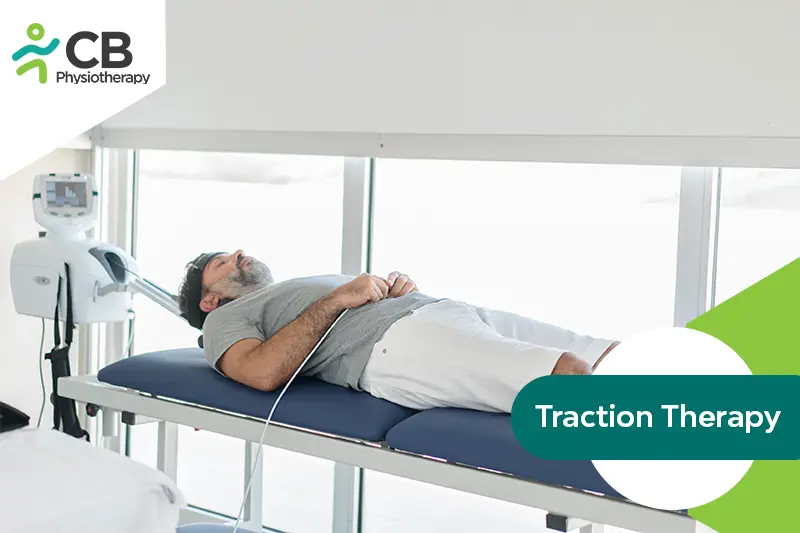
How Traction Therapy works
Traction Therapy is one of the treatment approaches our physiotherapists draw on — always as part of an assessment-led plan, never as a standalone fix.
What makes any therapy work is the decision-making around it: whether it fits your diagnosis, at what dose, and combined with what. At CB Physiotherapy, Traction Therapy is prescribed after a movement assessment and paired with active rehabilitation, because passive treatment alone rarely produces lasting change.
Traction Therapy — techniques & equipment
What the treatment actually involves — your plan combines the pieces your assessment calls for.
Assessment before application
Your physiotherapist first confirms Traction Therapy suits your diagnosis — and screens for anything that rules it out.
Targeted application
The treatment is applied to the specific structures your assessment identified, at a dose set for your case.
Paired with active rehab
Exercise and movement retraining run alongside, so the gains each session makes are kept.
Reviewed and progressed
Your response is checked every session; the plan is adjusted rather than repeated on autopilot.
Conditions Traction Therapy treats
Where it fits best — your assessment confirms whether it belongs in your plan.
- ✓ Cervical Spondylosis →
- ✓ Cervical Myelopathy →
- ✓ Spondylolisthesis →
- ✓ Lumbar Spondylosis →
- ✓ Sciatica →
- ✓ Pain or stiffness that has not settled with rest
- ✓ As part of a wider, assessment-led recovery plan
- ✓ When your assessment identifies the specific problem Traction Therapy addresses
What a Traction Therapy session looks like
Step by step — from screening to treatment to what comes next.
Screening and consent
A quick reassessment and safety screen — you will know what the session involves and why before it starts.
The treatment itself
Traction Therapy applied to the targeted area — most patients find sessions comfortable, and you can speak up at any point.
Active follow-through
Exercise or movement work right after, while the treatment effect is fresh.
Response check
What changed and for how long — the answer shapes your next session and the plan.
Benefits of Traction Therapy
- ✓ Available at CB clinics near you — and at home where equipment allows
- ✓ Drug-free support for pain relief and recovery
- ✓ Delivered by certified physiotherapists, never unsupervised
- ✓ Dosed to your case after a proper assessment
- ✓ Always combined with active rehab, for results that last
Safety & contraindications
How CB Physiotherapy delivers Traction Therapy
You will not walk into CB Physiotherapy and simply receive Traction Therapy — you will receive an assessment, and Traction Therapy if your case calls for it. That order matters: it is how we make sure every session moves you towards a goal rather than just filling a slot.
Your plan runs on Fizo IQ™ — diagnosis, root cause, milestones, goals — and Traction Therapy is combined with hands-on care and exercise as indicated, at a clinic near you or at home where the equipment allows.
Real published prices from our physiotherapists for Traction Therapy in India — your exact quote is confirmed after assessment, before you commit. Packages save 10%.
Get Traction Therapy near you
Certified physiotherapists at a clinic near you or at home — same-day slots, assessment-led care.
Request received!
We'll call you within 10 minutes to confirm your home visit.We'll call you within 10 minutes to confirm your slot.
Chat with us on WhatsAppTraction Therapy, answered
Cervical traction is commonly performed using manual, mechanical, or motorized methods (with a head or chin sling) or with the use of a supine posterior distraction unit. Mechanical cervical traction can be applied in the supine position, which reduces the weight of the head but increases frictional resistance. This position also allows for better control of the head by the patient and is typically more comfortable.
Lumbar traction requires a significantly greater force to create a distraction of the vertebral segments than cervical traction. Common traction systems include a thoracic or chest belt with a pelvic belt, inversion, a split traction table, or an auto traction table. Split traction tables have a mobile half and a stationary half. Auto traction tables allow both segments of the table to move and are controlled by the patient. The patient assumes the most pain-free position and performs active traction by pulling on an overhead bar. The patient then uses his or her feet to activate a bar, which alternates compressive and distracting forces.
Spinal traction therapy can be administered manually or mechanically, depending on your need.
1: Manual Traction:
In manual spinal traction, a physical therapist uses their hands to put people in a state of traction. Then they use manual force on the joints and muscles to widen the spaces between vertebrae. The period of traction generally doesn’t last very long. Manual traction sounds quite scary however it is a safe treatment option that can be effective for certain conditions.
2: Mechanical Traction:
The specialized treatment technique of mechanical traction uses devices that work by stretching the spinal vertebrae and muscle. Mechanical traction allows for continuous or intermittent stretching on a traction table while combining heat, vibration, and/or massage. These tables can use computer-based systems to apply exact amounts and/or variations of pressure. Mechanical traction is, however, not appropriate for patients with serious bone conditions such as osteoporosis, osteomyelitis, and bone cancer, or with heart disease and spinal cord diseases. It is also not appropriate for those with spinal fractures or arthritis. This type of treatment should only be considered following careful examination and diagnosis, and professionally supervised by a licensed physical therapist or doctor to ensure effectiveness and safety
A disc is a circular structure that sits between each vertebra in the spine. It has a tough outer layer surrounding soft inner tissue. When a disc is under pressure and damaged, the tough outer layer is damaged and the soft inside protrudes through the gap. This protrusion compresses nearby nerves causing pain. Traction pulls the vertebra away from the disc, releasing the pressure on the disc. This assists the soft part of the disc to return within the disc. This decompresses the nerve and reduces pain. This also helps to rehydrate the disc. Traction relieves pressure on the spine and alleviates pain. Cervical traction and lumbar traction are similar, but they have a couple of key differences: with cervical traction, a gentle force is used to stretch or pull the head away from the neck. With lumbar traction, a gentle force is used to gently gap the pelvis from the lower back. Both of these methods are useful in manipulating the spine and providing relief.
1: Slipped discs
2: Bone spurs
3: Degenerative disc disease
4: Herniated discs
5: Facet disease
6: Sciatica
7: Foramina stenosis
8: Pinched nerves
9: Cervical Spondylosis
10: Lumbar Spondylosis
1: Stretching Sensation: Patients typically experience a gentle stretching sensation in the targeted area during traction therapy. This stretching helps to decompress the spine or joints, relieving pressure and promoting relaxation.
2: Relaxing: Many patients find traction therapy relaxing, as it can help alleviate muscle tension and promote blood flow to the affected area.
3: Mild Discomfort: While traction therapy is generally well-tolerated, some patients may experience mild discomfort or soreness during or after the treatment, particularly if the traction force is too strong or applied incorrectly.
1: Muscle Spasms: In some cases, traction therapy may induce muscle spasms, especially if the traction force is too intense or applied improperly.
2: Soreness: Some patients may experience temporary soreness or discomfort in the treated area following traction therapy. This is usually mild and resolves on its own.
3: Nerve Irritation: Rarely, traction therapy may aggravate nerve symptoms in certain individuals, leading to increased pain or discomfort. Proper technique and monitoring can help minimize this risk.
4: Skin Irritation: There is a slight risk of skin irritation or redness at the contact points where the traction device is applied. Ensuring proper padding and adjustments can help prevent this.
1: Acute Injuries: Patients with acute spinal injuries, fractures, or severe musculoskeletal trauma may not be suitable candidates for traction therapy, as it could exacerbate their condition.
2: Pregnancy: Traction therapy is generally avoided during pregnancy, especially in the lumbar region, due to potential risks to the fetus.
3: Certain Medical Conditions: Patients with conditions such as osteoporosis, spinal cord compression, or severe osteoarthritis may not be suitable candidates for traction therapy. It's essential to consult with a healthcare provider to determine if traction therapy is appropriate for your specific condition.
4: Uncontrolled Hypertension: Traction therapy may temporarily increase blood pressure, so it's typically avoided in patients with uncontrolled hypertension or cardiovascular issues.
Before undergoing traction therapy or any other form of treatment, it's crucial to consult with a qualified physiotherapist to discuss your medical history, current symptoms, and treatment options. They can help determine if traction therapy is appropriate for you and develop a personalized treatment plan to address your needs.
Ready to start your recovery?
Get assessed today — find the cause, get a plan, and know when you'll feel better.