
Shoulder Impingement — Symptoms, Causes & Treatment
Also known as Subacromial Impingement Syndrome. Causes, symptoms and how physiotherapy treats Shoulder Impingement — without surgery or medicines.
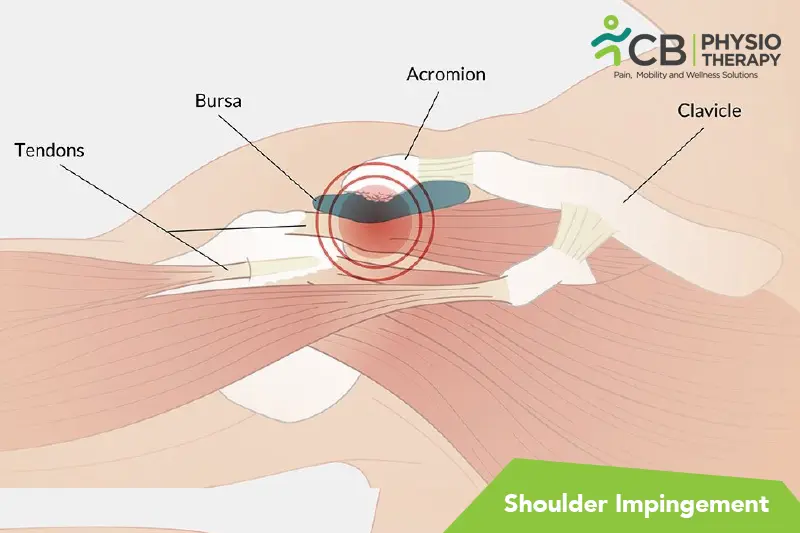
Understanding Shoulder Impingement
Shoulder Impingement (also called Subacromial Impingement Syndrome) can arrive suddenly or build over months, and how much it hurts is a poor guide to how serious it is — minor strains can hurt intensely, while slow-building problems stay quiet until they start limiting you.
Physiotherapy approaches Shoulder Impingement by treating the cause rather than chasing the symptom: a detailed movement assessment first, then a plan combining hands-on treatment, targeted exercise and the habit changes that stop it returning.
Causes & risk factors of Shoulder Impingement
What commonly drives it — your assessment pins down which of these apply to you.
Posture and long static hours
Desks, driving and screens keep the same structures loaded for hours at a stretch — comfortable at first, aching later.
Joint stiffness and age-related change
Joints that move less start to hurt more; age-related wear is normal, but painful stiffness is not something to simply accept.
Weakness and deconditioning
When supporting muscles lose strength, load shifts to structures that were never meant to carry it.
Old injuries and compensations
A previous injury that never fully rehabilitated often leaves a movement pattern that overloads something else.
Sudden spikes in activity
A new sport, a new gym program, a long trek — tissue adapts to gradual change and protests when change is sudden.
When physiotherapy is the right call
If any of these sound like you, an assessment is the right first step.
- ✓ You want to return to sport or work with a plan, not by trial and error
- ✓ Shoulder Impingement that keeps returning or hasn't settled within two weeks
- ✓ Pain or stiffness that limits work, sleep or daily activities
- ✓ You want to avoid long-term painkillers — or surgery has been mentioned
- ✓ You've been diagnosed with Shoulder Impingement and told to "rest and see"
Your treatment journey
Step by step — from your first assessment to a tracked recovery plan.
A detailed first assessment
History, movement testing and strength checks — a focused session to find what is actually driving your Shoulder Impingement.
A diagnosis you understand
Your physiotherapist explains the findings in plain language — what is affected, why it happened and what that means for you.
Active, tracked treatment
Hands-on therapy, the right modalities and graded exercise — progressed session by session and tracked on Fizo IQ™.
Prevention, built in
The final phase rebuilds strength and habits so the same problem does not come back — with a home plan you keep.
What recovery looks like
- ✓ Lower chance of recurrence, with a prevention plan
- ✓ Care without long-term medicines — at a clinic near you or at home
- ✓ Relief that comes from treating the cause, not masking it
- ✓ A clear diagnosis and a timeline you can plan around
- ✓ Strength and movement rebuilt, not just pain reduced
When to see a doctor — red flags
How CB Physiotherapy treats Shoulder Impingement
We treat Shoulder Impingement the way we treat everything: assessment first, plan second, treatment third. It sounds obvious, but it is the difference between sessions that fill a slot and sessions that move you towards a goal. Care is delivered by certified physiotherapists at a clinic near you or at home.
Your whole journey is tracked on Fizo IQ™ — the diagnosis, the root cause, the milestones and the goals — so progress is measured, not guessed, and the plan adapts the moment your response calls for it.
Get Shoulder Impingement treatment near you
Certified physiotherapists at a clinic near you or at home — same-day slots, assessment-led care.
Request received!
We'll call you within 10 minutes to confirm your home visit.We'll call you within 10 minutes to confirm your slot.
Chat with us on WhatsAppShoulder Impingement, answered
- Repetitive overhead activities: Repeated overhead activities such as throwing, swimming, or lifting weights can put a lot of stress on the shoulder joint, which can lead to impingement.
- Poor posture: Poor posture can cause the shoulder joint to be in an awkward position, which can increase the likelihood of impingement.
- Shoulder instability: If the muscles and ligaments that support the shoulder joint are weak or damaged, the joint can become unstable, which can lead to impingement.
- Bone spurs: Bone spurs, which are bony growths that can develop on the bones of the shoulder joint, can also cause impingement.
- Pain in the shoulder joint, particularly when lifting the arm overhead or reaching behind the back.
- Weakness or limited range of motion in the affected arm.
- Swelling or inflammation around the shoulder joint.
- A clicking or popping sensation in the shoulder joint.
Shoulder impingement occurs when the tendons or bursa in the shoulder joint become compressed or irritated, which can cause pain, inflammation, and limited mobility in the affected arm. This compression can occur due to a variety of factors, including repetitive overhead activities, poor posture, shoulder instability, and bone spurs.
The therapist will perform a physical examination of the shoulder joint to check for pain, weakness, and limited range of motion. He/she may also move the arm in various positions to assess the impingement.
X-ray:
An X-ray can help detect any bone abnormalities or spurs that may be contributing to the impingement.
Magnetic resonance imaging (MRI):
An MRI can provide detailed images of the soft tissue structures in the shoulder joint, including the tendons and bursa, to help diagnose impingement.
Ultrasound Therapy:
Ultrasound therapy can provide real-time images of the shoulder joint and can be used to detect any inflammation or damage to the tendons or bursa.
Injection test:
A doctor may inject a local anesthetic or anti-inflammatory medication into the affected area to determine if it provides pain relief, which can help confirm a diagnosis of impingement.
Note: Medication should not be taken without a doctor’s prescription.
Surgery:
Surgery for shoulder impingement is typically considered a last resort when non-surgical treatments have not been successful in relieving symptoms. Surgery may also be recommended if there is a structural problem with the shoulder, such as a bone spur or a torn rotator cuff, that is causing the impingement.
The two main types of surgery for shoulder impingement are:
- Arthroscopic surgery: This is a minimally invasive procedure in which a small camera and surgical tools are inserted through small incisions in the shoulder to remove any bone spurs or inflamed tissue that may be causing the impingement. Arthroscopic surgery is typically performed on an outpatient basis and has a shorter recovery time than open surgery.
- Open surgery: This involves making a larger incision in the shoulder to access the affected area and remove any bone spurs or inflamed tissue. Open surgery may be necessary if the impingement is severe or if there are additional structural problems that need to be addressed. Recovery time for open surgery is typically longer than for arthroscopic surgery.
Cryotherapy, which involves the application of cold therapy, can be an effective treatment for reducing pain and inflammation associated with shoulder impingement. Cold therapy can help numb the affected area, constrict blood vessels, and reduce swelling, which can in turn help reduce pain and inflammation.
Thermotherapy:
Thermotherapy, which involves the application of heat therapy, can also be an effective treatment for shoulder impingement. Heat therapy can help increase blood flow, relax muscles, and reduce pain and stiffness associated with shoulder impingement.
Transcutaneous electrical nerve stimulation (TENS):
TENS uses electrical impulses to stimulate the nerves in the affected area, which can help reduce pain and promote healing.
Ultrasound therapy:
Ultrasound therapy uses high-frequency sound waves to promote tissue healing and reduce inflammation in the affected shoulder joint.
Electrical muscle stimulation (EMS):
EMS uses electrical impulses to stimulate the muscles in the affected shoulder joint, which can help improve strength and reduce pain.
Interferential current therapy (IFC):
IFC uses electrical impulses to stimulate the nerves in the affected area, which can help reduce pain and improve circulation.
Cold laser therapy:
Cold laser therapy uses low-level laser light to promote tissue healing and reduce inflammation in the affected shoulder joint.
Range of motion exercises:
These exercises can help improve flexibility and mobility in the shoulder joint.
Strengthening exercises:
Strengthening exercises can help improve the strength of the muscles that support the shoulder joint, which can help reduce impingement.
Manual therapy:
Manual therapy techniques, such as massage or joint mobilization, can help reduce pain and stiffness in the affected shoulder joint.
Posture correction:
Poor posture can contribute to shoulder impingement, so a physiotherapist can work with the individual to correct any postural imbalances that may be contributing to the condition.
Activity modification:
The physiotherapist may recommend modifying or avoiding certain activities that may exacerbate the impingement.
Don't let Shoulder Impingement decide your day.
Get assessed today — find the cause, get a plan, and know when you'll feel better.