Open today · 8 AM–8 PM · Same-day slots
CB Physiotherapy
Same-day appointments

Sciatica Treatment Doctors in Jammu And Kashmir

Whether it's a dull ache, a sharp catch, or pain that keeps coming back — we find the root cause of your Sciatica and fix it, at a clinic near you or at home.

Precision Care, Proven Recovery
ACCURATE DIAGNOSIS
ROOT CAUSE ASSESSMENT
COMPREHENSIVE RECOVERY PLAN
MILESTONE TRACKING
GOALS ACHIEVED
STAYING ACTIVE
See how it works ↓
Move pain-free Avoid drugs & surgery
5.0 / 5 · 23 Google reviews Verified on Google

Request received!

We'll call you within 10 minutes to confirm your home visit.We'll call you within 10 minutes to confirm your slot.

Chat with us on WhatsApp

Book in 30 seconds

Visit your nearest CB clinic. Tell us your concern and a preferred time — we'll confirm your slot by call within 10 minutes.

Same-day booking by default. We'll confirm your exact slot by call.
+91
No spam · Your number is safe with us
Prefer to talk now? Call +08082666216
Understanding your sciatica

Does this sound like you?

Common triggers include muscle strain, joint stiffness, poor posture and long desk hours. If two or more of these fit, a physiotherapy assessment can identify exactly what's driving it.

  • A dull ache or sharp, burning sciatica that keeps returning
  • Discomfort that worsens with movement, lifting or long sitting hours
  • Morning stiffness that eases as you move
  • Pain that limits work, sport or everyday activities
  • Recurring episodes that keep coming back

Most sciatica improves without surgery or long-term medication — the key is finding the cause first.

⚠ When to seek urgent medical care

Sciatica rarely signals something serious, but see a doctor immediately if it comes with:

  • Fever, unexplained weight loss, or a history of cancer
  • Numbness or weakness that keeps getting worse
  • Loss of bladder or bowel control
  • Pain after a major fall or accident

Our physios screen for these red flags at every first assessment and refer you to the right doctor if needed.

Assessment-led treatment

How we treat sciatica

We start with an AI-based assessment to find the root cause — then follow a clear, four-phase plan.

Phase 1

Ease the pain

Hands-on therapy and advanced modalities to calm pain and inflammation fast.

Phase 2

Restore movement

Mobility work and posture correction so everyday movement feels normal again.

Phase 3

Build strength

Targeted strengthening that protects you — in-clinic or in our physio gym.

Phase 4

Return to activity

Back to work, sport and life — with a home program that prevents relapse.

Your physiotherapist, with Fizo IQ™

Every recovery, planned and proven

One patient record, stage by stage: your physiotherapist pinpoints the diagnosis, finds the root cause and builds your in-clinic plan — while Fizo IQ™, our AI decision-support engine, tracks every milestone until your goals are met and you leave with an exercise plan to stay active.

Physio Expert @CB with Fizo IQ™ — recovery engine
TRACKING
ACCURATE DIAGNOSIS
Sciatic nerve compression at L5–S1 · radiating leg pain traced to its source at the first assessment
ROOT CAUSE ASSESSMENT
Disc pressure plus a tight piriformis · pinching the nerve on long sitting days
COMPREHENSIVE RECOVERY PLAN
20 clinic sessions · spinal decompression + neural mobilisation · with guided exercise therapy, reviewed weekly
MILESTONE TRACKING
Leg tingling settled ✓ · 30-minute sitting ✓ · next: the full office day, pain-free
GOALS ACHIEVED
Pain 8 → 3 in six weeks · walking tall again, no shooting pain
STAYING ACTIVE
A nerve-friendly movement plan, yours to keep · daily habits that keep the sciatica from returning
Example recovery journey · every plan is built around you
Feeling something?

Symptoms Sciatica addresses

These symptoms respond well to Sciatica — tap one to see how we treat it near you.

Move better

Exercises that help with Sciatica

More exercises →

Make these exercises yours

Get my personalized plan

General guidance only — stop if an exercise increases your pain, and check with your physio before starting a new routine.

Meet your care team

Licensed experts who treat hundreds like you every month

Every CB physio is a qualified BPT/MPT clinician. You don't need to choose one — our lead physiotherapist reviews your case and assigns the specialist best suited to treat it.

Dr. Shafiya, physiotherapist in Anantnag

Dr. Shafiya

Physiotherapist

5.0 (13)
Anantnag
cb physiotherapy janglat mandi
1 yrs experience
Ortho Spine Sports Physiotherapy Center
Dr. Athur Un Nisa, physiotherapist in Anantnag Verified

Dr. Athur Un Nisa

Physiotherapist

5.0 (10)
Anantnag
cb physiotherapy janglat mandi
4 yrs experience
Ortho Spine Sports Physiotherapy Center
Not sure who to see? You don't have to decide. Our lead physiotherapist reviews every case and assigns the physio best suited to it — based on your condition and availability.
Patient stories

Sciatica recoveries, verified on Google

Rated 5.0 / 5 across 23 verified patient reviews in Jammu And Kashmir.

Verified

“Received treatment at Cb Anantnag clinic where Dr. Athar treated me she was highly skilled and professional. Her treatment approach is effective, and I noticed significant improvement in my knee pain within a short time. I highly recommend her for quality physiotherapy care. in Anantnag”

KZ
Khan Zainab Verified patient · Treated at CB · 7 months ago
Verified

“Excellent physiotherapist, Dr. Athar! Her expertise and customized care assisted me in recovering swiftly. from back issue, I strongly recommend her..”

SJ
Saima Jan Verified patient · Treated at CB · 7 months ago
Verified

“I had an excellent experience with Dr. Shafiya. My back pain recovery was made easier and less stressful thanks to her knowledge and kind attitude. Thank you for your incredible care. Doctor Shafiya.”

SB
Saima Bhat Verified patient · Treated at CB · 7 months ago
Verified

“Dr. Shafiya is an excellent physiotherapist! Her expertise, concern, and dedication enabled me to heal fast and painlessly. I definitely recommend her to anyone looking for efficient physiotherapy treatment.”

RJ
Rumaisa Jaan Verified patient · Treated at CB · 7 months ago
Verified

“Dr. Athar un Nisa is a wonderful physical therapist who honestly cares about her patients. She devised a treatment regimen that helped me restore mobility and strength following my injury. Her treatment sessions were quite successful and motivational. I am incredibly appreciative for her effort and support.”

RB
Rafia Bhat Verified patient · Treated at CB · 7 months ago
Verified

“Dr. Athar un Nisa is a wonderful physical therapist who honestly cares about her patients. She devised a treatment regimen that helped me restore mobility and strength following my injury. Her treatment sessions were quite successful and motivational. I am incredibly appreciative for her effort and support.”

RB
Rafia Bhat Verified patient · Treated at CB · 7 months ago
Good to know

Sciatica, answered

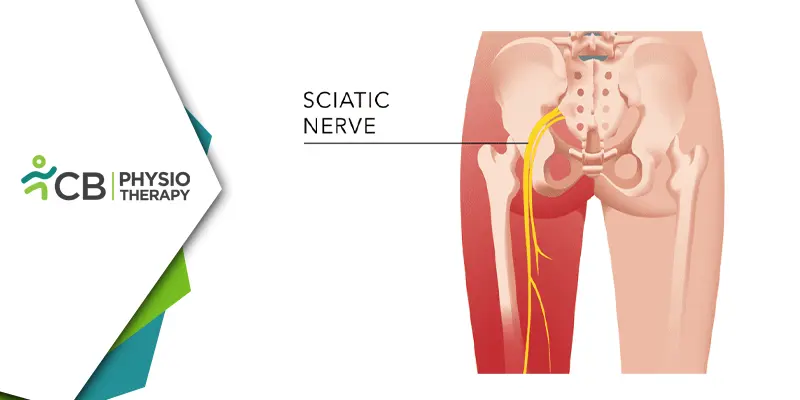
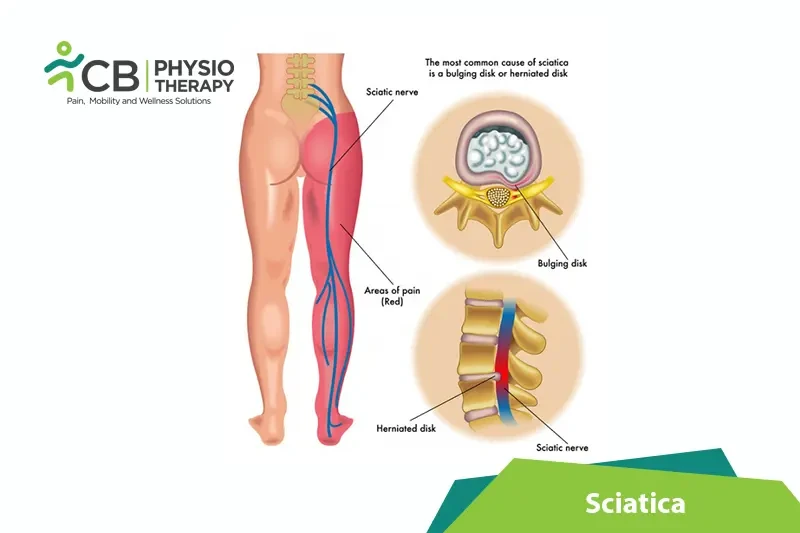
Sciatica is a type of pain that radiates along the path of the sciatic nerve, which runs from the lower back through the hips, buttocks, and down each leg. Typically, sciatica affects only one side of the body. It is often caused by a herniated disc, bone spur on the spine, or spinal stenosis (narrowing of the spine), which compresses the sciatic nerve. This compression results in inflammation, pain, and sometimes numbness or tingling sensations in the leg.

At CB Physiotherapy, we offer comprehensive treatment for sciatica, focusing on non-surgical, drug-free methods. Our expert physiotherapists use an assessment-driven approach to identify the root cause of your sciatica and create a personalized treatment plan. This plan may include targeted exercises, manual therapy, dry needling, laser therapy, and cryotherapy to relieve pain, restore mobility, and improve strength. We also offer home physiotherapy and provide ongoing support through our Activ PT app to ensure continued progress and prevent recurrence.

Any condition that compresses the sciatic nerve may cause sciatica symptoms. Commonly the reasons can be:

  • Herniated disc,
  • Bulging disc
  • Prolapsed disc,
  • Lumbar spinal stenosis,
  • Trauma,
  • Pregnancy,
  • Misalignment of one vertebra related to another,
  • Lumbar or pelvic muscular spasm or inflammation may impinge on a lumbar or sacral nerve root.

The symptoms of sciatica are pain due to irritation of the sciatic nerve. The type of pain can vary from person to person:

  • Constant or intermittent pain,
  • Pain in the lumbar spine,
  • Pain may be aggravated by certain movements like coughing or sneezing,
  • Burning sensation,
  • Prolonged sitting, standing, and bending can aggravate the pain,
  • Pain can be felt in the back, buttocks, knee, and leg,
  • Radiating pain to one side of the leg,
  • Heaviness in the leg,
  • Reduced power, reflexes, and sensation in the nerve root,
  • Gait dysfunction (toe walking, foot drop, and knee-buckling).

Pathology:

Sciatica occurs most commonly when a spinal nerve is compressed by a disc bulge, disc herniation, or bony spur. It causes pain, inflammation, and numbness in the affected leg. Sciatica can be severe, though most cases are resolved by non-operative treatments in a few weeks.

Physical examination:

The examiner checks for the source of the pain and discomfort. Examines the muscle strength and nerve functions, and whether the pain is felt while moving or touching the affected area. The aggravating and relieving factors are also noted along with the medical history.

Straight leg test:

A straight leg test is performed by asking the patient to lie in the supine position, then lift the leg, flex at the hip joint, and keep the knee in full extension and straight. Usually, the pain that is reproduced between 30 to 70 degrees of hip flexion and experienced primarily in the back is likely due to a lumbar disc herniation.

X-rays:

The X-ray can be done to show any bony problem and thus rule out other conditions with similar symptoms

Magnetic resonance imaging (MRI):

A magnetic resonance imaging (MRI) scan can also be done to show the location of the disk and the affected nerves.

Discograms:

A discogram involves injecting dye into the center of the disc, which helps to show cracks in the disc. It also shows whether the herniated disc is exerting any pressure on the spinal cord and nerves.

Myelogram:

A myelogram is done by injecting dye into the spinal fluid and then an x-ray image is taken.

Medications: Anti-inflammatory, Analgesics, Muscle relaxers, Opioids, Anticonvulsants, Corticosteroid injections, etc.

Note: Medication should not be taken without the doctor's permission.

Surgery:

In patients, where pain doesn't subside for a prolonged period, surgery is recommended to relieve the pressure from the nerve endings. Surgical evaluation and correction of any structural abnormalities such as disc herniation, epidural abscess, epidural tumor, or hematoma are recommended.

Cryotherapy:

Cryotherapy or ice therapy is applied to decrease spasms, inflammation, and pain.

Thermotherapy:

Thermotherapy or heat therapy promotes blood flow and removes toxins.

Lumbar support:

Lumbar support is used for short-term support to limit the movement of the lower back.

Massage therapy:

Massage therapy like deep tissue massage helps to improve blood circulation and decrease inflammation.

Ultrasound:

Ultrasound uses sound waves, that stimulate the affected area and improves blood flow to the affected part.

Transcutaneous electrical stimulations (TENS):

Transcutaneous electrical stimulations (TENS) promote gentle relaxation and decrease pain.

Interferential therapy:

Interferential therapy is also recommended to reduce pain and inflammation.

Traction:

Traction reduces the weight on spinal discs, alleviates pressure on the affected nerve, and relieves pain.

Laser therapy:

Laser therapy is another advanced electrical modality that enhances the healing process, decreases pain, and increases mobility.

Manipulation and mobilization:

Manipulation and mobilization, both techniques are used to break the adhesions, align the bones and improve mobility.

Strengthening and stabilization exercises:

These exercises include exercises to increase core muscle strength and support for the back. Back strengthening exercises are done for the trunk and all layers of the core muscles, which helps to support the low back and prevent excessive strain through the discs.

Stretching exercises:

Gentle stretching of the lumbar spine and hamstrings are done to improve the flexibility of the back muscles.

Hydrotherapy:

Regular light exercises like doing simple range of motion exercises in water, walking in water, and swimming, are beneficial.

Balance exercises:

Balance exercises are taught to train the patient to show how the back should be while moving during various activities.
The patient is advised to avoid activities or prolonged sitting/standing and to practice good, erect position. Avoid lifting heavy objects, sudden twisting, and turning movements that lay stress on the back.

Ready when you are

Don't let the pain decide your day.

Get assessed today — find the cause, get a plan, and know when you'll feel better.

📞 Call 💬 WhatsApp Book now