Open today · 8 AM–8 PM · Same-day slots
CB Physiotherapy
Same-day appointments

Knee Osteoarthritis Treatment Doctors in Noida

Whether it's a dull ache, a sharp catch, or pain that keeps coming back — we find the root cause of your Knee Osteoarthritis and fix it, at a clinic near you or at home.

Precision Care, Proven Recovery
ACCURATE DIAGNOSIS
ROOT CAUSE ASSESSMENT
COMPREHENSIVE RECOVERY PLAN
MILESTONE TRACKING
GOALS ACHIEVED
STAYING ACTIVE
See how it works ↓
Move pain-free Avoid drugs & surgery
5.0 / 5 · 31 Google reviews Verified on Google

Request received!

We'll call you within 10 minutes to confirm your home visit.We'll call you within 10 minutes to confirm your slot.

Chat with us on WhatsApp

Book in 30 seconds

Visit your nearest CB clinic. Tell us your concern and a preferred time — we'll confirm your slot by call within 10 minutes.

Same-day booking by default. We'll confirm your exact slot by call.
+91
No spam · Your number is safe with us
Prefer to talk now? Call +09821966696
Understanding your knee osteoarthritis

Does this sound like you?

Common triggers include muscle strain, joint stiffness, poor posture and long desk hours. If two or more of these fit, a physiotherapy assessment can identify exactly what's driving it.

  • A dull ache or sharp, burning knee osteoarthritis that keeps returning
  • Discomfort that worsens with movement, lifting or long sitting hours
  • Morning stiffness that eases as you move
  • Pain that limits work, sport or everyday activities
  • Recurring episodes that keep coming back

Most knee osteoarthritis improves without surgery or long-term medication — the key is finding the cause first.

⚠ When to seek urgent medical care

Knee Osteoarthritis rarely signals something serious, but see a doctor immediately if it comes with:

  • Fever, unexplained weight loss, or a history of cancer
  • Numbness or weakness that keeps getting worse
  • Loss of bladder or bowel control
  • Pain after a major fall or accident

Our physios screen for these red flags at every first assessment and refer you to the right doctor if needed.

Assessment-led treatment

How we treat knee osteoarthritis

We start with an AI-based assessment to find the root cause — then follow a clear, four-phase plan.

Phase 1

Ease the pain

Hands-on therapy and advanced modalities to calm pain and inflammation fast.

Phase 2

Restore movement

Mobility work and posture correction so everyday movement feels normal again.

Phase 3

Build strength

Targeted strengthening that protects you — in-clinic or in our physio gym.

Phase 4

Return to activity

Back to work, sport and life — with a home program that prevents relapse.

Your physiotherapist, with Fizo IQ™

Every recovery, planned and proven

One patient record, stage by stage: your physiotherapist pinpoints the diagnosis, finds the root cause and builds your in-clinic plan — while Fizo IQ™, our AI decision-support engine, tracks every milestone until your goals are met and you leave with an exercise plan to stay active.

Physio Expert @CB with Fizo IQ™ — recovery engine
TRACKING
ACCURATE DIAGNOSIS
Grade II knee osteoarthritis · medial-compartment loading confirmed at the first gait assessment
ROOT CAUSE ASSESSMENT
Weak quadriceps and hip abductors · letting the joint take the load the muscles should
COMPREHENSIVE RECOVERY PLAN
24 clinic sessions · strength training + joint mobilisation · with laser pain-relief modalities, progressed weekly
MILESTONE TRACKING
Stairs without the rail ✓ · 20-minute walk ✓ · next: the morning temple visit, pain-free
GOALS ACHIEVED
Pain 7 → 3 in eight weeks · moving through the day without planning around the knee
STAYING ACTIVE
A joint-protecting strength plan, yours to keep · muscles carrying the load so the knee doesn't have to
Example recovery journey · every plan is built around you
Feeling something?

Symptoms Knee Osteoarthritis addresses

These symptoms respond well to Knee Osteoarthritis — tap one to see how we treat it near you.

Move better

Exercises that help with Knee Osteoarthritis

More exercises →

Make these exercises yours

Get my personalized plan

General guidance only — stop if an exercise increases your pain, and check with your physio before starting a new routine.

Meet your care team

Licensed experts who treat hundreds like you every month

Every CB physio is a qualified BPT/MPT clinician. You don't need to choose one — our lead physiotherapist reviews your case and assigns the specialist best suited to treat it.

Dr. Vidhi, physiotherapist in Noida Extention Verified

Dr. Vidhi

Physiotherapist · BPT

5.0 (9)
Noida Extention
5 yrs experience
Ortho Spine Sports Physiotherapy Center
Dr. Deepika, physiotherapist in Greater Noida Verified

Dr. Deepika

Physiotherapist

5.0 (1)
Greater Noida
4 yrs experience
Ortho Spine Sports Physiotherapy Center
Not sure who to see? You don't have to decide. Our lead physiotherapist reviews every case and assigns the physio best suited to it — based on your condition and availability.
Patient stories

Knee Osteoarthritis recoveries, verified on Google

Rated 5.0 / 5 across 31 verified patient reviews in Noida.

Verified

“Dr kasim listened well to my situation, was very quick to diagnose me and gave very clear guidelines on how I should manage my condition”

AB
Aahil Verified patient · Treated at CB · 3 weeks ago
Verified

“I recently had the opportunity to experience physiotherapy at home, and I must say it was an outstanding and convenient experience. One of the biggest advantages of receiving physiotherapy at home was the convenience it offered. Instead of traveling to a clinic or hospital, the physiotherapists came to my doorstep, saving me time and energy. This personalized approach allowed me to receive treatment in the comfort of my own home, which greatly contributed to my overall well-being and recovery. Thanks Dr. kasim for the services.”

RG
Rakhi Gupta Verified patient · Treated at CB · 3 months ago
Verified

“I wholeheartedly recommend Dr. Kasim to anyone seeking treatment for a shoulder issue. His outstanding care, expertise, and compassionate approach make him an exceptional physiotherapist. Under his guidance, I experienced remarkable progress and successful recovery. Thank you, Dr. Kasim, for your exceptional care and dedication to helping your patients regain their shoulder health.”

AH
Anwer Hussain Verified patient · Treated at CB · 3 months ago
Verified

“Dr. Vidhi's approach is highly professional and patient-centered. She took the time to thoroughly assess my condition, asking detailed questions and actively listening to my concerns. She ensured that I fully understood my diagnosis, the treatment plan, and the expected outcomes. . Her dedication to providing evidence-based care was evident. thanks for treated me so well..god bless.”

RK
Rakulpreet Kaur Verified patient · Treated at CB · 3 months ago
Verified

“Thank you sir for providing home physiotherapy treatment. its wonderful to have session with you. 🙏🙏”

SL
Sham Lal Verified patient · Treated at CB · 3 months ago
Verified

“Hats off to you, ma'am. I am very satisfied with the treatment I had for body posture. Every session was great; it made me feel comfortable.👍👍”

AV
Anjali Verma Verified patient · Treated at CB · 3 months ago
Good to know

Knee Osteoarthritis, answered

Osteoarthritis of the knee occurs when the cartilage in the knee joint breaks down, causing the bones to rub together. The friction makes the knees hurt, become stiff, and sometimes swell. While osteoarthritis in the knee can't be cured, there are many treatments to slow its progress and ease the symptoms.

Women are more prone to osteoarthritis than men and usually occurs after the age of 40. Other causes of knee osteoarthritis are:

  • Wear and tear of the knee cartilage.
  • Overweight.
  • BMI more than 30 or more.
  • Injury to the knee.
  • Frequent stress on the knee.
  • Due to playing sports.
  • Inheritance.
  • Knocked knees, etc.

The symptoms of this condition vary from patient to patient, the common symptoms may be:


  • Pain In the knee.
  • Pain even while sitting still.
  • Pain while moving.
  • Knee stiffness.
  • Swollen or puffy knees.
  • Cracking or grinding noise while moving the knee.
  • Feeling of buckling or giving out.
  • Sudden lock up, or feeling of getting stuck.

Pathology:

Osteoarthritis is the degradation of the cartilage and thickening of the synovium, the subchondral bone begins to remodel forming lytic lesions.

Physical examination:

The examiner does the physical examination and asks about the medical history. The physical examination includes the knee joint area, pain, tenderness, range of motion, joint stability, and the pattern of walking

X-rays:

X-ray creates detailed images of bones. In an X-ray, an arthritic joint may show changes in the bone like narrowing of the joint space, and the formation of osteophytes.

Magnetic resonance imaging (MRI):

Magnetic resonance imaging (MRI) is used to check damage to soft tissues.

Bone scan:

A bone scan helps to find and locate the condition of the bone and soft tissues of the knee.

Medications: Non-steroidal anti-inflammatory drugs (NSAIDs), painkillers, corticosteroids, viscosupplementation, etc.

Note: Medication should not be taken without the doctor's prescription.

Surgery:

Surgery is done in case the symptoms are not relieved by conservative treatment.

Surgical treatments include:

  • Cartilage grafting.
  • Knee osteotomy.
  • Partial knee replacement.
  • Total knee replacement.

Cryotherapy:

Cryotherapy or cold therapy reduces knee pain, stiffness, and swelling.

Thermotherapy:

Thermotherapy or heat therapy improves blood flow, removes toxic substances, and decreases pain. It also improves flexibility and range of motion.

Knee brace:

A knee brace or adding shock-absorbing inserts in the shoes can reduce pressure on the knees.

Orthotics:

Using orthotics such as insoles or special footwear can also be helpful.

Ultrasound Therapy:

Therapeutic ultrasound helps to decrease inflammation and joint stiffness.

Transcutaneous electrical stimulation (TENS):

Transcutaneous electrical stimulations (TENS) send electric stimulations, through pads placed on the skin, to relieve pain.

Interferential current therapy (IFT):

Interferential current therapy (IFT), is another electrical modality used to decrease pain and increase mobility.

Hydrotherapy:

Hydrotherapy is given by immersing the body for 15 to 20 minutes in water which causes the weight-bearing muscles to relax, by alternatively doing simple flexion-extension exercises range of motion is increased.

Manual Therapy:

Manual therapy consists of several techniques like myofascial release, manipulation, and mobilization that increase the quality and range of movement of the knee.

Range of motion Exercises:

Range of motion exercises are started with PROM (passive range of motion) exercises of the knee and slowly progressed to active exercises.

Strengthening Exercises:

Strengthening exercises are taught to restore strength, endurance, and agility. These include the use of weight cuffs, resistance bands, and cardio exercise equipment such as treadmills or stationary bicycles.

Stretching Exercises:

Physiotherapists use stretching techniques to gently move the joint and stretch the soft tissue. Daily stretching increases the range of motion and mobility.

Aerobic Exercises:

Aerobic exercises like a stationary bike, speed walking, vigorous swimming, etc can also be done without stressing the knee joint.

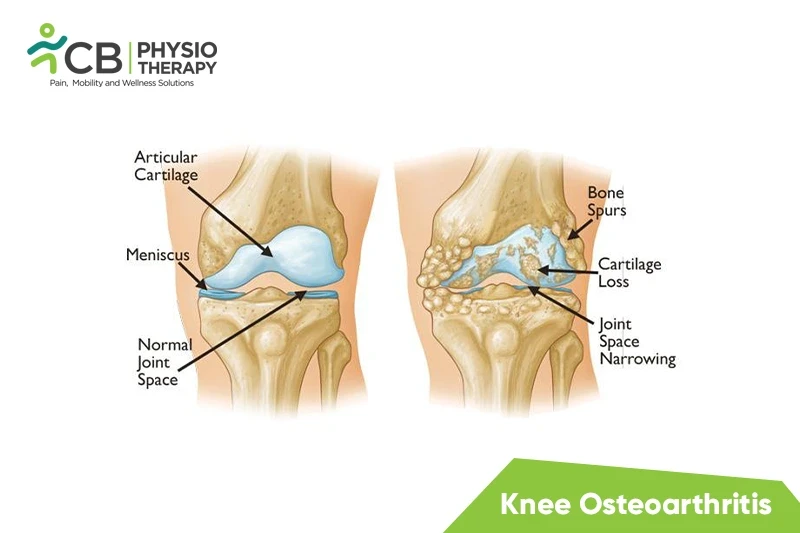
Though the effects of knee osteoarthritis can't be reversed. But treatment and self-care can help relieve the symptoms and slow the progress of the condition. The patient is advised to maintain a healthy weight, take plenty of rest, and add light strength training to the fitness routine. Jogging or running should be done on grass or soft surfaces.

Ready when you are

Don't let the pain decide your day.

Get assessed today — find the cause, get a plan, and know when you'll feel better.

📞 Call 💬 WhatsApp Book now