
Ankle Syndesmosis Ligament Injury — Symptoms, Causes & Treatment
Also known as Ankle Syndesmosis Ligament Injury. Causes, symptoms and how physiotherapy treats Ankle Syndesmosis Ligament Injury — without surgery or medicines.
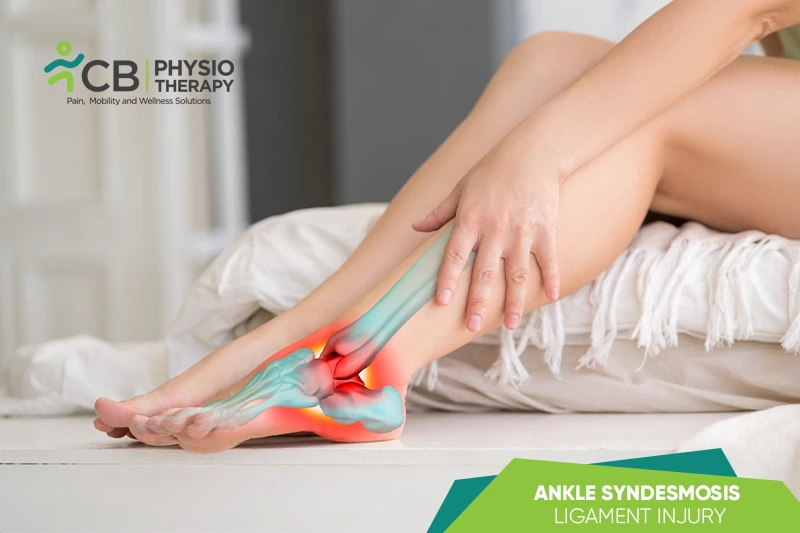
Understanding Ankle Syndesmosis Ligament Injury
Ankle Syndesmosis Ligament Injury is one of the conditions our physiotherapists treat most often — and one of the most treatable when the actual driver is found. Two people with Ankle Syndesmosis Ligament Injury rarely share the same underlying cause, which is why one-size-fits-all treatment so often disappoints.
What matters clinically is the pattern: how it started, what makes it better or worse, and how it behaves through the day. That pattern — mapped in a structured assessment — tells us which structures are involved and which treatment will actually move the needle.
Causes & risk factors of Ankle Syndesmosis Ligament Injury
What commonly drives it — your assessment pins down which of these apply to you.
Joint stiffness and age-related change
Joints that move less start to hurt more; age-related wear is normal, but painful stiffness is not something to simply accept.
Weakness and deconditioning
When supporting muscles lose strength, load shifts to structures that were never meant to carry it.
Old injuries and compensations
A previous injury that never fully rehabilitated often leaves a movement pattern that overloads something else.
Sudden spikes in activity
A new sport, a new gym program, a long trek — tissue adapts to gradual change and protests when change is sudden.
Muscle strain and overload
A sudden lift, an awkward movement or simply more load than the tissues were prepared for — the most common trigger.
When physiotherapy is the right call
If any of these sound like you, an assessment is the right first step.
- ✓ Pain or stiffness that limits work, sleep or daily activities
- ✓ You want to avoid long-term painkillers — or surgery has been mentioned
- ✓ You've been diagnosed with Ankle Syndesmosis Ligament Injury and told to "rest and see"
- ✓ Movement feels restricted, weak or guarded compared to before
- ✓ You want to return to sport or work with a plan, not by trial and error
Your treatment journey
Step by step — from your first assessment to a tracked recovery plan.
A detailed first assessment
History, movement testing and strength checks — a focused session to find what is actually driving your Ankle Syndesmosis Ligament Injury.
A diagnosis you understand
Your physiotherapist explains the findings in plain language — what is affected, why it happened and what that means for you.
Active, tracked treatment
Hands-on therapy, the right modalities and graded exercise — progressed session by session and tracked on Fizo IQ™.
Prevention, built in
The final phase rebuilds strength and habits so the same problem does not come back — with a home plan you keep.
What recovery looks like
- ✓ A clear diagnosis and a timeline you can plan around
- ✓ Strength and movement rebuilt, not just pain reduced
- ✓ Lower chance of recurrence, with a prevention plan
- ✓ Care without long-term medicines — at a clinic near you or at home
- ✓ Relief that comes from treating the cause, not masking it
When to see a doctor — red flags
How CB Physiotherapy treats Ankle Syndesmosis Ligament Injury
We treat Ankle Syndesmosis Ligament Injury the way we treat everything: assessment first, plan second, treatment third. It sounds obvious, but it is the difference between sessions that fill a slot and sessions that move you towards a goal. Care is delivered by certified physiotherapists at a clinic near you or at home.
Your whole journey is tracked on Fizo IQ™ — the diagnosis, the root cause, the milestones and the goals — so progress is measured, not guessed, and the plan adapts the moment your response calls for it.
Exercises that help with Ankle Syndesmosis Ligament Injury
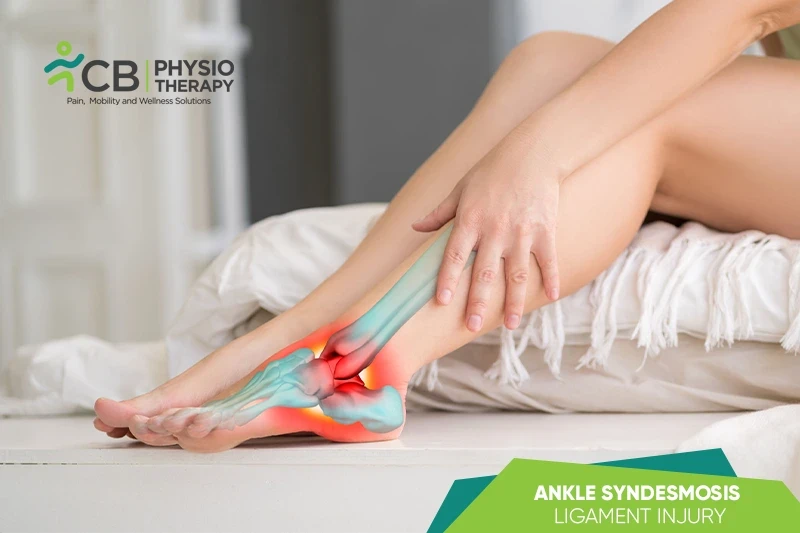
Make these exercises yours — a CB physio personalizes, doses and tracks your plan week by week.
Get my personalized planGeneral guidance only — stop if an exercise increases your pain, and check with your physio before starting a new routine.
Get Ankle Syndesmosis Ligament Injury treatment near you
Certified physiotherapists at a clinic near you or at home — same-day slots, assessment-led care.
Request received!
We'll call you within 10 minutes to confirm your home visit.We'll call you within 10 minutes to confirm your slot.
Chat with us on WhatsAppAnkle Syndesmosis Ligament Injury, answered
Ankle syndesmosis ligament injury or high ankle sprain is also known as tibiofibular syndesmosis, it is the injury of a ligament that holds the fibrous joint together. It's located near the ankle joint, between the tibia (shinbone), and the distal fibula (outside leg bone). The ligament acts as a shock absorber, providing stability and support for the ankle, and also aligns the tibia and fibula and preventing them from spreading too far apart.
It is made of several ligaments. The primary ones are:
- Anterior inferior tibiofibular ligament
- Posterior inferior tibiofibular ligament
- Interosseous ligament
- Transverse tibiofibular ligament.
Ankle syndesmosis ligament injury can occur due to many reasons, few causes of the injury can be:
- Tripping over something,
- Leg rotated internally.
- External rotation of the talus (bone),
- Sudden twisting motion,
- High energy blow to the firmly planted foot,
- Sports like football, rugby, downhill skiing, hockey,
- Planting the foot in place while the ankle is forced to rotate outwardly,
- Blow to the outer side of the ankle.
Generally, ankle syndesmosis ligament injuries don't swell or bruise as much as other ankle sprains. Symptoms can vary depending on the severity of the injury:
- Pain above the ankle,
- Pain radiating up to the leg,
- Tenderness to touch,
- Pain aggravated while walking,
- Pain when the foot is flexed or rotated,
- Inability to raise the calf,
- Inability to bear full weight.
- Often accompanied by injuries to bones, ligaments, or tendons.
Pathology:
Ankle syndesmosis ligament injury occurs due to maximal tension when the ankle is fully dorsiflexed or fully plantarflexed or external rotation of the foot on the leg causes the talus to press against the lateral malleolus. Excessive force at the syndesmosis can sprain or rupture the anterior and posterior tibiofibular ligaments, tear the deltoid ligament, force the talus to push the fibula laterally, and damage the lateral ankle ligaments, and also disrupt the ankle mortise and fibular stability.
Physical examination:
Physical examination may be painful, or uncomfortable. The examiner squeezes and manipulates the leg and foot to see how well he/she can be flexed, rotated, and whether they can bear weight.
Squeeze test:
The examiner tries to separate the tibia and fibula and identifies a fibular fracture or syndesmosis sprain. This is performed by squeezing the tibia and fibula together above the injury. Pain is reproduced along the fibular shaft, if it's a fibular fracture and the distal tibiofibular joint for syndesmosis sprain.
X-ray:
X-ray is required to determine if there are one or more broken bones.
Magnetic resonance imaging (MRI):
Magnetic resonance imaging (MRI) can help to detect tears and injuries to ligaments and tendons.
CT scan:
CT scans take X-rays from different angles and combine them to make 3-D images. CT scans are done to reveal more detailed images of the bones of the joint.
Ultrasound:
Ultrasound uses sound waves to produce images that may help the doctor to check the condition of a ligament or tendon when the foot is in different positions.
Medication: Non-steroidal anti-inflammatory drugs, Analgesics, etc.
Note: Medication should not be taken without the doctor's prescription.
Surgery:
Surgery is recommended in higher grade injuries if instability and widening between the two shin bones are significant. Pins and screws may be placed in place to allow the ligament to have a better healing capacity.
Rest:
Rest is recommended to limit any movement that causes pain. This may include non-weight bearing in a brace with crutches.
Cryotherapy or ice therapy is a simple and effective modality used to reduce pain and swelling. Ice is applied for 20-30 minutes.
Compression:
Compression bandaging is recommended to support the injured soft tissue and reduce excessive inflammation.
Elevation:
The affected leg is kept in elevation above the heart to assist gravity to reduce excessive swelling around the ankle.
Ankle support:
An ankle brace can be used to protect the damaged ligament, it provides protection and stability.
Kinesio taping helps to provide mechanical support for an unstable ankle joint.
Transcutaneous Electrical Stimulation:
Transcutaneous Electrical Stimulation is found to be effective to decrease swelling, spasms, and pain.
Therapeutic Ultrasound:
Therapeutic ultrasound decreases pain, and inflammation improves function, and helps to enhance the healing process.
Manual therapy includes soft tissue massage, lymphatic drainage, talocrural distraction in the neutral position, and anterior to posterior talocrural glides. Manual therapy helps in pain reduction, reduces stiffness, and increases functionality.
Range of Motion exercises:
Range of motion exercises are done to increase joint movement and functionality. Simple range of motion exercises can be done to improve joint movement. Passive range of motion exercises for dorsiflexion can be performed in both weight-bearing and non-weight-bearing positions.
Muscle Strengthening exercises:
Calf, ankle, and foot muscles require strengthening after a high ankle sprain. Strengthening exercises provide normal dynamic ankle control and function. Strength and power should be gradually progressed from non-weight bearing to partial and then full weight-bearing and resistance-loaded exercises.
Stretching exercises:
Stretching exercises like standing stretch, seated dorsiflexion, stretch with theraband, double heel raise progressing to single heel raise, and dorsiflexion stretching on a step stool can be used to increase the flexibility of the muscles.
Proprioception and Agility exercises:
Balance and proprioception are adversely affected by a high ankle sprain. To prevent the re-injury, the patient should return to sport, the physiotherapist guides the patient through the exercises to improve the performance. Depending on the type of sport or lifestyle, speed, agility, proprioception, and power program are customized to prepare the patient for light sport-specific training. Ankle proprioception, postural reflexes, and balance reeducation are also done.
Plyometric Training;
Exercise training is progressed to jogging, cycling, agility, jumping, and sport-specific drills involving high-intensity exercises.
The patient is advised to practice foot and ankle functions with a brace during high-intensity exercises for protection and support.
Don't let Ankle Syndesmosis Ligament Injury decide your day.
Get assessed today — find the cause, get a plan, and know when you'll feel better.