
Guillain-barré Syndrome — Symptoms, Causes & Treatment
Also known as GBS. Causes, symptoms and how physiotherapy treats Guillain-barré Syndrome — without surgery or medicines.
Understanding Guillain-barré Syndrome
Guillain-barré Syndrome (also called GBS) affects the nervous system's control of movement — and while the diagnosis itself is made and managed by your doctor, physiotherapy shapes what daily life looks like with it. Strength, balance, walking and everyday tasks can all improve with the right rehabilitation, at almost any stage.
Neuro-rehabilitation works because of neuroplasticity: with repeated, task-specific practice the nervous system re-learns. A structured program targets what matters to you — transfers, walking, stairs, confidence — and measures progress milestone by milestone.
Causes & risk factors of Guillain-barré Syndrome
What commonly drives it — your assessment pins down which of these apply to you.
The underlying neurological event
Conditions like Guillain-barré Syndrome begin in the nervous system — diagnosis and medical management sit with your doctor and neurologist.
Reduced activity after diagnosis
Fear, fatigue and difficulty shrink movement — and inactivity then adds its own layer of weakness and stiffness.
Muscle weakness and tone changes
Altered signals change how muscles fire — some weaken, some tighten — reshaping movement patterns over time.
Balance and confidence
Balance changes raise fall risk, and fear of falling quietly cuts activity further — a loop rehabilitation is designed to break.
When physiotherapy is the right call
If any of these sound like you, an assessment is the right first step.
- ✓ A new diagnosis of Guillain-barré Syndrome and you want a clear rehabilitation start point
- ✓ Daily tasks, walking or stairs are getting harder than they used to be
- ✓ Strength, stamina or balance has visibly dropped
- ✓ You want a structured clinic + home program with measurable milestones
- ✓ Family members need guidance to support you safely
Your treatment journey
Step by step — from your first assessment to a tracked recovery plan.
A detailed first assessment
History, movement testing and strength checks — a focused session to find what is actually driving your Guillain-barré Syndrome.
A diagnosis you understand
Your physiotherapist explains the findings in plain language — what is affected, why it happened and what that means for you.
Active, tracked treatment
Hands-on therapy, the right modalities and graded exercise — progressed session by session and tracked on Fizo IQ™.
Prevention, built in
The final phase rebuilds strength and habits so the same problem does not come back — with a home plan you keep.
What recovery looks like
- ✓ More independence in daily tasks
- ✓ Better strength, balance and stamina
- ✓ Fewer setbacks, with red flags monitored
- ✓ A program your family understands and can support
- ✓ Progress measured milestone by milestone on Fizo IQ™
When to see a doctor — red flags
How CB Physiotherapy treats Guillain-barré Syndrome
We treat Guillain-barré Syndrome the way we treat everything: assessment first, plan second, treatment third. It sounds obvious, but it is the difference between sessions that fill a slot and sessions that move you towards a goal. Care is delivered by certified physiotherapists at a clinic near you or at home.
Your whole journey is tracked on Fizo IQ™ — the diagnosis, the root cause, the milestones and the goals — so progress is measured, not guessed, and the plan adapts the moment your response calls for it.
Get Guillain-barré Syndrome treatment near you
Certified physiotherapists at a clinic near you or at home — same-day slots, assessment-led care.
Request received!
We'll call you within 10 minutes to confirm your home visit.We'll call you within 10 minutes to confirm your slot.
Chat with us on WhatsAppGuillain-barré Syndrome, answered
GBS can occur at any age but is more common in adults and males. The symptoms of GBS typically develop over a few days to a few weeks and can from milranged to severe. In severe cases, the muscle weakness can progress to paralysis, affecting breathing and requiring hospitalization.
- Viral infections: GBS often follows a viral or bacterial infection, such as the flu, Zika virus, or Campylobacter jejuni, a bacteria commonly found in undercooked poultry.
- Bacterial infections: GBS can also be triggered by bacterial infections such as pneumonia or meningitis.
- Vaccinations: In rare cases, GBS has been associated with some vaccines, including the flu vaccine and the vaccine for swine flu (H1N1).
- Surgery: GBS has been known to occur following surgery.
- Trauma: GBS can occur after physical trauma, such as a car accident or injury.
- Cancer: In rare cases, GBS has been associated with cancer, particularly lymphoma.
- Tingling or numbness in the hands and feet
- Loss of reflexes in the arms and legs
- Difficulty with eye movement, facial movement, chewing or swallowing
- Difficulty speaking or slurred speech
- Rapid heart rate or changes in blood pressure
- Difficulty breathing, which may require the use of a ventilator
- Severe pain in the back, arms, or legs
Pathology
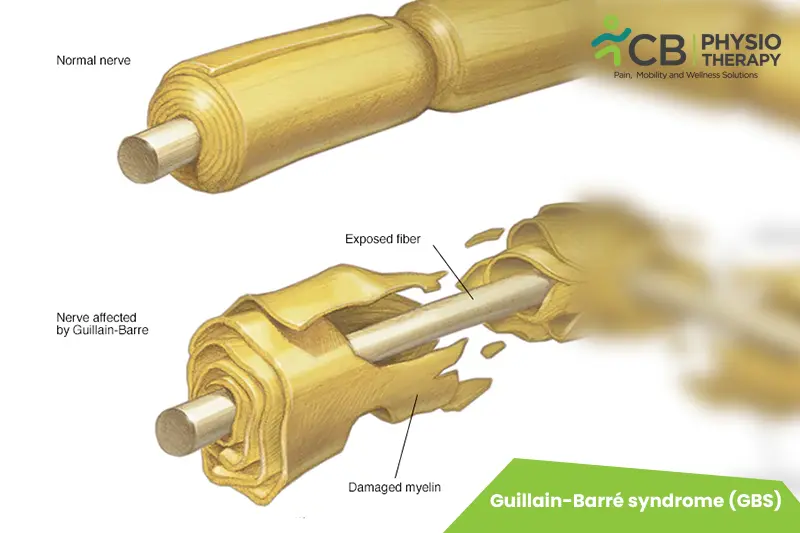
The pathology of Guillain-Barré syndrome (GBS) involves an autoimmune attack on the peripheral nerves, which are the nerves that transmit messages from the brain and spinal cord to the rest of the body. The immune response in GBS primarily targets the myelin sheath, which is the protective covering around the nerves. As a result, the myelin sheath is damaged, leading to a condition known as demyelination. This damage interferes with the normal transmission of nerve impulses, resulting in the symptoms of GBS, such as muscle weakness, tingling, and numbness.
Nerve conduction studies and electromyography (EMG):
These tests measure the electrical activity in the nerves and muscles to help determine the extent of nerve damage.
Lumbar puncture (spinal tap):
This involves inserting a needle into the lower back to collect a sample of cerebrospinal fluid, which can help identify signs of inflammation and rule out other conditions.
Blood tests:
Blood tests may be used to rule out other conditions and to check for signs of inflammation or infection.
Imaging tests:
Imaging tests such as magnetic resonance imaging (MRI) may be used to rule out other conditions that may be causing the symptoms.
Note: Medication should not be taken without the doctor’s prescription.
Guillain-Barre Syndrome (GBS) is a disorder in which surgery is not a typical treatment for GBS, there are some situations where it may be considered.
For example, if a patient with GBS develops respiratory failure, they may require intubation or mechanical ventilation. In some cases, a tracheostomy may be necessary to help the patient breathe. Surgery may also be required to place a feeding tube if the patient has difficulty swallowing.
In addition, plasmapheresis and intravenous immunoglobulin (IVIG) are two common treatments for GBS that involve removing or replacing blood plasma. Plasmapheresis involves filtering the blood to remove antibodies that may be attacking the nervous system, while IVIG involves administering high doses of immunoglobulins to help block these antibodies. These treatments may be administered through a central venous catheter, which may require a minor surgical procedure to insert.
However, it is important to note that surgery is generally not considered a primary treatment for GBS, and should only be considered in cases where it is necessary to support the patient's breathing or nutritional needs. The primary treatments for GBS are typically supportive care and medical interventions such as plasmapheresis and IVIG.
Heat therapy or thermotherapy helps in pain management, heat therapy increases circulation and decreases pain.
Transcutaneous electrical nerve stimulation (TENS):
TENS involves applying electrical current to the skin using electrodes. This can help to reduce pain and improve circulation.
Neuromuscular electrical stimulation (NMES):
NMES uses electrical impulses to stimulate muscles and improve strength and function. This can be particularly useful for people with GBS who have weakness or paralysis.
Functional electrical stimulation (FES):
FES uses electrical impulses to stimulate nerves and muscles, allowing people with weakness or paralysis to perform functional tasks such as walking.
Range of motion exercises:
These exercises can help to prevent muscle stiffness and joint contractures.
Strengthening exercises:
Strengthening exercises can help to improve muscle strength and function and can be particularly useful for people with GBS who have weakness or paralysis.
Balance and coordination training:
GBS can affect balance and coordination, and physical therapy can help to improve these skills and reduce the risk of falls.
Respiratory exercises:
GBS can affect the muscles involved in breathing, and respiratory exercises can help to improve respiratory function and prevent complications.
Gait training:
Gait training can help people with GBS to learn to walk again and improve their mobility.
Assistive devices:
Physiotherapists may recommend the use of assistive devices such as braces, walkers, or wheelchairs to help improve mobility and prevent falls.
Don't let Guillain-barré Syndrome decide your day.
Get assessed today — find the cause, get a plan, and know when you'll feel better.