
Lumbarization — Symptoms, Causes & Treatment
Also known as Lumbarization. Causes, symptoms and how physiotherapy treats Lumbarization — without surgery or medicines.
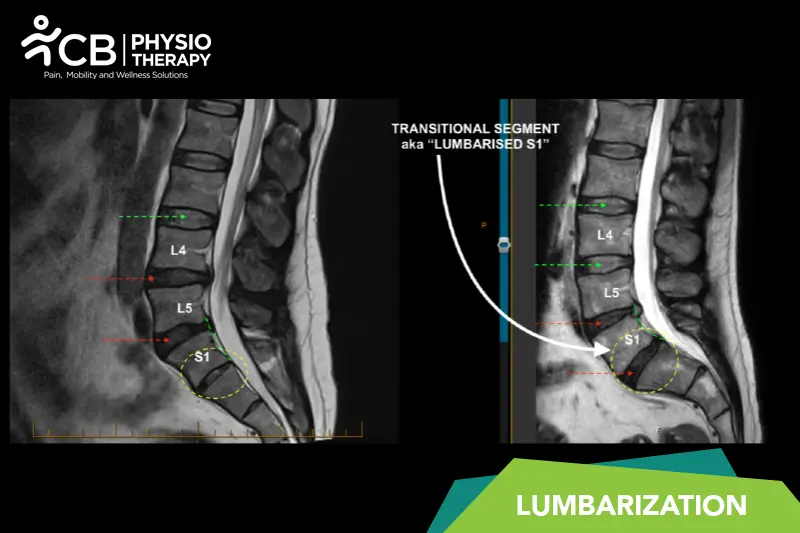
Understanding Lumbarization
Lumbarization can arrive suddenly or build over months, and how much it hurts is a poor guide to how serious it is — minor strains can hurt intensely, while slow-building problems stay quiet until they start limiting you.
Physiotherapy approaches Lumbarization by treating the cause rather than chasing the symptom: a detailed movement assessment first, then a plan combining hands-on treatment, targeted exercise and the habit changes that stop it returning.
Causes & risk factors of Lumbarization
What commonly drives it — your assessment pins down which of these apply to you.
Old injuries and compensations
A previous injury that never fully rehabilitated often leaves a movement pattern that overloads something else.
Sudden spikes in activity
A new sport, a new gym program, a long trek — tissue adapts to gradual change and protests when change is sudden.
Muscle strain and overload
A sudden lift, an awkward movement or simply more load than the tissues were prepared for — the most common trigger.
Posture and long static hours
Desks, driving and screens keep the same structures loaded for hours at a stretch — comfortable at first, aching later.
Joint stiffness and age-related change
Joints that move less start to hurt more; age-related wear is normal, but painful stiffness is not something to simply accept.
When physiotherapy is the right call
If any of these sound like you, an assessment is the right first step.
- ✓ You want to avoid long-term painkillers — or surgery has been mentioned
- ✓ You've been diagnosed with Lumbarization and told to "rest and see"
- ✓ Movement feels restricted, weak or guarded compared to before
- ✓ You want to return to sport or work with a plan, not by trial and error
- ✓ Lumbarization that keeps returning or hasn't settled within two weeks
Your treatment journey
Step by step — from your first assessment to a tracked recovery plan.
A detailed first assessment
History, movement testing and strength checks — a focused session to find what is actually driving your Lumbarization.
A diagnosis you understand
Your physiotherapist explains the findings in plain language — what is affected, why it happened and what that means for you.
Active, tracked treatment
Hands-on therapy, the right modalities and graded exercise — progressed session by session and tracked on Fizo IQ™.
Prevention, built in
The final phase rebuilds strength and habits so the same problem does not come back — with a home plan you keep.
What recovery looks like
- ✓ Relief that comes from treating the cause, not masking it
- ✓ A clear diagnosis and a timeline you can plan around
- ✓ Strength and movement rebuilt, not just pain reduced
- ✓ Lower chance of recurrence, with a prevention plan
- ✓ Care without long-term medicines — at a clinic near you or at home
When to see a doctor — red flags
How CB Physiotherapy treats Lumbarization
We treat Lumbarization the way we treat everything: assessment first, plan second, treatment third. It sounds obvious, but it is the difference between sessions that fill a slot and sessions that move you towards a goal. Care is delivered by certified physiotherapists at a clinic near you or at home.
Your whole journey is tracked on Fizo IQ™ — the diagnosis, the root cause, the milestones and the goals — so progress is measured, not guessed, and the plan adapts the moment your response calls for it.
Get Lumbarization treatment near you
Certified physiotherapists at a clinic near you or at home — same-day slots, assessment-led care.
Request received!
We'll call you within 10 minutes to confirm your home visit.We'll call you within 10 minutes to confirm your slot.
Chat with us on WhatsAppLumbarization, answered
1: Genetic Factors: Mutations or variations in genes that control vertebral development.
2: Hereditary Influence: A family history of spinal anomalies can increase the likelihood of lumbarization.
3: Developmental Anomalies: Errors during the embryonic development of the spine, which can lead to abnormal vertebral segmentation.
4: Environmental Factors: Although not well established, certain environmental influences during pregnancy might affect spinal development.
5: Unknown Factors: In many cases, the precise cause cannot be identified, as it may result from a complex interplay of genetic and environmental factors.
1: Lower Back Pain: Chronic or intermittent pain in the lower back.
2: Limited Mobility: Reduced flexibility or stiffness in the lower back.
3: Sciatica: Pain radiating from the lower back down through the buttocks and legs, caused by compression or irritation of the sciatic nerve.
4: Muscle Weakness: Weakness in the lower back and legs.
5: Nerve Compression Symptoms: Numbness, tingling, or a burning sensation in the lower back, buttocks, or legs due to nerve compression.
6: Postural Abnormalities: Changes in posture or gait due to altered spinal mechanics.
7: Localized Tenderness: Pain or tenderness upon palpation of the lower back.
Pathology
The pathology of lumbarization involves the abnormal development of the vertebral column, specifically the transformation of the first sacral vertebra (S1) into a structure resembling a lumbar vertebra. The normal spine has five lumbar vertebrae, but in lumbarization, there are six lumbar vertebrae. This change can alter the natural curvature and mechanics of the spine.
Clinical Examination: Initial assessment by a physiotherapist may include a thorough history and physical examination to assess symptoms and signs suggestive of lumbarization.
X-rays: Standard anterior-posterior (AP) and lateral lumbosacral spine radiographs are often used to identify lumbarization. These images help visualize the number of lumbar and sacral vertebrae.
CT Scan (Computed Tomography): CT scans provide more detailed imaging of bone structures, allowing for a clearer view of the vertebral anatomy and any anomalies such as lumbarization.
MRI (Magnetic Resonance Imaging): MRI is useful for assessing soft tissue structures and can provide detailed images of the spine, including discs, nerves, and the spinal cord. It can help rule out other causes of back pain and assess any associated abnormalities.
Bone Scintigraphy (Bone Scan): This nuclear imaging technique can help detect any abnormal bone activity and is sometimes used to differentiate between symptomatic and asymptomatic lumbarization.
Electromyography (EMG) and Nerve Conduction Studies (NCS): These tests can be used to evaluate the function of the nerves and muscles to determine if any nerve involvement or compression is associated with lumbarization.
(Note: Medication should not be taken without the doctor’s prescription.)
Surgery:
Surgery for lumbarization is typically considered a last resort and is generally reserved for cases where conservative treatments have failed to relieve symptoms, or when there are severe neurological deficits. The specific surgical approach depends on the individual's symptoms and the exact nature of the anatomical anomaly. Here are some surgical options that might be considered:
Spinal Fusion:
Purpose: To stabilize the spine by fusing the anomalous vertebra (the lumbarized S1) to the sacrum or adjacent lumbar vertebrae.
Laminectomy:
Purpose: To relieve pressure on the spinal cord or nerves by removing part of the vertebral bone (the lamina).
Discectomy:
Purpose: To remove herniated or degenerated disc material that is compressing a nerve root.
Foraminotomy:
Purpose: To enlarge the foramen (the opening through which spinal nerves exit) to relieve nerve compression.
Interbody Fusion:
Purpose: To remove a degenerated disc and replace it with a bone graft or synthetic spacer to maintain spinal alignment and stability.
Application of heat to relax muscles and improve blood flow, or cold to reduce inflammation and numb pain.
Electrical Stimulation:
Techniques such as TENS (Transcutaneous Electrical Nerve Stimulation) help to reduce pain by stimulating nerves.
Ultrasound Therapy:
Ultrasound therapy uses sound waves to generate heat within tissues and promote healing.
Electrical Muscle Stimulation (EMS):
EMS devices deliver electrical impulses to stimulate muscle contractions in specific muscle groups.
Interferential Current Therapy (IFT):
Purpose: IFT involves using two high-frequency electrical currents that intersect and interfere with each other within the tissues.
Galvanic Stimulation (GS):
Purpose: GS uses direct current (DC) to stimulate nerves and muscles.
Exercise Therapy:
a) Strengthening Exercises: Focus on strengthening the core, lower back, and pelvic muscles to provide better support for the spine.
b) Stretching Exercises: Improve flexibility and reduce muscle tension in the lower back and hamstrings.
c) Aerobic Exercises: Low-impact activities such as walking, swimming, or cycling to improve overall fitness without putting excessive strain on the back.
Manual Therapy:
a) Spinal Manipulation: Gentle adjustments by the physiotherapist to improve spinal alignment and mobility.
b) Mobilization: Techniques to increase the range of motion in the affected joints.
c) Soft Tissue Massage: To reduce muscle tension and improve blood flow.
Postural Training:
Ergonomic Advice: Guidance on maintaining proper posture during daily activities and using ergonomic furniture and devices.
Postural Exercises: Training to improve posture and reduce strain on the lower back.
Core Stabilization:
Core Strengthening: Exercises to strengthen the muscles around the abdomen and lower back, which support the spine.
Functional Training:
Functional Exercises: Activities designed to improve everyday movements and tasks, enhancing overall functionality and reducing pain during daily activities.
Don't let Lumbarization decide your day.
Get assessed today — find the cause, get a plan, and know when you'll feel better.